Investments/retirement professor & Frank M. Engle Chair of Economic Security at The American College. Contributing Editor, Investment Advisor Magazine.
My new article for @AdvPerspectives I look deeper into the remarkable predictability of the @RobertJShiller CAPE ratio in recent decades. @TheAmerCol
https://t.co/b6aqzzj7vK
What's the "right" way to spend down your retirement savings?
On the latest YMM, Bill Bengen – creator of the famous 4% rule – joins ALI Fellow @FinkeonFinance to discuss how protected income can give retirees the confidence to spend more freely. https://t.co/OKnv2G7wyj
Why Advisors Should (Almost) Never Recommend Social Security Claiming at 62: The long-run benefits of delaying Social Security benefits and how advisors can address potential concerns hesitant clients might raise (@FinkeonFinance | @ThinkAdvisor), and more on social security this #WeekendReading: https://t.co/E6iBb78SFA
Research shows that three investments you make today can help you live better in retirement. @FinkeonFinance explains in this episode of the Your Money, Your Wealth podcast. Watch or listen and download the Retirement Lifestyles Guide for free: https://t.co/N2P29EvpCq
We'd also like to extend our thank you to our #Climb25 keynote speakers @markmathewssurf, Andrew Sykes, and @FinkeonFinance! Your contributions made this event truly unforgettable. Your powerful messages inspired and energized everyone in attendance!👏🌟#TruChoice#FinServ
What drives the worries of people across the wealth spectrum about running out of money in retirement — and what can advisors do to help? @FinkeonFinance offers his perspective in this piece from @WSJ! https://t.co/5qyMmxyTzn #FinancialServices#Retirement
Join @FinkeonFinance and TPCP™ Program thought leader Alan Gassman for an in-depth conversation on the knowledge contained in our newest designation program…and how tax-informed planning affects your clients. https://t.co/cGDAQkwpkk #financialservices#podcast#tpcp
There are three pillars of a successful retirement:
1) Money
2) Health
3) Relationships
Most advisors know the money part.
But, in this episode, @FinkeonFinance explains how to incorporate all three elements in your work with clients.
🔗https://t.co/j21iG0wbSG
Planning horizons for higher-income individuals are substantially longer than for average Americans. A higher-income man and woman can expect to live to 88/90 on average, and they need to push the horizon to 95/97 for an 80% chance of success.
“We're doing a much better job of extending people's lifespan, and that adds to the complexity of retirement income planning, because it means that you have to fund more years of spending.” @FinkeonFinance@TheAmerCol @GregoryFCA #CAAFP
This is a must-read thread. A progressive policy that provides workers with an inflation-adjusted income annuity significantly reduces wealth inequality when the substantial present value is included on a household's balance sheet.
🧵🚨Accepted paper🧪
with @mjmill611 (Harvard) and @NatashaRSarin (Yale)
Existing studies paint an incomplete picture of trends in wealth inequality in the US. When Social Security is properly accounted for, wealth inequality has not really increased over the past three decades.
We've gained about a year of longevity every decade over the last century, and one of the biggest reasons is the ongoing advancement of science and the treatment of disease. Drugs like Ozempic that effectively reduce obesity mean that people will live longer and healthier lives.
GLP-1 drugs and reduction of cancer
Among ~1.6 million people w/ T2 diabetes, for GLP-1 drugs vs insulin Rx, there was less risk for 11 of the 13 cancers associated with obesity
https://t.co/ci28bjWwRV
@126613LBSUB @DanielYerger3 @WadePfau@RetirementRisks@HigherEdCraig We're all motivated by compensation (shockingly, even academics).
Each compensation method has its own potential conflicts. We're interested in knowing what the outcomes look like for clients who employ advisors with different compensation methods.
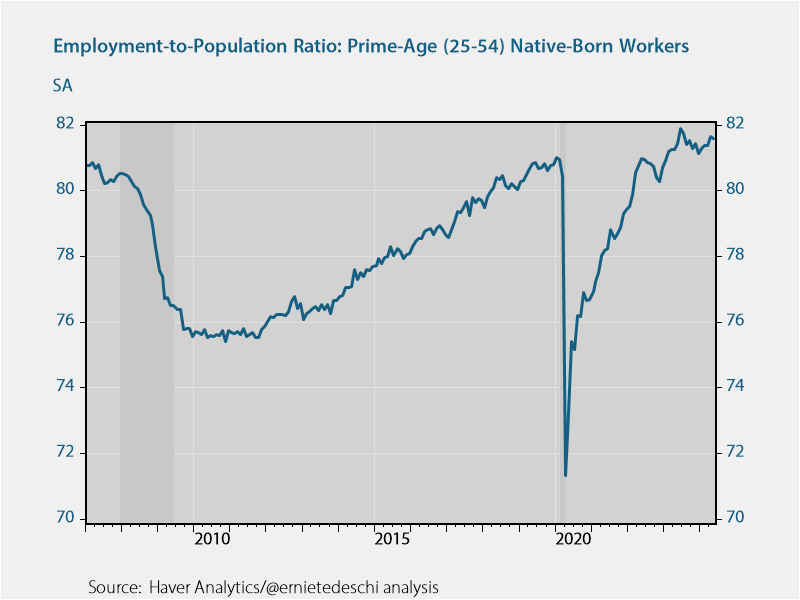
If you want to assess whether the economy is hot, exclusively for native born workers, look at the prime age native born workers employer to population ratio.
It's at a multi decade high.
Interesting comparison of private US debt vs. Federal and state government (bars represent actual size the suns to total bar on right). Federal debt it a surprisingly small percentage of total debt. Source: Federal Reserve
Mutual funds with a prospectus that is relatively more unique (a niche fund) have significantly lower performance, higher fees, and lower @MorningstarInc ratings. #ASSA2024