India’s expanding transport infrastructure is enabling the movement of goods at an unprecedented scale, with growing freight volumes boosting logistics capacity and supporting various sectors across the economy.
In FY26, Indian Railways transported 1.7 billion tonnes of freight, making it the world’s second-largest rail freight carrier. Growing freight volumes are strengthening logistics capacity and supporting the movement of goods across India’s economy.
#IndianRailways #RailFreight #Logistics #Infrastructure
Listen to K S Nanda, Past Chairman, CII Bhopal Zone & Proprietor, Inderr Engineering Industries, as he shares valuable insights on entrepreneurship, leading through challenges and driving innovation.
He is in conversation with Animesh Jain, Past Chairman, CII Madhya Pradesh & Executive Director, R M Chemicals Southeast Asia Inc.
CII Podcast ➡️ https://t.co/GM9ovQX3gU
#CIIPodcasts #CIILeadersUnplugged #Leadership #Innovation #Entrepreneurship
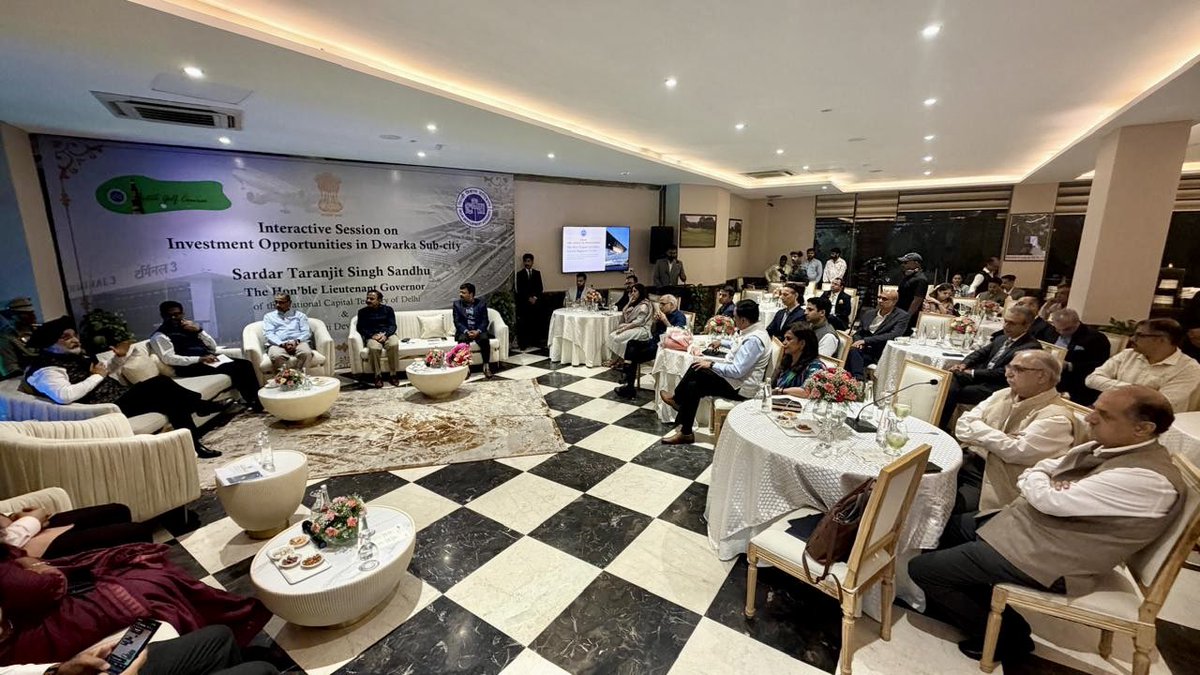
Participated in an interactive session on investment opportunities in Dwarka Sub-city at DDA’s Qutab Golf Course, organised by @official_dda, with members of the Confederation of Indian Industry (CII).
As one of Asia’s largest planned sub-cities, Dwarka is uniquely positioned to emerge as a premier destination for investment, with its proximity to the international airport, integrated transport network, and growing urban ecosystem creating opportunities across commerce, hospitality, healthcare, education, technology and high-quality urban infrastructure.
Engaged in a constructive dialogue with industry leaders on unlocking Dwarka’s full potential through collaborative partnerships and future-ready planning. Reaffirmed our commitment to advancing Hon’ble Prime Minister Shri @narendramodi Ji’s vision of Ease of Doing Business by fostering a transparent, efficient and investor-friendly ecosystem that drives sustainable growth, creates employment, and strengthens Delhi’s march towards #ViksitDilli and #ViksitBharat2047.
UPI has transformed the country’s digital payments ecosystem since its launch in 2016. In FY26, UPI accounted for 85% of all digital payment transactions in India, powering billions of seamless transactions and becoming an indispensable part of everyday commerce.
#DigitalIndia #UPI #FinTech
When a GCC establishes itself in one of these cities, there is a multiplier impact. It creates demand for advanced skills and specialised training.
It supports start-ups, professional services, housing, urban infrastructure and research collaborations. It also encourages stronger partnerships between universities, industry and local institutions, helping cities evolve into vibrant innovation ecosystems.
In doing so, GCCs become catalysts for balanced regional development. This presents an important partnership opportunity for GCCs in shaping the next generation of innovation-led economic regions across India.
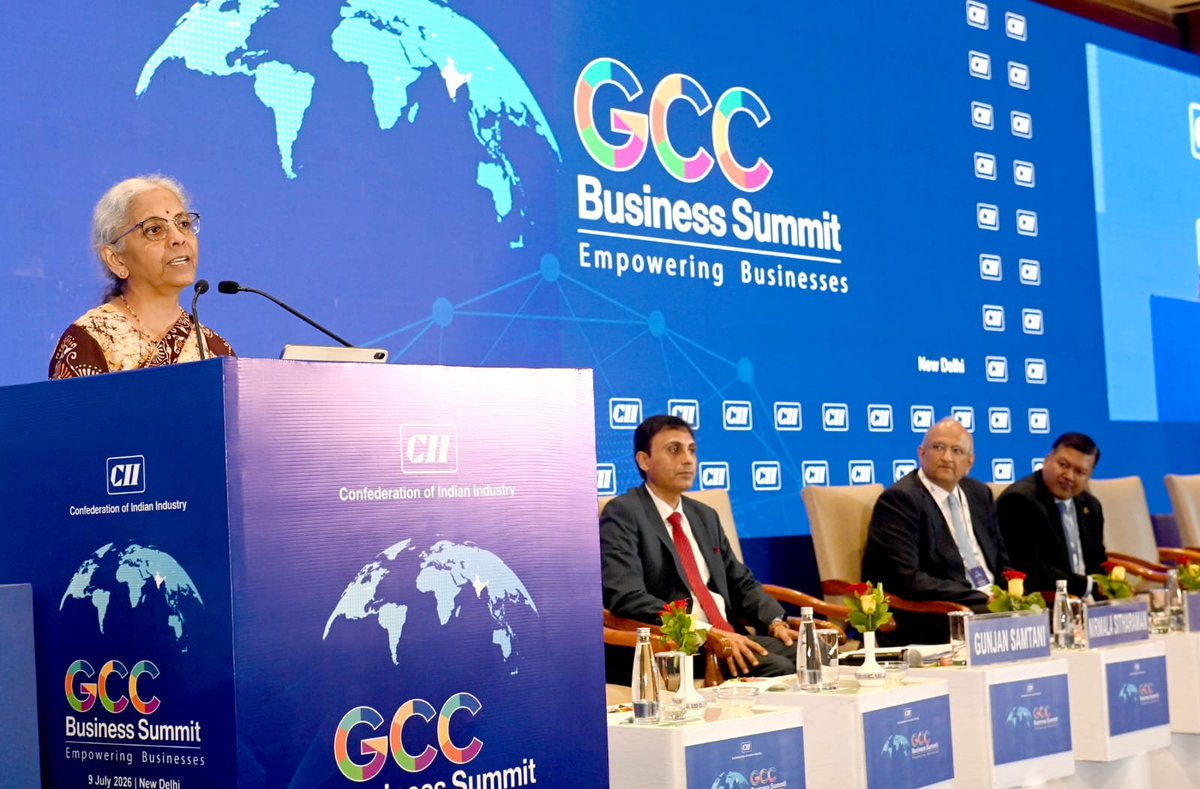
- Smt @nsitharaman at the CII National GCC Business Summit, 2026 (4/n)
The discussions today have reinforced an important lesson. Global enterprises no longer choose countries merely based on costs or incentives. It is ecosystems, not incentives alone, that determine long-term competitiveness.
Recognising that India's next phase of GCC growth requires institutional rather than incremental change, the ‘National Framework’ adopts a lifecycle approach - From investment decisions and establishment to expansion, innovation and long-term retention.
I congratulate the CII for bringing together the National and State GCC Framework reports. These reports provide valuable inputs for policymakers and contribute meaningfully to the ongoing dialogue between the government and industry.
- Smt @nsitharaman at the CII National GCC Business Summit, 2026 (1/n)
I would also encourage greater engagement with the State Governments and City Administrations. As GCCs expand into newer locations, such partnerships can help shape infrastructure, skills and institutional support in line with industry requirements.
The engagements will help the policymakers appreciate the importance of GCCs. In fact, the National and State Frameworks developed by CII also provide valuable inputs for collaborative policymaking.
- Smt @nsitharaman at the CII National GCC Business Summit, 2026 (4/n)
In my interactions with investors and business leaders from across the world, and recently in France, I increasingly find that many of them are either operating GCCs in India or actively exploring opportunities to establish one. Air Liquide GCC in Pune is one example of that.
Their experiences reinforce the confidence that ourtalent base, innovation capabilities and policy environment continue to make India an attractive long-term partner.
I would encourage all of you to remain active partners in this dialogue. This feedback mechanism helps us identify emerging challenges and refine policy so that India remains an attractive destination for long-term investments.
- Smt @nsitharaman at the CII National GCC Business Summit, 2026 (3/n)
The ambition of building an ecosystem capable of supporting around 5,000 GCCs by 2030 is therefore both realistic and achievable. And this is a milestone on a much larger journey.
These markets are looking for trusted partners capable of supporting advanced innovation.
- Smt @nsitharaman at the CII National GCC Business Summit, 2026 (2/n)
From Capability to Global Leadership is what I think defines India's Next Decade. The opportunity before India is to redefine our place in the global economy.
Around two-thirds of the Fortune Global 2000 companies have yet to establish a Global Capability Centre in India. This is one of the largest untapped investment opportunities before us.
- Smt @nsitharaman at the CII National GCC Business Summit, 2026 (1/n)
Indian GCCs are assuming a growing share of global leadership mandates and strategic decision-making responsibilities. In other words, India's value proposition has evolved from cost efficiency to capability leadership.
Enterprises are now moving beyond minimising cost to maximising innovation, accelerating discovery and strengthening long-term competitiveness.
And that, I believe, should define the ambition for the next decade.
Not simply to host more GCCs, but to ensure that an increasing share of the world's ideas, patents, products, algorithms, platforms and enterprise capabilities are conceived, engineered and led from India.
- Smt @nsitharaman at the CII National GCC Business Summit, 2026 (3/n)
In 2024, one new GCC was set up in India every week. Now, on average, one new GCC gets established every day.
India now hosts more than half of the world's GCCs. Few countries in modern economic history have built an innovation ecosystem of this scale and sophistication in such a short period.
The GCCs being established today are fundamentally different from those established even a decade ago. Increasingly, they are being entrusted with Artificial Intelligence (AI), Engineering Research and Development (ERD), Cybersecurity, Digital Platforms, Product Architecture, Financial Innovation and Enterprise-wide transformation.
More than half of new GCCs are now AI-first. Engineering Research & Development (ERD) has emerged as one of the fastest-growing capability areas.
- Smt @nsitharaman at the CII National GCC Business Summit, 2026 (2/n)
India's GCC Story is actually the shift from Scale to Strategic Leadership.
For nearly 3 decades, our success was measured by scale. We counted the number of centres established, the professionals employed and the value of services delivered. But every mature ecosystem eventually reaches a point where scale alone is no longer the defining measure of success.
I believe India has reached that point. The question before us is no longer whether India can host Global Capability Centres. We have answered that convincingly.
- Smt @nsitharaman at the CII National GCC Business Summit, 2026 (1/n)
India's GCC journey is much larger than the story of one successful sector. It is about making India indispensable to the world's knowledge economy and strengthening our long-term economic resilience.
In doing so, we will gain a new form of economic resilience and strategic relevance. India possesses every ingredient required to lead this transformation.
Our aspiration is not merely to host the world's capability centres, but to shape the next-generation technologies, products and enterprises of the future.
That is how India moves from capability to leadership. It is also an important step towards building a Viksit Bharat that is prosperous, innovative, resilient and respected across the world.
- Smt @nsitharaman at the CII National GCC Business Summit, 2026 (2/n)
I'd like to place before the industry a few expectations for the next phase of India's GCC journey:
1. Continue moving decisively up the value chain
2. Deepen your engagement with India's knowledge institutions
3. Expand confidently into our emerging cities
4. Become an ambassador for India's capabilities
5. Strengthen partnerships with Governments
- Smt @nsitharaman at the CII National GCC Business Summit, 2026 (1/n)
In Union Budget 2026–27, we have also announced measures to create stronger innovation ecosystems:
- Continued support for Digital Public Infrastructure, skilling, urban infrastructure and multimodal logistics, creating stronger innovation ecosystems.
- 5 University Townships to deepen industry, academia and research linkages while creating future-ready talent pools.
- City Economic Regions (CERs) to accelerate the emergence of globally competitive innovation hubs across India, enabling GCCs to expand confidently beyond traditional metropolitan centres.
- Urban Challenge Fund (Budget 2025–26), supporting cities in improving economic competitiveness and preparing them for the next generation of investment.
- Smt @nsitharaman at the CII National GCC Business Summit, 2026 (2/n)
The Government recognises that India's next phase of GCC growth requires an enabling policy ecosystem that reduces friction, improves certainty and supports long-term investments.
In Union Budget 2026–27, we have announced several measures that directly strengthen India's attractiveness as a global capability destination:
- Unified Safe Harbour Regime for IT/IT-enabled services, simplifying transfer pricing compliance for GCCs.
- Enhanced Safe Harbour Threshold from ₹300 crore to ₹2,000 crore, bringing many more enterprises under a simplified compliance framework.
- Fast-track Advance Pricing Agreement (APA) mechanism to provide greater tax certainty.
- Smt @nsitharaman at the CII National GCC Business Summit, 2026 (1/n)
The future of economic growth will increasingly be shaped by trusted partnerships between nations.
At the Australia-India CEOs Forum and Economic Roadmap Business Event, Hon'ble PM Shri Narendra Modi (@narendramodi) and Prime Minister of Australia, Mr. Anthony Albanese (@AlboMP) highlighted the immense potential for India and Australia to move beyond sharing knowledge and work together to create new benchmarks for the world. The opportunities across education and skilling, green energy, critical minerals, the digital economy, banking and public infrastructure are both significant and far-reaching.
Grateful for the opportunity to be part of this forum and contribute to conversations shaping the next chapter of the India-Australia economic partnership.
@FollowCII
Australia and India have built one of the world's best education partnerships and today, it takes another significant step forward. 🇦🇺🇮🇳
At the Australia-India Education Roundtable, Prime Minister @AlboMP, in the presence of Indian Prime Minister @narendramodi announced that Victoria University will open an international campus in Gurugram and commence teaching in India, while Flinders University will establish its international campus in Bengaluru, India's leading technology and innovation hub.
The Roundtable also saw the launch of the Community of Practice initiative to support Australia’s international branch campuses in India, and the signing of a Statement of Collaboration between the Business Council of Australia (BCA) and the @FollowCII. These initiatives will strengthen links between education and industry, help build a future-ready talent pipeline for Australian and Indian businesses, support graduates and returning alumni, and inform course development based on real industry demand and workforce needs.
@Austrade with support from the Australian Government Department of Education remains committed to deepening the connections between Australian education, Indian industry and the next generation of talent that will drive both economies forward.