📢 #JobAlert: We're hiring a (Senior) Research & Advocacy Officer – Public Finance!
Work on EU fiscal rules, debt sustainability, climate risks, policy research and advocacy. Join us in 📍 Brussels to make finance serve society.
Apply now 🔗 https://t.co/g7MTMmzdhA
📢 We’re hiring a Head of Operations & Finance in Brussels.
Oversee finance, HR, grants, governance, compliance, IT, internal operations. Send your CV & motivation letter to 📩[email protected]. Subject: Head of Operations & Finance - Vacancy 👉https://t.co/Jzuv6OSBO5
🚨Traditional risk models are leaving the financial system driving blind.
In our new report, Finance Watch proposes a science-based macroprudential buffer to protect banks from climate chaos and radical uncertainty.
Read the full report: https://t.co/klaXmYEiHW
#safetransition
If only financial crises came with #heatwave alerts... 🥵
Extreme weather disrupts businesses, damages infrastructure, drives up insurance losses and puts pressure on the economy. The climate is changing. So should financial regulation!
Last month, a small win: member states can spend an extra 0.3% GDP on an ‘energy buffer’.
It shows that:
🩵 If Europe can find fiscal space for #defence, it can do so for energy security, climate resilience, and ending fossil fuel dependence
https://t.co/4jZ7TsVfog
Alongside civil society including @triodosuk, @FEBEAethicalfin, & @Germanwatch, we affirm that #simplification must not mean lower capital requirements, weaker buffers or a rollback of the safeguards introduced after the 2008 financial crisis.
Read the letter 👇
A historic step for Europe! 🇪🇺 💶
The @Europarl_EN backed the #DigitalEuro, bringing public money into the digital age & reducing Europe’s dependence on foreign payment giants.
That makes Europe’s payments more inclusive, sovereign & resilient.
https://t.co/q2sBLenRPu
🎉 Thank you to everyone who joined us for #FWConference2026!
15 years after Finance Watch was founded in the wake of 2008, the conversations in Brussels demonstrated that the need for robust, forward-looking financial regulation remains as important as ever.
Albuquerque noted that EU banks stand in competition with the US, but warns against blindly following the US regulatory agenda:
"We should look at our own capacity to compete (...) but it does not mean that we will follow the US in the race to the bottom."
#FWConference2026
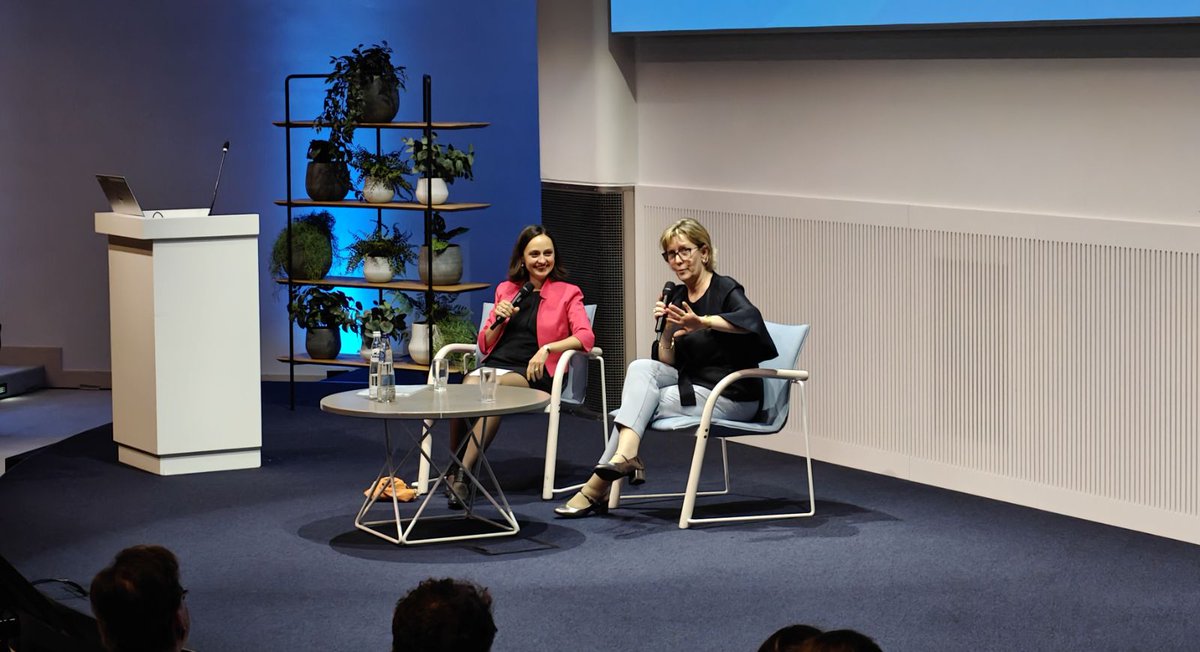
Our secretary general @ibuscke joined commissioner for financial services and the savings & investments union Maria Luís Albuquerque for a fireside chat during the #FWConference2026 at the national bank of Belgium.
"The financial sector does not exist for its own sake. It exists to be an intermediary - between those who have money and those who need money."
- Maria Luís Albuquerque at the #FWConference2026
Rebecca Christie reminds us that Europe was already deemed not compliant with #Basel.
She argues that "Europe needs strong & credible regulators that we can believe in - this will make the EU banking sector more competitive."
#FWConference2026
During our panel session, Verena Ross from @ESMAComms, MEP Jonás Fernández from @AndSocialists & Rebecca Christie from @Bruegel_org debate the topic of financial resilience in uncertain times.
#FWConference2026
MEP Jonás Fernández from @AndSocialists suggests to focus on the real economy & the lack of investable projects in Europe:
"If we are not able to remove the fragmentation in the real economy, we will not be able to deploy savings productively."
#FWConference2026
Géraldine Thiry explains that we need robust systems to 'prevent crises and absorb shocks'.
She asserts: "The response should not be to roll back regulation, but adapt regulation. (...) What seems inefficient today is what protects us tomorrow."
#FWConference2026
Géraldine Thiry, director at the National Bank of Belgium, addresses the debate around simplification during her speech:
"We must recast the conversation as one of robustness over fragility."
#FWConference2026
At the #FWConference2026, Géraldine Thiry states that a stable financial system underpins our economy.
"Financial stability cannot be treated as an impediment to growth. It is not a constraint on the economy, but its foundation (...) and serves a vital societal role."