In the next six hours, the largest IPO in the history of financial markets goes live.
SpaceX has priced its IPO at $135/share, raising $75B at a valuation of roughly $1.77T.
That is bigger than Saudi Aramco’s record IPO and instantly puts SpaceX in the same valuation conversation as the world’s largest tech companies.
But this is not a simple “rocket company goes public” story.
It is SpaceX, Starlink, xAI, Grok, X, Bitcoin exposure and Elon Musk’s control structure all wrapped into one stock.
Here is the Good, the Bad and the Ugly.
The Good
• Starlink is the strongest part of the business, with millions of subscribers across the world and fast-growing connectivity revenue.
• SpaceX dominates launch infrastructure, with reusable rockets giving it a real operating edge.
• Starship could completely change launch economics if it works at scale.
• Retail investors are getting access to a company that was private for more than two decades.
• The upside case is obvious: global internet, space infrastructure, AI compute, defense contracts and Mars-level ambition in one company.
The Bad
• The valuation is extremely rich, at roughly 90 to 95 times trailing revenue.
• SpaceX is still spending aggressively, especially after bringing xAI into the structure.
• The company posted a major loss in 2025, despite Starlink’s growth.
• At this burn rate, the $75B raise buys time, but it does not remove execution risk.
• A lot has to go right for this valuation to make sense.
The Ugly
• Governance is the biggest issue.
• Public investors are buying economic exposure, not real control.
• Elon Musk’s supervoting shares give him overwhelming voting power.
• That means investors are not just underwriting SpaceX. They are underwriting Musk’s entire operating style across SpaceX, xAI, X and everything else he may decide to build next.
So what is SPCX after all the noise?
A once-in-a-generation company at a once-in-a-generation valuation, controlled by a once-in-a-generation founder.
That makes the bull case exciting.
It also makes the risk very real.
Not financial advice. Do your own research before investing.
A top-tier VC called him in for a meeting. Not to invest. But to tell him that he was in a shitty business.
Today, Ashok Hariharan's IDfy processes 100,000 verification requests per second, with revenue estimated close to ₹300 cr and is headed to IPO.
Link in comments👇
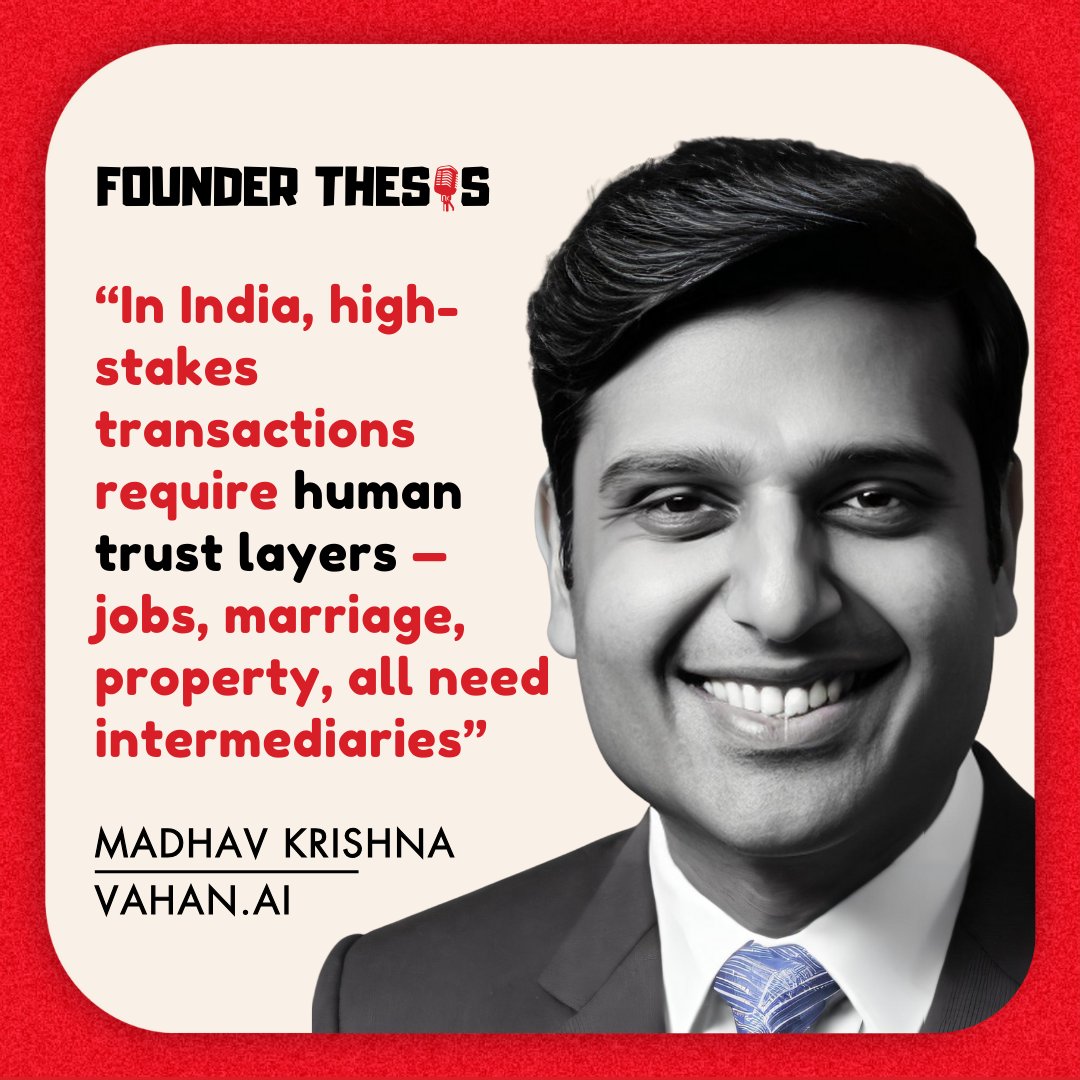
Why does India still rely on agents for everything?
Cultural context matters.
This isn't backwardness - it's understanding how trust actually works in low-trust markets.
Essential insight for anyone building in India.
Full episode at: https://t.co/b24b1ECMUs
Madhav Krishna, Founder of @VahanInc, cracked the code on India's blue-collar hiring crisis.
40,000 placements monthly. AI cheaper than humans. And a moat that ChatGPT can't replicate.
New episode out now: https://t.co/b24b1ECMUs
In this episode, we unpack the hardest part of the chip value chain: wafers.
If you care about India’s semiconductor ambitions, supply chains, and deep-tech manufacturing, this conversation is a must-watch.
Full Episode: https://t.co/RwxRKK2spU
Obsessive focus on cash flow, outcome-based pricing, and saying no to toxic clients. This is the anti-VC playbook.
Full story on: https://t.co/U3ERYQiQ5E
What separates a strategic partner from a vendor?
Learn why outcome-based contracts create trust that traditional hourly billing destroys. When you share the delivery risk, you transform from "another IT vendor" into an indispensable partner.
Listen: https://t.co/U3ERYQiQ5E
Why deep tech sales require fundamentally different collateral than software? What actually closes deals when you're selling to engineers?
Check out the latest episode: https://t.co/RwxRKK2spU
“India story” takes are usually either euphoria or despair.
We overestimate India in 3–5 years and underestimate it over a decade.
Full episode at: https://t.co/sU22vVTvch
The ear is 20 times faster than the eye.
Yet most brands still ignore sound as a strategic asset.
Learn how sonic identity drives brand recall and emotional connection.
New episode dropping soon.
Charge for real value, make everything else free.
Watch the full episode to learn how to think about monetization in consumer fintech: https://t.co/1N4GchYftt