AI traffic grew 393% in a year and converts 42% better than everything else.
Then it hits a wall: most sites are built for human eyes, not for agents that need clean HTML, structured data, and content they can actually parse.
The demand is here. The plumbing isn't.
Everyone's talking about "loop engineering" right now.
Engineers have basically stopped prompting their AI one request at a time. They hand it a goal, give it a gate, and let it run the loop itself.
But what does that actually look like for content? 👇https://t.co/KDhqT4DiWc
A lot of AI content has mostly meant piles of drafts nobody asked for.
The reason is simple: teams wired up the part that 'makes' and skipped the part that 'checks'.
An agent grading its own writing is the most generous grader alive.
Not appearing in AI search and losing to competitors in AI search are different problems with different fixes.
Visibility gap: your content isn't citation-ready yet.
Positioning gap: you're indexed, just not winning the queries.
Know your problem before you change anything.
The test: pick your most important content workflow and explain it to someone new in under 5 minutes.
If you can't — it doesn't exist as infrastructure yet. It exists as institutional knowledge held together by whoever's been there long enough to remember.
That's fragile.
Your content team isn't underperforming. Your content stack is.
Tools solve problems. Infrastructure compounds. Most teams have one. Very few have built the other.
See our latest blog for more on how to build content infrastructure that compounds.
Your support queue is a list of questions AI is answering about your industry.
If your content doesn't answer them, your competitor's might.
Most content teams don't look at it this way.
Close the gap. Start winning in AI search.
"Your brand was mentioned" is not a metric.
The real question: what share of citations do you own on a given prompt versus your competitors? Tools that still just count mentions are a generation behind.
And if you don't know the answer to that question, it's time to find out.
AI Overview citation overlap with Google's top 10 fell from 76% to 38% in under a year.
Ranking on Google and getting cited by AI are now two separate jobs. If you only measure one, you're working half-blind.
You don't have a content problem. You have a handoff problem.
The 5-step relay: research, briefing, writing, AI visibility tracking, & publishing is what adds days- not the work itself.
Ask what it would take to go from idea to published in 1 hr. The bottleneck will show itself
Seer Interactive ran a 3,119-query study on what AI Overview citations get you.
Brands cited in AIOs earn 35% more organic clicks & 91% more paid clicks than non-cited brands on the same queries.
Citation isn't a vanity metric. It's a click metric. And it's being redistributed.
Run this quick audit on your content today:
1. Pick your 3 best-performing blog posts
2. Check each one with the free GEO Score Checker (link in comments)
3. Note which dimension scores lowest across all three
If it's Content Structure: Your formatting isn't extraction-friendly. Add clear H2s, bullet summaries, and defined terms sections.
If it's Definitions: AI engines love definitional clarity — "X is Y" structures that they can pull directly.
Want to get your next blog post cited by ChatGPT?
Write a 40–60 word self-contained definition as your first paragraph, cite three .edu or .gov sources above the fold, and add FAQPage schema.
That is what the extraction algorithms actually pull from.
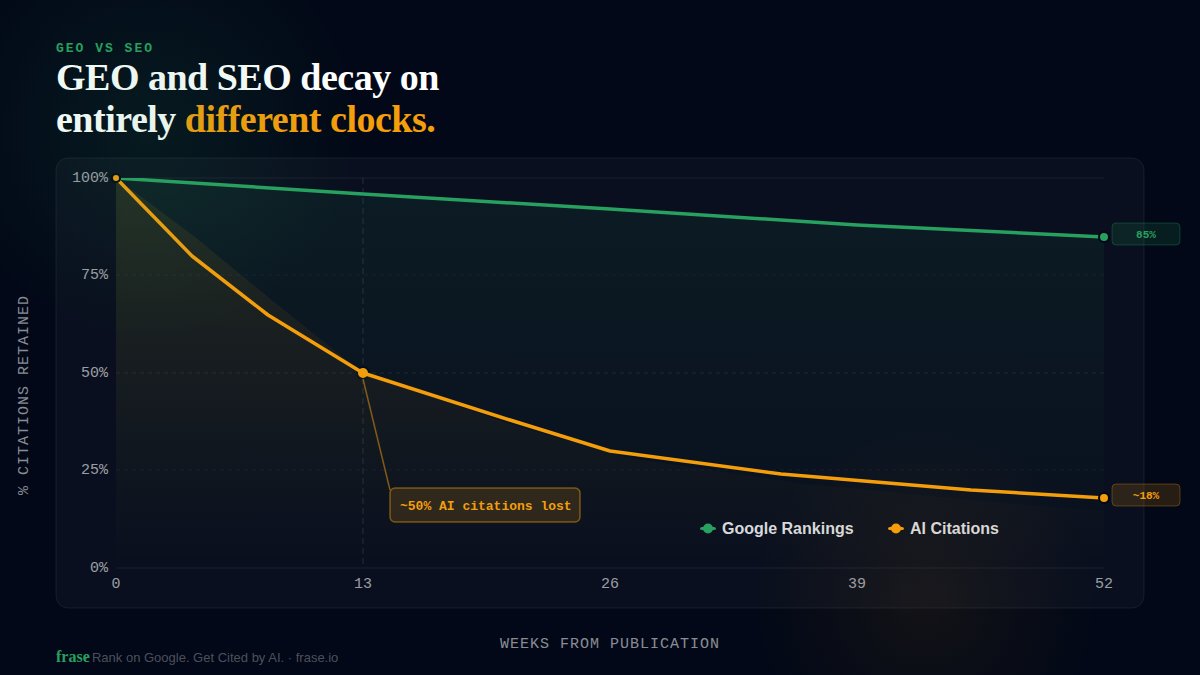
Half of the content cited in AI answers is under 13 weeks old.
SEO rankings on the same topic often persist for over a year.
GEO and SEO decay on entirely different clocks, and most content calendars are still running one refresh cadence for both.
AI search traffic converts at 14.2%.
Google organic 2.8%.
Small channel. Highest conversion rate in search.
Teams ignoring AI citations aren't missing visibility. They're ignoring the traffic that's 5x more likely to convert.
(13 months of LLM data, Search Engine Land).