AI infra capital partner. We originate, underwrite & manage financing for AI compute economy. Backed by @hack_vc, @FactionVC, @ambergroup_io, @AntalphaGlobal.
Is GPU compute more like oil, or more like electricity? Carmen Li (@carmenli), CEO of Silicon Data (@Silicon_Data) says it's neither and explains why on the latest episode.
GPU isn't quite oil, and it isn't quite electricity. It's somewhere in between, with its own logic.
Like oil, it comes in different grades. But unlike electricity, it holds residual value over time. And unlike oil, it's more elastic, because depending on the workload, compute can move to wherever the resources are, in a way other markets can't.
Carmen Li @carmenli@Silicon_Data explained why GPU pricing needed its own logic entirely.
AI companies can grow fast and still bleed margin, not from demand, but from GPU pricing that swings from $3, to $6, to $9, and back to $3, for the same chip, in the same week.
Carmen Li @carmenli, CEO of @Silicon_Data and Compute Exchange, on why that’s not a founder’s job to predict.
Full episode link in bio.
Compute is the new commodity and nobody was pricing it right.
While everyone was racing to build “decentralized AI,” @konyk001 saw the real gap: GPUs are the hottest asset on the planet, and there was zero financial infrastructure around them.
That gap became @gaib_ai turning GPU plus data center compute into a real, yield-bearing, on-chain asset class.
Compute isn’t just infrastructure. It’s an investable asset class.
Built on @Aptos.
interview w/ @aptAlix
The test of a thesis isn't whether it's right. It's whether you'll hold it before anyone agrees.
No pivot, no refocus. Conviction usually arrives years before the market does.
@gaib_ai's @konyk001 and Aptos Foundation's @aptAlix on mainstream adoption.
Everyone asks why NeoClouds are 2-3x more expensive than hyperscalers for the same GPU.
It’s not just markup. It’s demand, packaging, and who can actually get the chips, explained by @carmenli@Silicon_Data
Full conversation link in bio.
New episode of Where Capital Meets Compute (hosted by @konyk001): Carmen Li (@carmenli) of Silicon Data (@Silicon_Data) on building GPU pricing indices, and why the H100 and B200 forward curves are pointing in different directions right now.
Introducing Where Capital Meets Compute: a show about how AI infrastructure actually gets financed: the buildout, the offtake, the capital, beyond the hyperscaler headlines.
Episode 1:
Carmen Li (@carmenli), CEO of Silicon Data (@Silicon_Data) and Compute Exchange, on how GPU pricing indices are built, why compute doesn't fit the standard commodity model, and what the forward curve is signaling right now.
Everyone keeps asking me if this is an AI bubble. From where I sit, financing GPU deals every day, the data says the opposite.
Something structural changed in GPU financing over the past year. It used to be a deadlock: lenders needed a signed customer contract before financing GPUs, but clients wanted to see the GPUs before signing. Nobody could move first.
That broke in 2026. Clients now pay 20-30% deposits to lock in GPU capacity 3-6 months out. That deposit lets neoclouds place the actual purchase order, which finally gives lenders both a contract and a physical asset to underwrite against.
The demand side changed too. Before this year, most GPU offtakers were a handful of frontier labs. Now we're seeing real demand from revenue generating application-layer companies, video generation, AI avatars, music, and more. That's not speculative demand. That's paying customers.
The supply side tells its own story. Data center construction booked out well into 2027-2029 in many markets, driven by land, power and permitting constraints, not demand. NVIDIA's own $500B financing initiative with Apollo, BlackRock, Blackstone, Brookfield, Goldman Sachs and KKR is a signal in itself. GPUs are being treated as tradable, lendable assets now, not just capex.
A bubble usually looks like oversupply chasing uncertain demand. What I'm seeing is undersupply, real revenue and financing structures still catching up.
We get asked this a lot, here's GAIB in plain terms.
We originate, underwrite, and manage financing for the GPUs, robotics, and AI energy systems behind the AI economy, then tokenize that exposure so it's investable onchain.
sAID is how that shows up for depositors: real ownership in a portfolio of AI infrastructure financing deals. Structured, disclosed, backed by assets that exist.
New research from Epoch AI breaks down how Anthropic financed a $35B TPU buildout while its annualized revenue was still under $9B.
Institutional investors (Apollo, Blackstone, and others) provided the capital. Broadcom didn't fund the deal directly, but agreed to absorb part of the losses if Anthropic stops paying, making the debt safer, and cheaper, for outside lenders.
The price of that protection shows up directly in the numbers. Backed tranches priced at 5.75%. Unbacked tranches priced at 8.5%. That 2.75-point gap is the market putting a real number on what structure and protection are actually worth.
This is the similar discipline GAIB applies to every deal. We structure and underwrite exposure the way the A1/A2 tranches here are built: senior secured debt, with full contract coverage of repayments across the entire duration of the facility.
How capital gets structured now matters as much as how much of it there is.
Full article: https://t.co/emAuEEUUmo
Compute is the new oil, per OpenAI's president Greg Brockman today.
Oil needed financing markets to become an asset class. Compute does too.
That's what GAIB is for.
Legacy AID Alpha (AIDa) tokens, deprecated in November 2025, will stop being redeemable this week. Users still holding AIDa shall reach out to have their redemption requests evaluated.
The live AID and sAID tokens and all associated contracts continue operating normally.
Congrats to @Silicon_Data on the raise!
A daily, verified benchmark for GPU pricing is the primitive underneath every GPU-backed loan, forward, and credit facility, as you can't finance an asset class you can't price.
We are happy to announce a $30.5 million initial closing of our Series A, led by Valor Atreides AI Fund (@valor@Atreidesmgmt), with investments from @CMEVentures*, @DRWTrading, @FPrimeCapital, @SamsungNext, @vaneck_us, @further, @jumptrading, Tectonic Ventures, and @wintermute_t, and participation from @breed_vc, @hack_vc, @blank_vc, @SancusVentures, and @sogalventures.
The infrastructure underneath the round: daily GPU pricing benchmarks built from roughly 100 rental platforms in more than 40 countries, over 150,000 verified pricing records a day, continuous history since September 2024, alongside the GPU Forward Curve, the Silicon Data Token Index, the RAM Index, and SiliconMark performance benchmarking.
Our raise comes as @CMEGroup prepares to use Silicon Data benchmarks as the reference price for its planned cash-settled GPU futures market (pending regulatory approval) - a regulated instrument that will allow market participants to manage changes in GPU rental prices against a published, daily benchmark.
The Series A will fund expansion across four areas: benchmark pricing, performance measurement through SiliconMark, institutional market and alternative data, and risk infrastructure for derivatives, insurance and credit markets.
* Correction: in a previous post, we had mistakenly listed @CMEGroup as an investor instead of @CMEVentures.
Two years ago we said compute would be financed like infrastructure, not bought like hardware, and that was the genesis story of GAIB.
Some people underestimated key elements of the underwriting: GPU lifespan (A100 still earning after six years in the market), residual value (fungible across every cloud and workload), and whether the demand was real.
Financing has been the bottleneck on every industrial revolution; electricity, rail, telecom, fiber, all of them needed significant amounts of external capital.
$500B of institutional capital entering AI infrastructure validates the asset class. It also only serves the top of the market.
The operators building the next layer down still need capital, and that is the part we keep building.
Pre-IPO equity has historically been closed off to most investors.
GAIB Select is our first attempt at opening that door onchain, starting with a ByteDance position.
Check it out: https://t.co/KSQNqbMzKP
Nvidia, Blackstone, Coatue, and Jane Street just backed Firmus's $2B raise.
Another data point in a pattern all year: serious capital going into the physical layer of AI, power, compute, data centers.
That's the layer we've financed since day one.
AI data center company Firmus raised $2 billion in a funding round backed by Coatue, Nvidia, Blackstone vehicles and Jane Street, the company said https://t.co/d1HoMWmTkP
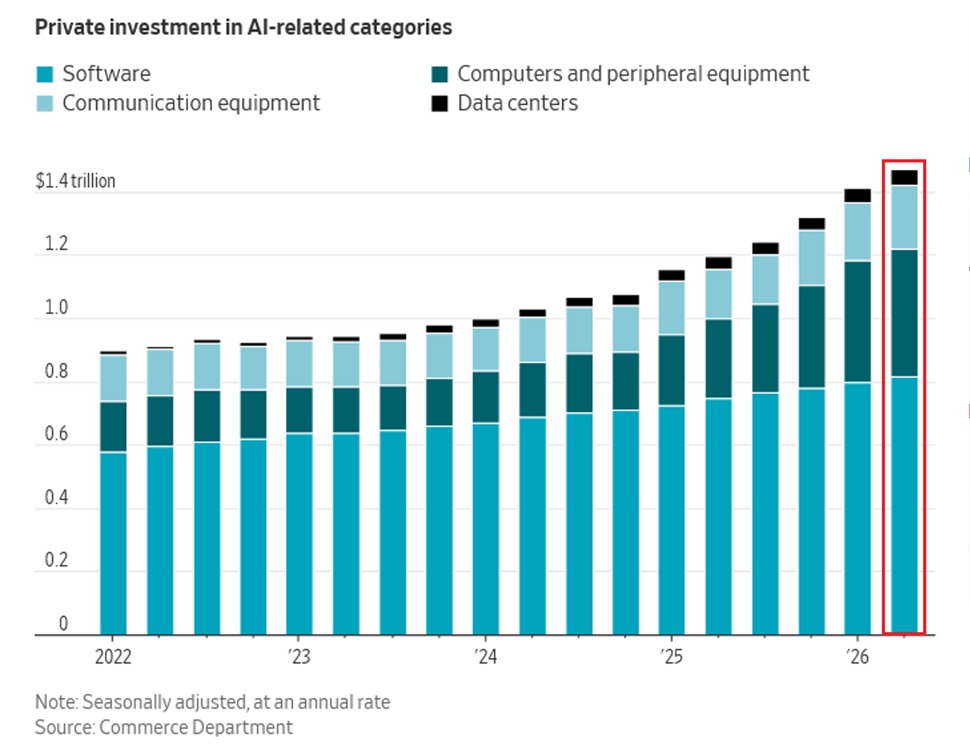
$500B added in two years. The fastest-growing line is computers and peripherals, which is also the fastest-depreciating.
Assets on a 4 to 6 year clock get financed, not equity funded. We underwrite that credit deal by deal and put it onchain.
sAID is the exposure.
AI has become the backbone of US economic growth.
Private business investment in AI-related categories jumped +$300 billion YoY in Q2 2026, or +25%, to a record $1.5 trillion annualized rate.
The surge was driven primarily by investment in computers and peripheral equipment, followed by communication equipment, software, and data centers.
This metric has now surged +$500 billion, or +50%, over the last 2 years.
Over this period, business investment in computers and peripheral equipment has more than doubled.
Meanwhile, direct AI investment now accounts for 25% to 33% of recent US GDP growth.
AI investment is now fueling the US economy.
Locking your sAID now gets you extra yield.
No lock: +2%. Lock 3 months: +3%. Lock 5 months: +4%.
sAID's native yield is already over 10.79% APY, for an estimated total of 12.79% APY.
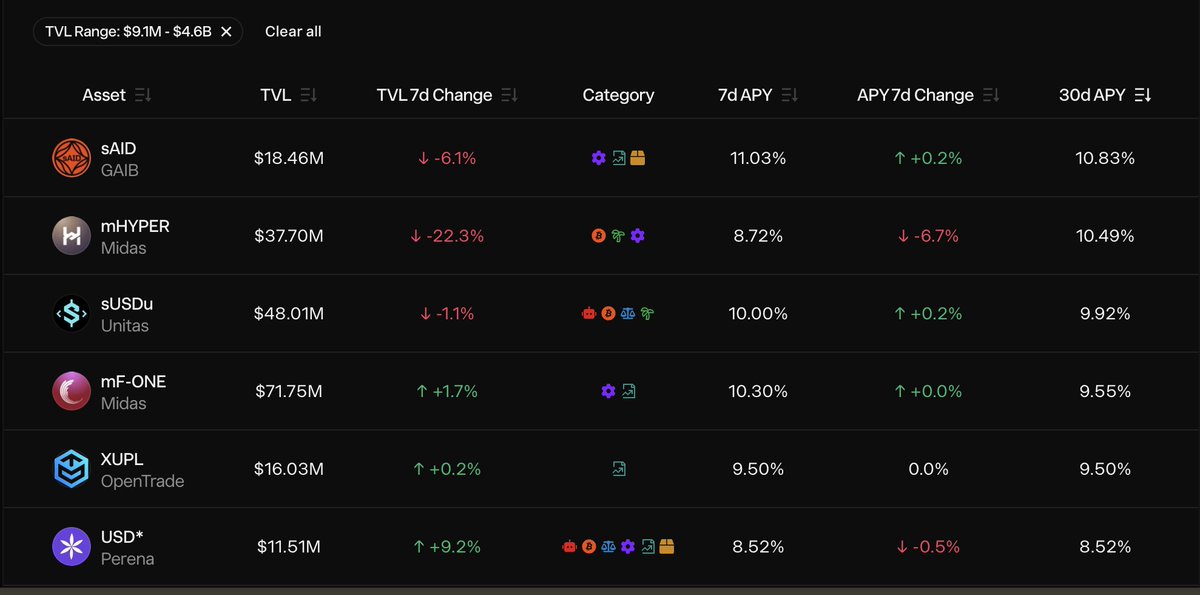
sAID is the #1 Yield Bearing Asset on @stablewatchHQ by 30d APY above $10M TVL at 10.83%!
We continue building to provide the best uncorrelated yield in DeFi, sourced from the real AI economy.
Check the program live on the Yield Boost page: https://t.co/J6zODUtzcR
Read out the full article for more information: https://t.co/0od0uAoEa2
Questions? Ask our team on Telegram https://t.co/g9y8CAVgIu
The Yield Boost continues.
sAID has paid out $1.1M to holders since launch, averaging 10.5% APY.
Yield Boost, our incentive program on top of that native yield, has been running since March, paying additional yield in $GAIB.
We're renewing it through December 31, 2026.
Pendle Markets
The current AID and sAID markets mature July 29.
The sAID market continues, a new market with Dec 31 maturity is already live. AID market winds down after this maturity, positions can exit now.
From August, incentives deploy directly into the sAID Pendle market too, on top of PT/YT and Yield Boost multipliers.