“People of the same trade seldom meet together, even for merriment and diversion, but the conversation ends in a conspiracy against the public, or in some contrivance to raise prices.” - Adam Smith, TWoN
Is this the "seldom"? Seems plausible
Frustrating decision from the Third Circuit in the algorithmic price-fixing case against Atlantic City's casino-hotels and Cendyn.
I co-authored the @LawEconCenter amicus the court quotes and rejects. Put that aside.
The opinion has checkable errors.
https://t.co/GAMbI0B664
I'm a fan of govt experimentation, but I don't think this is a very good idea.
The problem isn't that grocery stores are greedy. The problem is that food got expensive. The Producer Price Index for all foods—avg price paid to domestic producers for food—jumped 30% between 2021 and 2023. Since then, grocery prices have continued to climb, in part due to increases in wages and housing costs.
Without strong evidence that NYC bodegas and groceries stores are colluding to protect double-digit net profit margins, the reasonable assumption is that these businesses are operating with <3% margins after rent, labor, and utilities.
So, a plan to sell some food with a 30% discount seems like a plan to create very long lines to buy a very small number of subsidized groceries. We'll see how that goes. But I don't think literal bread lines are the image that a socialist mayor wants to cultivate.
As Keynes said in 1926, "the important thing for government is not to do things which individuals are doing already ... but to do those things which at present are not done at all." Bodegas are something we're doing already. Large grocers like Trader Joes are really really good at managing supply chains and keeping prices down, whatever you may think of their other policies. I do not trust a busy municipal govt trying to do 1,001 things to be better at groceries than grocers. But I guess we'll find out.
The European Commission’s two-speed approach to privacy under the Digital Markets Act gives stronger protection to anonymized search data than to the far more sensitive data accessible through AI interoperability mandates.
@AuerDirk examines the uneven safeguards. ⬇️
Another app wants to read my screen, use my microphone, and read my contacts. It asks for permission at the exact moment I'm trying to get the thing working. I'm unfamiliar with the app builder and have no idea what all they plan to do with the data or whether it's one of those "fake permission requests" where the app will still work mostly just fine even if I say no.
Sound familiar? Like everybody else, I tap allow. What's strange is how the law treats this situation so differently from another bit of sensitive data, our web search queries.
Dirk Auer has a piece at ICLE's Truth on the Market on two European Commission decisions from the same week, against the same company, under the same law. Anonymized search data gets layer after layer of protection: recipient screening, audits, ring-fenced processing, retention limits. Protection against access to your screen, microphone, and messages is via the humble (annoying and often contextless) permission prompt.
Auer reads the decisions as treating the relative sensitivity of the two types of data backwards. And to my mind, he's right about that. But I have a separate worry.
Apple has spent years now competing on privacy. Many people select their phone partly out of concern for privacy. The Digital Markets Act's Article 6(7) takes the power to build and maintain that privacy reputation away from Apple. Any app can prompt for access, and Apple is not permitted to restrict such prompts based on who the developer is, how it makes money, or what it has done with user data in the past. Apple is not permitted to screen developers on its users' behalf, and the prompts that are supposed to replace that effort are so devoid of context or require so much end-user legwork as to be basically useless.
The costs are already showing. Siri AI isn't coming to the EU, and Gemini on Android may follow suit. Faced with opening their most sensitive features to anyone who asks, firms are pulling the features instead.
@LawEconCenter@AuerDirk #DMA
https://t.co/2gYiuwRQOB
This reminds me of when @FTC asked people to submit comments about big tech censorship, people sent screen shots of their removed content, and the FTC then censored their submissions. https://t.co/pAxQr7IbXN
The DMA in a nutshell:
‘The Commission fined Google nearly a billion euros while crediting it with substantial progress… Companies often learn what compliance requires only after regulators decide they have failed’. -@AuerDirk https://t.co/eLMYCnuy26
The EU fined Google €890M under the DMA today: €460M for favouring its own services in Search, €430M for restricting how developers can point users to purchases outside Google Play.
Unfortunately, these fines merely double down on the DMA's failures 🧵
You must be kidding. AI might have big effects. It could have risks. So “policymakers,” must "act now,” before they have any idea what they’re doing, to "build the incentives, guardrails, and institutions needed to steer AI in a direction that complements humans and benefits society?” Boy I’m glad no self-appointed “policy maker” decided to “steer” the development of the steam engine. The ones who “steered” nuclear power destroyed it. Preemptive dirigisme is killing tech in Europe. If said “policy makers” could do something about the dumpster fires of US social programs, building restrictions, appalling costs of public infrastructure, broken tax code, failing schools, maybe I’d think about "calling" to unleash them on some vague AI crusade. (Previous essay on this here https://t.co/dHJDXU0cwM)
Second, asking policymakers and technology leaders to “build the incentives, guardrails, and institutions needed to steer Al” is the absolutely last thing we should be doing - unless we want EU-style technology stagnation or Mazzucato’s top-down, state-led model. 2/
outstanding essay from Seb:
"A cadre of elites decides which research directions are permissible, caps global compute and robotics, and creates state-administered scarcity rents. I shouldn’t need to explain why this is bad and dangerous, anyone can study History and Economics in their free time.
[...]
Building an entire apparatus tasked with maximally empowering the government and its grip on research, knowledge, and technology is dangerous."
Read every word of it 👉
The Guardian with a surprisingly fair interview and profile of @FTC consumer protection chief, and rising star, Chris Mufarrige.
https://t.co/z3A1d76Jeg
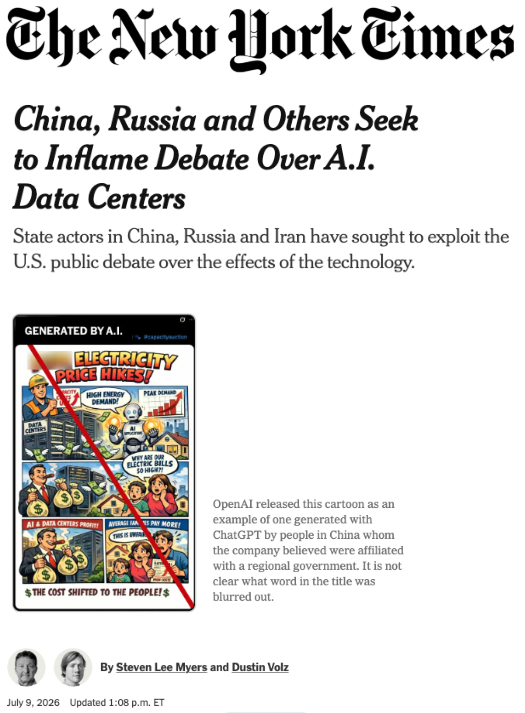
NEW: The New York Times reports that "China, Russia and, to a lesser extent, Iran have sought to use state media outlets to turn the controversy over data centers in the United States into 'a domestic fracture point.'"
Between Jan. and June, state media from these 3 countries mentioned data centers 700 times.
The NYT report cites BPI's research and highlights the work of Chinese propagandists and "covert Russian information operations" to foment anger against data centers.
"This is a common trap that we fall into when trying to figure out what’s going on with those declines [in youth mental health]” say Pete Etchells. “We try to answer the question of ‘What one big thing can explain this?’ The answer, in my view, is that there isn’t one big thing.”
Precisely right. Mono-causal explanations for complex social / psychological phenomenon are almost always shown to be wrong in the end. The science isn’t always settled, and sometimes it’s not science at all. We saw this with movies and video games long before today's battle over kids and social media.
Great @TheAtlantic article by @kait_tiffany 👉
Best tech policy essay of 2026 so far.
Don't miss @gmdickinson's new law review article on "Law Proofing the Future" in the Harvard Journal on Legislation.