GoBTC Pay delivers what was promised.
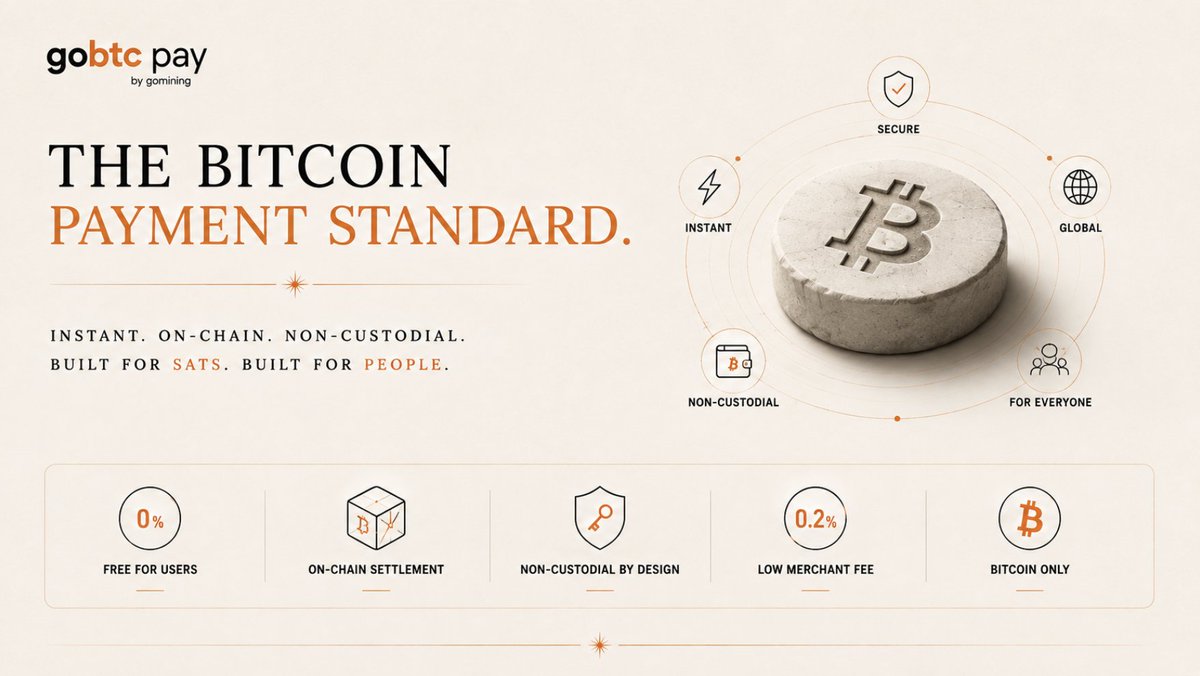
Instant confirmations. On chain settlement. No custody handover.
The original vision never needed modification. Just the right infrastructure to finish it.
#ConsensusGM#Unlockbitcoin#GoBTCPay
Every kind of money eventually gets a way to spend it.
-Cash had the wallet.
- Cards had the terminal.
Bitcoin never really had its own, until now. GoBTC Pay is built to be that missing piece: instant, on-chain, and yours the whole way through.
The standard Bitcoin was waiting for 👇
You've never once been asked to "convert" your dollars before buying coffee. You just pay.
So why does spending Bitcoin still involve selling it, waiting, and losing a cut on the way out?
GoBTC Pay drops all of that. Tap, done, still Bitcoin.
🏦 Your bank can undo a payment you already made.
Reverse it, freeze it, claw it back weeks later like it never happened.
Bitcoin doesn't work like that. Once it's on the chain, it's done. Block number, timestamp, locked in forever.
→ Some people find that terrifying.
→ Others have been waiting their whole life for it.
Which one are you?
Every other way to "spend crypto" quietly sells it first.
You off-ramp, you convert, you watch your Bitcoin turn into dollars before it ever leaves your hand.
GoBTC Pay breaks that: you pay in Bitcoin, the merchant gets Bitcoin, and you never left Bitcoin to do it.
The coin you spend and the coin you hold are finally the same coin.
What would you buy first?
💳 Every other way to spend Bitcoin quietly makes you sell it first.
Off-ramp, convert, watch it leave your wallet for good.
GoBTC Pay doesn't.
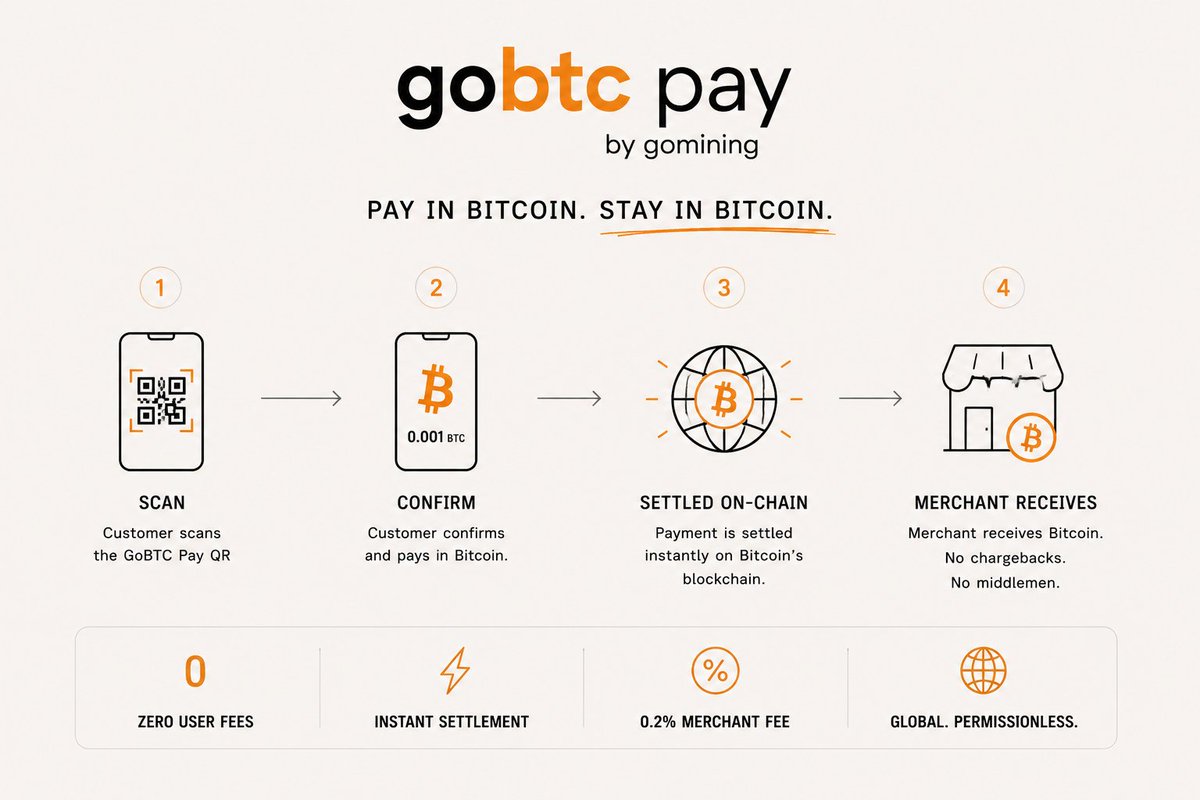
You scan, you confirm, it settles straight on Bitcoin's chain, and the merchant gets paid in actual BTC.
The coin you spend and the coin you hold are the same coin. Full flow below 👇
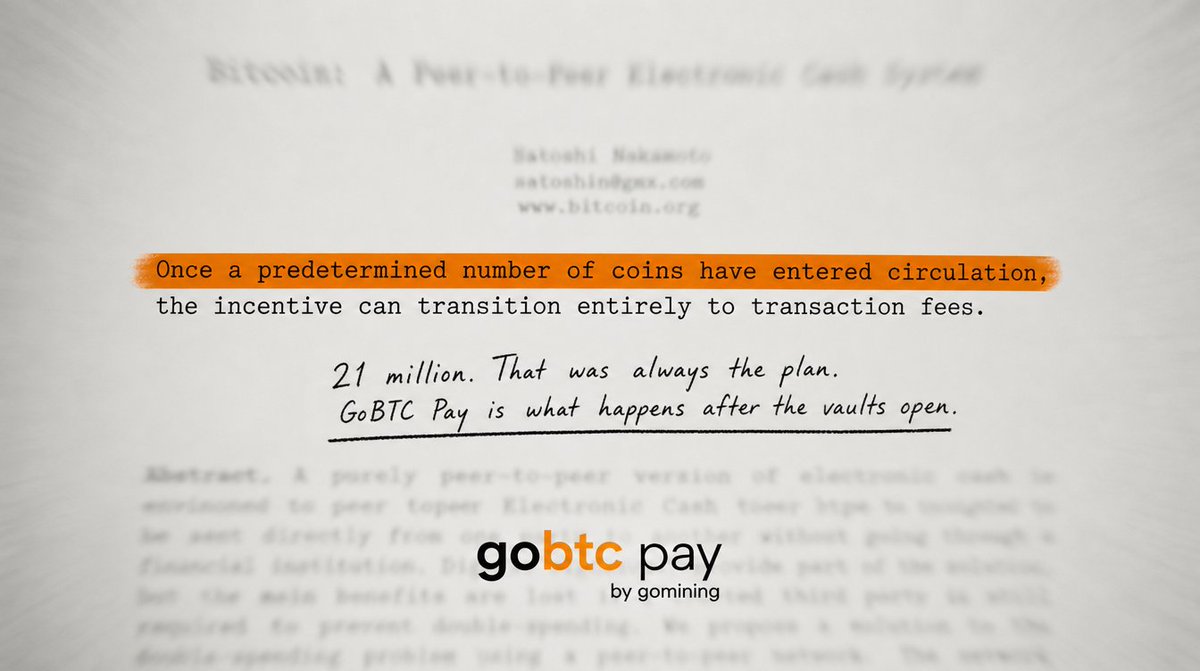
Almost nobody quotes this line. Satoshi wrote that as the new-coin reward fades over time, miners lean more and more on transaction fees.
Which means Bitcoin was never built to just sit still: the security model quietly assumes people are spending it.
Holding is only half of what Satoshi designed. GoBTC Pay is the other half.
Buried in the whitepaper: the reward for mining slowly shifts from new coins to transaction fees.
Satoshi didn't design Bitcoin to only be held: the long-term model leans on people actually transacting.
GoBTC Pay is built for the part everyone skips.
Was that always the plan, or is it Bitcoin's weak spot? Tell us what you think below 👇
For years "spend your Bitcoin" meant sell it first.
Not here. The coin you spend and the coin you keep are the same coin.
Pay in Bitcoin. Stay in Bitcoin.
👉 For years, "spend your Bitcoin" quietly meant "sell your Bitcoin."
You'd off-ramp to a card, eat the exchange fee, wait for it to clear, and watch the coins leave your wallet for good.
Then Bitcoin would run 20% the next month and you'd remember exactly what that coffee actually cost you. Spending and holding were enemies. You could do one or the other, never both.
GoBTC Pay breaks that. The coin you spend and the coin you keep are the same coin, settled on-chain, in seconds, with no exchange sitting in the middle taking a cut and a record.
Pay in Bitcoin. Stay in Bitcoin.
What's the last thing you bought with crypto, and what did it cost you to actually spend it?
🗞️ The whitepaper promised one thing: no institution in the middle.
For seventeen years there was always someone in the middle: swiping a fee, logging a purchase, holding your money for three days.
GoBTC Pay removes the middle. Not the idea of it. The actual middle.
Blessed be the block.
In 2008, the first sentence of the Bitcoin whitepaper described the problem.
Everyone spent 17 years arguing about the price instead.
GoBTC Pay finally fixes the part Satoshi actually wrote about.
Who's the middleman you'd cut out first?
Almost two decades ago, they told you to lock it away. To treat Bitcoin like gold that never moves. But the scripture said cash.
Today the prophecy is fulfilled. GoBTC Pay integration toolkit is live — on-chain settlement, next block, mined by our own network.
No Lightning. No fiat conversion. Zero fees for you, 0.2% for merchants. Tell the places you love to join the movement and tag them in the comments.
Pay in Bitcoin. Stay in Bitcoin. Blessed be the block.
In two weeks, Bitcoin stops being something you only hold and becomes something you spend.
On June 19th, GoBTC Pay goes live. And here is the part worth paying attention to: onboarding slots are limited, and we are not launching with everyone who asked to join.
→ Merchants pay 0.2%. Users pay nothing.
→ Every basis point routes back to miners and wallets, never a balance sheet.
→ Real on-chain settlement on Bitcoin's base layer. The block is the receipt.
→ Your keys stay yours, thanks to a 2-of-3 multisig design.
If you could spend Bitcoin anywhere tomorrow with almost zero fees, what is the very first thing you would buy?
"Our goal is to make this protocol completely open. APIs, SDKs — merchants, users, anyone can connect."
@MarkZalan_ at Consensus Miami, on why open rails change the economics.
#GoBTCPay#UnlockBitcoin
What unlocks Bitcoin as money? Velocity.
"Right now, everybody is sitting on their Bitcoin waiting for appreciation. Once you can spend it, the complexity disappears."
@MarkZalan_ at Consensus Miami, on why open rails change the economics.
#GoBTCPay#UnlockBitcoin
On Bitcoin Pizza Day, we don’t just celebrate the first BTC Pizza 🍕
We celebrate what it started:
Bitcoin as money you can actually use.
Instant payments.
Real BTC.
Zero user fees.
Welcome to GoBTC Pay 📷
#BitcoinPizzaDay#GoBTCPay#UnlockBitcoin
Why has buying with Bitcoin never quite worked?
Eighteen years of attempts. Lightning got the closest. Every version came with tradeoffs.
GoBTC Pay is here to fix it
Listen to @MarkZalan_ on @CoinDesk Live ⚡
#GoBTCPay#UnlockBitcoin
Finally, a Bitcoin payment protocol that respects self custody. 2-of-3 multisig with independent parties.
No single point of failure.
That is how you build trust into payments, not around them.
#GoBTCPay#UnlockBitcoin
We cannot move your sats.
Most “Bitcoin payment” products fix the UX problem by taking your keys. They hold the BTC; you hold an IOU on a screen. Convenient — until it isn’t.
GoBTC Pay is non-custodial by design. The wallet uses a 2-of-3 multisig architecture:
→ Key 1 — held by you, on your device, in the secure enclave.
→ Key 2 — held by GoMining, as co-signer.
→ Key 3 — held by an independent regulated custodian.
Any two keys authorise a transaction. No single party — including us — can move your BTC alone.
Why three keys instead of one? Because real non-custody has to survive real life. GoMining disappears tomorrow? You and the independent custodian can still sign. Custodian compromised? You and GoMining can still sign. No single point of failure. No trusted third party with unilateral control.
This isn’t “self-custody with help.” This is multisig the way Bitcoin’s protocol has always supported it, wired into a payment app anyone can use.
Not your keys, not your coins. With GoBTC Pay, the keys stay yours.
#GoBTCPay #UnlockBitcoin
Card networks charge too much and move too slow.
GoBTC Pay is built different. Instant settlement, lower fees, open rails.
#ConsensusGM#UnlockBitcoin#GoBTCPay
“Yesterday, people drove in buggies with horses, but the future is not that”.
Here's a clip of our CEO Mark Zalan discussing GoBTC Pay whilst taking on card providers at @consensus2026 - he was on fire 🔥
#ConsensusGM#UnlockBitcoin#GoBTCPay
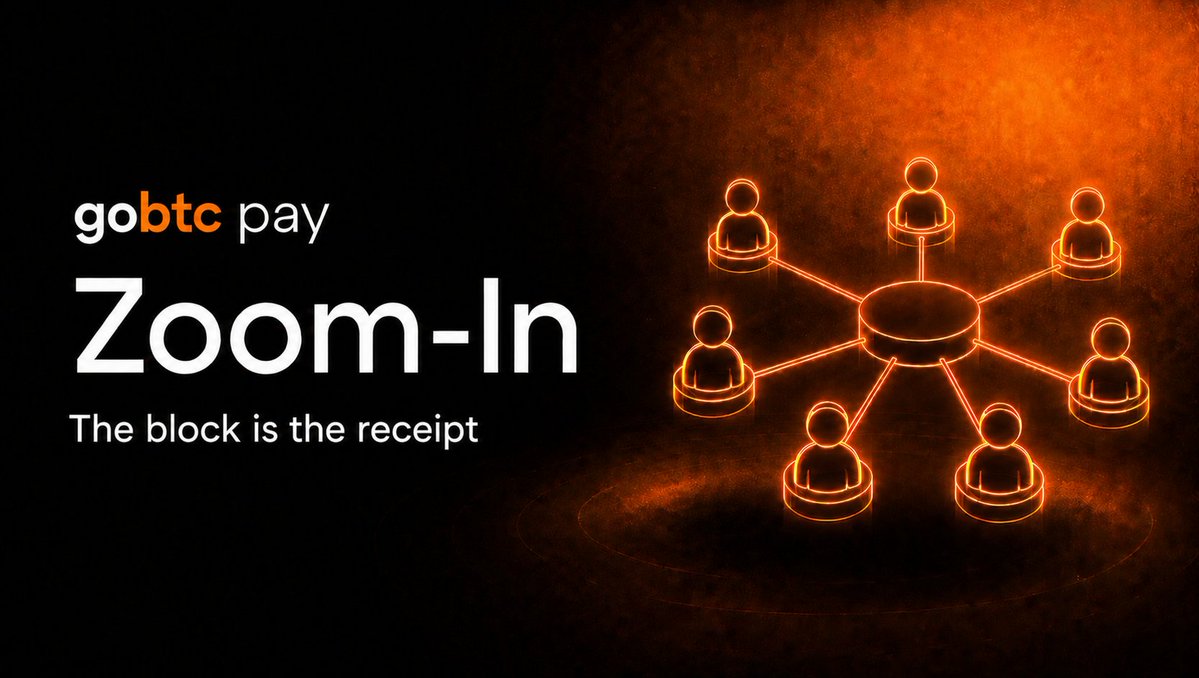
The block is the receipt.
Every previous attempt to make Bitcoin spendable at scale made the same compromise: they moved settlement off the base layer. Lightning channels. Sidechains. Wrapped tokens. Custodial IOUs you can redeem “later.”
Each one solved the speed problem by surrendering the thing that made Bitcoin worth solving for in the first place.
GoBTC Pay refuses the trade.
Every GoBTC Pay transaction settles on Bitcoin’s base layer. On-chain. In a real block. With a real hash. No L2. No sidechain. No wrapped anything. The block is the receipt.
This is possible because GoMining is a top-ten Bitcoin miner globally with a dedicated private pool processing GoBTC Pay transactions. Other payment products depend on someone else’s pool to confirm transactions, which means they depend on someone else’s priorities, fees, and timing.
We mine the blocks ourselves.
The target: 12-hour final on-chain settlement on every GoBTC Pay transaction by the end of 2026. Not “12 hours from a custodian’s spreadsheet.” 12 hours from broadcast to confirmed Bitcoin block.
Layer 1, or it doesn’t count.
#GoBTCPay #UnlockBitcoin
The fee model tells you everything. Card networks take 1.5% to 3.5% off the top. BitPay adds another 1% and converts to fiat.
GoBTC Pay charges 0.2% total, split between miners and wallets.
We keep nothing. That is how Bitcoin payments should work.
#GoBTCPay#UnlockBitcoin
The fee model is the message.
A retail card payment in 2026 costs the merchant somewhere between 1.5% and 3.5%. Interchange, scheme fees, processor margin, gateway, PCI — it stacks up. On a $100 sale, the merchant keeps between $96.50 and $98.50, and the customer often eats the cost twice through surcharges and higher menu prices.
BitPay charges 1% on top of all that, and converts your customer’s BTC into fiat whether you asked for it or not.
GoBTC Pay is 0% for the user and 0.2% for the merchant. On a $100 sale, the merchant keeps $99.80.
But the more interesting number is where that 0.2% goes.
It doesn’t sit on a balance sheet in San Francisco. It is split in half and sent back into the network that produced the transaction:
→ 0.1% to the miners in GoMining’s pool, pro-rata to hashrate.
→ 0.1% to the wallet that initiated the payment.
We keep nothing on third-party flow. Every basis point routes back to the people running the rails.
Card networks extract value from every swipe. GoBTC Pay routes value back to the network. That isn’t a tagline. That’s the protocol.
#GoBTCPay #UnlockBitcoin