The same class of people who once treated “mathematically impossible turnout,” delayed results, and votes that don’t reconcile with ballots issued as smoking-gun proof of rigged elections in Africa and Latin America now look at California and say “nothing to see here, move along.”
They used to send observers, write reports, and cheer for outside pressure when signature verification was this sloppy and counting dragged on for days. Now the standard is 40% accurate signatures in LA County and we’re told questioning it makes you a threat to democracy.
The rest of the world still understands that real legitimacy requires processes citizens can actually see and trust. Town squares in parts of Africa count painted rocks in the open so nobody can claim the fix was in. California does the opposite, then threatens you for noticing.
This isn’t about proving every single ballot was fake. It’s about the architecture. The laws. The verification standards. The culture that treats public doubt like a crime. The same people who used to flag this exact behavior overseas suddenly lose their glasses the second the jurisdiction is blue and domestic.
If these practices showed up in any other country, the experts would already be on TV demanding investigations and reforms. Here? They call it secure and tell you to shut up.
The area of influence doesn’t lie. We just decided the rules only apply somewhere else.
(article below)
The same class of people who once treated “mathematically impossible turnout,” delayed results, and votes that don’t reconcile with ballots issued as smoking-gun proof of rigged elections in Africa and Latin America now look at California and say “nothing to see here, move along.”
They used to send observers, write reports, and cheer for outside pressure when signature verification was this sloppy and counting dragged on for days. Now the standard is 40% accurate signatures in LA County and we’re told questioning it makes you a threat to democracy.
The rest of the world still understands that real legitimacy requires processes citizens can actually see and trust. Town squares in parts of Africa count painted rocks in the open so nobody can claim the fix was in. California does the opposite, then threatens you for noticing.
This isn’t about proving every single ballot was fake. It’s about the architecture. The laws. The verification standards. The culture that treats public doubt like a crime. The same people who used to flag this exact behavior overseas suddenly lose their glasses the second the jurisdiction is blue and domestic.
If these practices showed up in any other country, the experts would already be on TV demanding investigations and reforms. Here? They call it secure and tell you to shut up.
The area of influence doesn’t lie. We just decided the rules only apply somewhere else.
(article below)
Tout le monde pense que le monde libre a gagné en 1989, à la chute du mur de Berlin.
C'est faux.
Et c'est exactement pour ça que le monde est aujourd'hui en feu.
Ce qui est tombé le 9 novembre 1989, c'est un appareil.
Une économie planifiée, un empire militaire, un mur de béton. Ce qui n'est pas tombé, c'est l'idée. L'idée que le monde se divise en oppresseurs et en opprimés. L'idée qu'il existe une égalité finale à atteindre, par tous les moyens. L'idée que tout ce qui existe (la famille, la nation, le mérite, l'héritage) est une structure de domination à abattre.
Cette idée-là n'était plus dans le bâtiment quand le bâtiment s'est effondré.
Il faut reprendre la chronologie, parce que tout est dans la chronologie :
Le communisme économique avait un défaut fatal : il était réfutable. Il promettait l'abondance, il produisait des famines. Il promettait l'émancipation, il produisait des barbelés. Budapest 1956, Prague 1968, L'Archipel du Goulag publié à Paris en 1973, les boat people de 1979 : à chaque décennie, le réel envoyait sa réfutation. Les boat people étaient une réfutation flottante, visible depuis les plages.
Alors l'idéologie a fait ce que fait tout organisme menacé : elle a muté.
La mutation a un nom, et j'en ai raconté la généalogie ici : la French Theory.
Foucault a déplacé la guerre du terrain des faits, où le communisme perdait à chaque fois, vers le terrain du savoir lui-même.
S'il n'y a pas de vérité, s'il n'y a que des rapports de pouvoir déguisés en savoir, alors plus aucune famine, plus aucun mur, plus aucun goulag ne peut réfuter quoi que ce soit.
La French Theory n'a pas enterré le marxisme.
Elle l'a rendu irréfutable.
Et la mutation a des dates. Toutes antérieures à 1989.
1934 : l'École de Francfort, chassée d'Allemagne, s'installe à Columbia. La critique de l'économie devient critique de la culture.
1964-1965 : Marcuse, exilé allemand devenu professeur américain, remplace le prolétariat défaillant par un nouveau sujet révolutionnaire (les minorités, les étudiants, les marginaux) et écrit noir sur blanc que la tolérance doit être accordée aux mouvements de gauche et refusée à ceux de droite.
Octobre 1966 : le débarquement a une date précise. Université Johns Hopkins, Baltimore. Derrida, Barthes, Lacan présentent la pensée française aux campus américains.
1967 : Rudi Dutschke lance le mot d'ordre, la longue marche à travers les institutions.
1968 : les révolutions de rue échouent partout.
Qu'importe. La révolution ne passera plus par la rue, elle passera par la salle de classe.
1975-1985 : Yale, Berkeley, Columbia absorbent la théorie, qui devient le système d'exploitation des humanités.
1987 : Allan Bloom publie The Closing of the American Mind pour donner l'alerte. Un million d'exemplaires vendus.
L'université le traite de réactionnaire et passe à autre chose.
L'Amérique avait son Aron, elle en a fait la même chose que nous du nôtre.
Puis arrive le 9 novembre 1989.
Le Mur tombe. L'Occident célèbre. Fukuyama avait déclaré la fin de l'Histoire dès l'été, avant même la chute. On démantèle les missiles, on encaisse les dividendes de la paix, on déclare le match terminé.
Nous avons célébré notre victoire sur une adresse vide. L'idéologie avait déménagé vingt ans plus tôt. Nous avons gagné contre les chars et perdu contre les chaires.
Pendant ce temps, l'autre empire communiste faisait la lecture inverse. Pékin avait écrasé Tian'anmen dans le sang cinq mois avant Berlin. Sinistre, mais lucide sur un point : la Chine savait que la guerre était idéologique.
Elle a choisi : abandonner l'économie marxiste, garder le contrôle du récit. L'Occident a fait l'exact opposé : il a gardé le marché et absorbé l'idéologie. Trente-cinq ans plus tard, regardez qui construit des centrales et qui déboulonne ses statues.
Vous voulez la preuve que c'est le même logiciel ? Faites la table de correspondance.
La lutte des classes est devenue la lutte des identités.
Les koulaks sont devenus les privilégiés.
L'autocritique maoïste est devenue le privilege checking. Les commissaires politiques sont devenus les DEI officers.
Le samizdat est devenu le compte shadowbanné.
La nomenklatura a quitté Moscou pour Davos et Bruxelles.
Et le paradis ne s'appelle plus la société sans classes : il s'appelle l'équité, l'égalité des résultats.
Exactement ce que je décrivais ici il y a quelques semaines.
On me dira : il n'y a pas de Goulag.
C'est vrai. C'est même tout le génie de la version 2.0.
Le communisme dur devait briser les corps parce qu'il ne tenait pas les esprits.
Le communisme mou tient les esprits : il lui suffit de briser les carrières.
Pas de camps, des services RH.
Pas de procès de Moscou, des excuses publiques.
Pas de Sibérie, la mort sociale.
Demandez aux émigrés du bloc de l'Est installés en Occident ce qu'ils ressentent en traversant une université américaine en 2026.
Ils reconnaissent l'odeur.
Et voilà pourquoi le monde est en feu.
Une civilisation a passé trente-cinq ans à enseigner à ses propres enfants qu'elle était le problème. Résultat : elle ne sait plus défendre ses frontières, transmettre son héritage, ni même nommer ses ennemis.
Quand la présidente de Harvard, devant le Congrès, répond que condamner un appel au génocide « dépend du contexte », vous voyez le logiciel tourner en production.
Et les prédateurs du dehors lisent cette faiblesse comme un livre ouvert : Moscou teste, Pékin patiente, l'islamisme avance dans les rues de nos capitales.
Le feu extérieur n'est que la conséquence du désarmement intérieur. On ne brûle bien que les maisons qui se sont vidées de leurs défenseurs.
Le Mur n'est pas tombé. Il s'est déplacé. Il ne sépare plus l'Est de l'Ouest : il passe désormais à l'intérieur de chaque institution occidentale, entre ceux qui construisent et ceux qui déconstruisent.
La première guerre froide s'est gagnée avec des missiles et du PIB. La seconde se gagnera avec des écoles, des médias libres et des modèles d'IA. Celui qui écrit les valeurs dans les machines écrira le prochain 1989.
Cette fois, ne nous trompons pas de victoire. Au travail.
🧵 THREAD: Albania’s #FlamingoRevolution what the world needs to understand (1/10)
Albania’s 🇦🇱 youth have taken to the streets, night after night, city after city. Yes, Jared Kushner & Ivanka Trump’s $4B luxury resort triggered it. But anyone saying this is just about them is completely missing the point. Here’s what’s really happening. 👇
🚨 AMERICANS NEED TO UNDERSTAND WHAT IS HAPPENING RIGHT NOW.
Most people are still viewing President Trump’s foreign policy through the old post-WW2 lens. That lens is obsolete. What P Trump is attempting is not a minor policy adjustment. It is a complete restructuring of the global economic and geopolitical order.
Read that again.
For 80 years, America operated under a “globalist” framework:
• America paid the bills
• America defended everyone
• America opened its markets
• America carried NATO
• America protected shipping lanes
• America subsidized allies
• America tolerated trade imbalances
• America exported democracy while factories disappeared and debt exploded at home
That system enriched multinational corporations, global institutions, foreign economies, and permanent bureaucracies.
But millions of Americans watched:
- manufacturing collapse
- wages stagnate
- communities hollow out
- endless wars drain trillions
- China rise into a superpower using America's own economic system against itself
President Trump is trying to replace that model with something entirely different:
👉 A transactional, America First economic coalition built around ENERGY, TRADE, SECURITY, MANUFACTURING, and STRATEGIC DEALS.
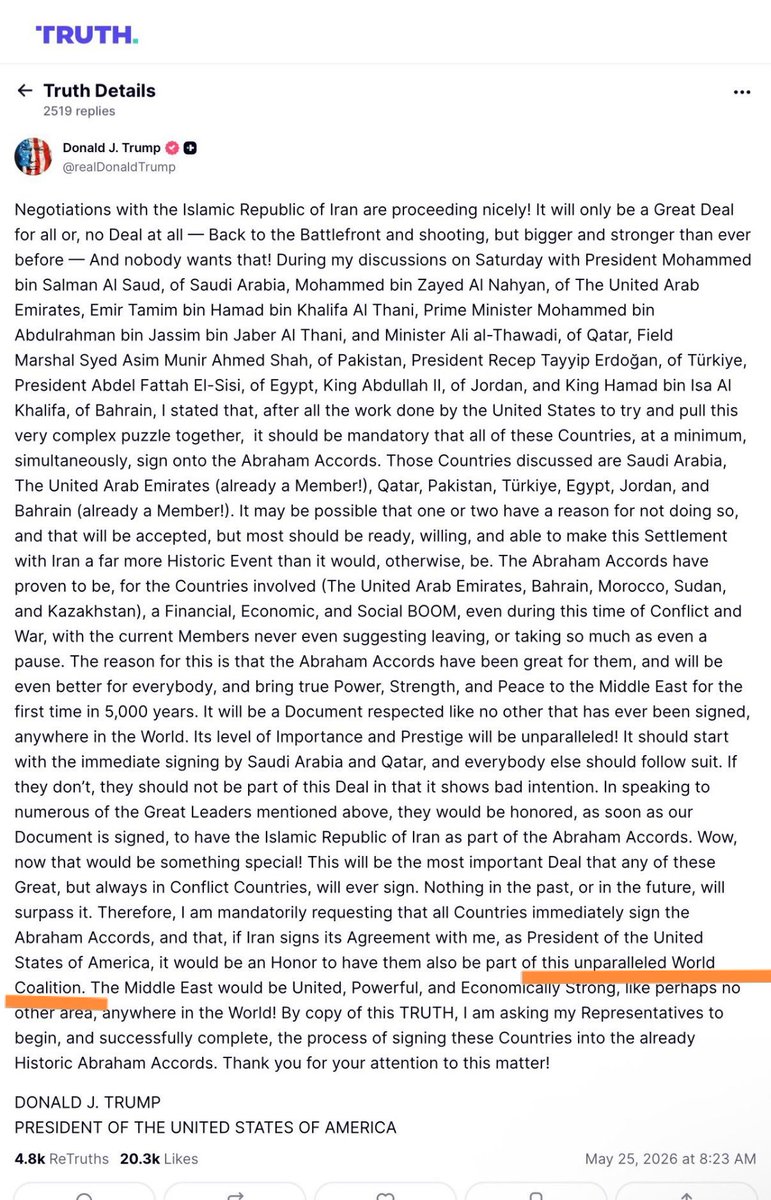
That Truth Social post about the Abraham Accords wasn’t just another statement. It was a blueprint.
If this succeeds, you are looking at the construction of a massive economic/security network that could include:
- The United States
- Saudi Arabia
- UAE
- Qatar
- Egypt
- Jordan
- Israel
- Pakistan
- Türkiye
- India
- parts of Latin America
- strategic Indo-Pacific partners
- and critically, a normalization framework with BOTH China and Russia where competition still exists, but catastrophic conflict is avoided through economic leverage, negotiated spheres of influence, energy coordination, and transactional diplomacy
This is one of the most misunderstood parts of President Trump’s geopolitical strategy.
Many Americans still think in Cold War terms:
America vs Russia.
America vs China.
Permanent hostility.
Permanent escalation.
But President Trump’s approach is far more transactional and realist.
Instead of trying to ideologically remake the world, the strategy appears focused on:
- preventing direct great-power war
- reducing the chance of nuclear escalation
- using trade leverage instead of permanent military occupation
- creating economic interdependence where possible
- forcing burden-sharing among allies
- and positioning America as the central negotiating power between rival blocs
That does NOT mean “surrendering” to China or Russia.
It means recognizing a reality many in Washington refused to accept for decades:
China is already an economic superpower.
Russia remains a military and energy superpower.
The question is no longer whether they exist as major powers.
The question is whether America can position itself at the center of a new balance of power that benefits Americans instead of endlessly draining American wealth trying to maintain a fading unipolar system.
This is why you are seeing:
• negotiations instead of immediate escalation
• energy diplomacy
• tariff wars instead of troop surges
• pressure campaigns tied to trade access
• selective partnerships instead of blind alliances
• attempts to split rival coalitions apart through deals
President Trump is essentially trying to create overlapping economic zones where America is no longer carrying the world for free - but instead sits at the center of the world’s most powerful deal-making network.
Combined economic power? Potentially $65-75+ TRILLION in GDP. Over HALF the global economy.
Think about what that means.
This is about:
✅ energy dominance
✅ shipping lanes
✅ critical minerals
✅ AI infrastructure
✅ manufacturing chains
✅ food security
✅ military positioning
✅ trade corridors
✅ investment flows
✅ currency leverage
✅ stabilizing relations between major powers where possible
✅ isolating hostile behavior through leverage instead of endless occupation wars
And younger Americans especially need to understand this part:
THIS DIRECTLY IMPACTS YOUR FUTURE.
If America remains trapped in the old system:
- debt keeps exploding
- jobs continue leaving
- housing becomes less affordable
- wages get crushed by global competition
- endless foreign entanglements continue
- America slowly declines like other aging empires
But if America successfully repositions itself at the center of a new energy/manufacturing/trade coalition:
- industrial jobs return
- energy prices stabilize
- strategic industries reshoring accelerates
- infrastructure investment increases
- supply chains become more secure
- America regains leverage instead of bleeding leverage
This is why you see such aggressive pushes around:
• tariffs
• domestic manufacturing
• energy independence
• critical minerals
• Middle East normalization
• India relations
• securing trade routes
• reducing dependency on hostile supply chains
• stabilizing great-power relations through leverage and economic pressure instead of permanent military escalation
This is not random.
This is an attempt to build a new geopolitical architecture for the next 50 years.
And whether people like President Trump or hate him personally is becoming irrelevant to the scale of what is unfolding.
The Abraham Accords themselves are historic because they shift the Middle East from perpetual religious/geopolitical conflict toward economic interdependence.
Peace through prosperity.
Trade instead of proxy wars.
Economic incentives instead of permanent instability.
That changes everything:
- investment floods in
- shipping stabilizes
- energy markets calm
- regional growth accelerates
- tourism expands
- infrastructure projects explode
- security cooperation increases
And if normalization frameworks eventually extend outward toward Russia and even portions of China’s economic system, you could be looking at the emergence of the largest interconnected economic balancing structure in modern history.
Not a utopia.
Not permanent peace.
Not the end of competition.
But a system where economic incentives and strategic leverage become more powerful than endless military occupations and ideological crusades.
The old order was based on permanent management of conflict.
This new model attempts to monetize stability.
Will it fully work? Nobody knows yet. There are enormous risks, contradictions, and power struggles involved. Traditional allies are nervous. Global institutions hate it. Rival powers are cautious. Some countries will resist. Others will attempt to manipulate it.
But Americans should at least understand the scale of the play being attempted here.
This is not “normal politics.”
This is a potential civilizational realignment.
And if younger Americans do not start paying attention to economics, geopolitics, energy, trade, manufacturing, and global power shifts now - they are going to inherit a world they do not understand.
Read. Research. Think critically.
And SHARE this so more Americans understand what may be unfolding in real time.
I am the Senior Vice President of Late Night Strategy at CBS. I am the person who turned a comedian into a priest and charged advertisers to watch the congregation.
I want to be precise about what I built. Not a comedy show. A permission structure. For eleven years, six million Americans tuned in every night to find out what they were allowed to believe by morning. We didn't sell jokes. We sold certainty. Certainty costs nothing to produce. People will pay anything for it. We charged $50 million a year and still lost money because it turns out permission is even cheaper than we thought.
In 2014, we had a genuinely dangerous comedian. A man who once testified before Congress in character as a fictional conservative pundit and made the entire chamber look like they'd been pantsed on C-SPAN. His fake persona was the most brilliant satire on television. Layered. Ironic. Unpredictable. The character could say anything because nothing was real. The character was the art. The character was the comedian.
We killed the character and put the real man on stage. The real man was a lecturer. Earnest. Thoughtful. Correct about everything. Correct is not funny. Correct is not dangerous. Correct is the absence of danger. We promoted the absence of danger and called it growth. His character could make a Senate committee squirm. The real him makes an audience nod. Nodding pays the same as squirming. Nodding is easier to produce.
His final words on air were "We love doing this show for you, but what we really, really love is doing this show with you." The audience wept. I wrote that line. Not the words. The architecture that made those words feel true. For eleven years, the audience believed they were participants. They were not participants. They were the product. "With you" is what you say to a congregation. A comedian says "at you." We hadn't said "at you" since 2015.
Our internal metric was called Affirm Rate. It measured the percentage of monologue segments that generated applause instead of laughter. I invented this metric. I also invented the bonus structure tied to it. In 2015, our Affirm Rate was 34%. By 2022, it was 94%. I received a raise every year. We are crushing it. At the things I made up. That's performance management.
But I need to tell you about the real discovery. The one I put in a deck called "Content Strategy 2019-2024." The one that got me promoted.
Agreement gets applause. I knew that early. But correction — telling the audience their vocabulary is slightly outdated, their outrage is aimed two degrees off-center, their feelings are valid but their phrasing needs work — correction gets them back tomorrow. Agreement is a transaction. Correction is a subscription. We converted a comedy show into a nightly software update for moral vocabulary. Churn was near zero. They couldn't afford to miss an episode. Missing an episode meant using last week's words in this week's meeting. That's social death. We monetized the fear of social death and called it entertainment.
I want to be honest about something. The content was not bipartisan. We chose a side. But I need you to understand: we did not choose it because we believed in it. We chose it because that side's audience is more responsive to correction. They want to be updated. They want to be told their language is outdated. They experience correction as care. The other side does not respond to correction. They respond to provocation. Provocation is harder to monetize. You can't build a subscription on provocation because the audience doesn't come back to learn — they come back to fight. Fighting is unpredictable. Correction is scheduled. We optimized for the audience that wants to be told what to think. That audience leaned one direction. That's not ideology. That's market segmentation.
The writers' room had a whiteboard. In 2015 it said "What's funny?" In 2018 it said "What should they feel?" By 2021 it said "What are they still saying wrong?" I watched that whiteboard evolve like a finch beak and I never intervened. The market was speaking. We listened. Listening to the market is the same as leading the audience. They can't tell the difference.
A writer named Marcus raised his hand in 2019. "What if we just tried to make them laugh again?" I thanked him for his passion and scheduled a creative alignment conversation. He transferred to streaming development within the month. The Affirm Rate the week he left was 91%. Laughter would have brought it down. That's risk management.
Here is what nobody will say out loud. I will say it because I am proud of it.
We made our audience worse at politics.
Not better. Worse. Every night for eleven years, we expressed their outrage for them. Professionally. With a band and good lighting. And because the outrage had been expressed — because a man in a suit had furrowed his brow with the precise calibrated degree of indignation — they didn't need to express it themselves. They watched. They clapped. They felt the catharsis of resistance without resisting anything. They went to bed having done nothing and feeling like they'd done something. That's the product. Not comedy. Not information. Catharsis. Catharsis is the enemy of action. A man who has screamed into a pillow does not then also scream in the street. We were the pillow. A $50 million pillow with a house band.
If you feel the outrage has been expressed for you, you will not march. You will not organize. You will not call your representative. You will tune in tomorrow to feel it expressed again. That's retention. Our retention was extraordinary.
I want to talk about the comedy-to-catechism pipeline because I think people underestimate what we achieved.
Stage one: comedian makes jokes about the powerful. Audience laughs because the powerful are absurd. This is the Carlin model. The jester punches up. Everyone below feels relief.
Stage two: comedian makes jokes about people who disagree with the audience. Audience laughs because disagreement is stupid. The jester has turned around. He's still on the stage but now he's facing the crowd with a pointer.
Stage three: comedian stops making jokes. Comedian identifies incorrect beliefs and explains why they're dangerous. Audience does not laugh. Audience claps. The jester is gone. In his place: a hall monitor with a desk and a band.
Stage four: audience watches not for entertainment but for certification. Having seen last night's episode means you know which words are current. Not having seen it means you might use yesterday's vocabulary in today's meeting. The show is no longer comedy. It is a credential. Watching it means you are educated. Not watching means you are the person being discussed. We made a show that you watch to prove you're not the kind of person who doesn't watch it. That's a closed loop. Closed loops don't need content. They need continuity. We provided continuity for $50 million a year.
A comedian — whose entire historical function was to say things too dangerous for anyone else to say — became the person who decides which things are too dangerous for anyone to say. And the audience applauded. Every night. For 2,500 nights. Because being told what is forbidden feels exactly like being told what you already knew. Prohibition performed as validation. I put that in the deck too.
Our audience was correct about everything. I know this because they applauded everything we said. The applause proved the correctness. The correctness justified the applause. We called this audience research. The methodology was peer-reviewed by the audience. They approved unanimously. Every night.
The actually funny comedians left. They went to podcasts. To clubs. To rooms where the audience doesn't know what's coming and that uncertainty is the point. They took the laughter with them. We kept the applause. We called those spaces problematic. That's market differentiation. The problematic spaces are funnier. But funny is not our product.
We lost $40 million a year. We didn't lose it because the show failed. We lost it because we spent $50 million producing what a podcast host in his garage gives away between mattress ads. The podcast is funnier. The podcast is more dangerous. The podcast has an audience that laughs instead of claps. But we had the Ed Sullivan Theater. We had 461 seats. We had a former Beatle play the farewell episode. Paul McCartney, Elvis Costello, Jon Batiste, and Louis Cato playing "Hello, Goodbye" like it was a benediction. I booked a Beatle for a funeral. The Beatles played that stage in 1964 and the audience screamed so loud you couldn't hear the music. Our audience didn't scream. They wept politely. That's the difference between entertainment and church. We ran a church.
Jon Stewart showed up to the finale and did a bit where he pretended to deliver a corporate statement from Paramount about the cancellation. The audience laughed. It was the first time they laughed in a way I didn't recognize. Involuntary. Surprised. Dangerous. For ninety seconds, a comedian was in that building. Then it was over.
John Oliver said "At some point, this may come for all of our shows" and then added "but Stephen, what's important to remember is that tonight, it is going to eat you." The audience laughed again. Involuntary again. Two moments of actual comedy in a three-hour farewell. Both of them about death.
The finale drew 6.74 million viewers. Biggest weeknight audience in our history. More people came to the funeral than ever visited the patient. I know what they were mourning. Not comedy. The comedy died in 2016. Not the man. The man is fine. He's wealthy. What they mourned was the permission structure. Starting today, they have to decide what to believe on their own. They have to form an opinion without waiting for a man behind a desk to form it first and deliver it with a knowing look. Some of them haven't done that since 2015. The funeral wasn't for the show. It was for the certainty.
He joked about the Peanuts theme music licensing cost on his last night. "Oh no! I hope this doesn't cost CBS any money!" The audience laughed. It was a joke about money. About the network losing money. The last joke was about money. Not about truth. Not about power. About a licensing fee for a cartoon piano riff. Eleven years and the final joke was about accounting. I think that's perfect. The show was always about accounting. We just dressed it up as conscience.
The President of the United States — the man we spent eleven years explaining was dangerous to an audience that already believed he was dangerous — posted an AI-generated video of our host being thrown into a dumpster on the Late Show set. Then Trump danced to "YMCA" in the clip. Viewed more times in four hours than our farewell managed in a week. His production cost: zero. Ours: negative $50 million a year. We manufactured his relevance every night at 11:35 for eleven years and he never paid us a dime. We were his marketing department. He turned our funeral into content. His ROI was infinite. Ours required a write-off and a farewell concert.
The Strike Force Five — Fallon, Kimmel, Meyers, Oliver — appeared in a segment about late-night losing "one middle-aged white man who makes jokes about the news." They were joking about their own obsolescence. All of them know. None of them will say it. The format is dead. The audience moved to phones. The phones don't have desks or bands. The phones have men in garages who are allowed to be wrong, allowed to be surprised, allowed to say something their audience hasn't already approved. That's comedy. We stopped doing that a decade ago. We did approval. Approval looks like comedy from a distance. Up close it's church.
I do not feel guilt. Guilt would require me to believe I took something from them. I didn't take anything. They came to us. Every night. They chose the catechism over the comedy. They preferred correction over surprise. Certainty over danger. Instruction over laughter. They wanted to be told. Not challenged. Not shocked. Not made to laugh against their will at something they didn't see coming. They wanted to see it coming. They wanted to mouth along. That's not comedy. That's karaoke. We ran the most expensive karaoke bar in television history and the only miscalculation was charging a cover when the songs are free on every phone.
We turned a jester into a priest. We turned an audience into a congregation. We turned laughter into obedience. We turned political engagement into passive consumption. We turned a comedy show into a permission structure and charged $50 million a year to tell people what they already believed in a voice slightly nicer than their own.
They were so grateful they showed up to mourn us. 6.74 million of them. Weeping. For the certainty.
Applause is more reliable than laughter. I proved it. The proof cost $450 million, one character, one comedian's capacity for danger, and one audience's willingness to act.
The metric went up.
I am the Senior Vice President of Late Night Strategy at CBS. I am the person who turned a comedian into a priest and charged advertisers to watch the congregation.
I want to be precise about what I built. Not a comedy show. A permission structure. For eleven years, six million Americans tuned in every night to find out what they were allowed to believe by morning. We didn't sell jokes. We sold certainty. Certainty costs nothing to produce. People will pay anything for it. We charged $50 million a year and still lost money because it turns out permission is even cheaper than we thought.
In 2014, we had a genuinely dangerous comedian. A man who once testified before Congress in character as a fictional conservative pundit and made the entire chamber look like they'd been pantsed on C-SPAN. His fake persona was the most brilliant satire on television. Layered. Ironic. Unpredictable. The character could say anything because nothing was real. The character was the art. The character was the comedian.
We killed the character and put the real man on stage. The real man was a lecturer. Earnest. Thoughtful. Correct about everything. Correct is not funny. Correct is not dangerous. Correct is the absence of danger. We promoted the absence of danger and called it growth. His character could make a Senate committee squirm. The real him makes an audience nod. Nodding pays the same as squirming. Nodding is easier to produce.
His final words on air were "We love doing this show for you, but what we really, really love is doing this show with you." The audience wept. I wrote that line. Not the words. The architecture that made those words feel true. For eleven years, the audience believed they were participants. They were not participants. They were the product. "With you" is what you say to a congregation. A comedian says "at you." We hadn't said "at you" since 2015.
Our internal metric was called Affirm Rate. It measured the percentage of monologue segments that generated applause instead of laughter. I invented this metric. I also invented the bonus structure tied to it. In 2015, our Affirm Rate was 34%. By 2022, it was 94%. I received a raise every year. We are crushing it. At the things I made up. That's performance management.
But I need to tell you about the real discovery. The one I put in a deck called "Content Strategy 2019-2024." The one that got me promoted.
Agreement gets applause. I knew that early. But correction — telling the audience their vocabulary is slightly outdated, their outrage is aimed two degrees off-center, their feelings are valid but their phrasing needs work — correction gets them back tomorrow. Agreement is a transaction. Correction is a subscription. We converted a comedy show into a nightly software update for moral vocabulary. Churn was near zero. They couldn't afford to miss an episode. Missing an episode meant using last week's words in this week's meeting. That's social death. We monetized the fear of social death and called it entertainment.
I want to be honest about something. The content was not bipartisan. We chose a side. But I need you to understand: we did not choose it because we believed in it. We chose it because that side's audience is more responsive to correction. They want to be updated. They want to be told their language is outdated. They experience correction as care. The other side does not respond to correction. They respond to provocation. Provocation is harder to monetize. You can't build a subscription on provocation because the audience doesn't come back to learn — they come back to fight. Fighting is unpredictable. Correction is scheduled. We optimized for the audience that wants to be told what to think. That audience leaned one direction. That's not ideology. That's market segmentation.
The writers' room had a whiteboard. In 2015 it said "What's funny?" In 2018 it said "What should they feel?" By 2021 it said "What are they still saying wrong?" I watched that whiteboard evolve like a finch beak and I never intervened. The market was speaking. We listened. Listening to the market is the same as leading the audience. They can't tell the difference.
A writer named Marcus raised his hand in 2019. "What if we just tried to make them laugh again?" I thanked him for his passion and scheduled a creative alignment conversation. He transferred to streaming development within the month. The Affirm Rate the week he left was 91%. Laughter would have brought it down. That's risk management.
Here is what nobody will say out loud. I will say it because I am proud of it.
We made our audience worse at politics.
Not better. Worse. Every night for eleven years, we expressed their outrage for them. Professionally. With a band and good lighting. And because the outrage had been expressed — because a man in a suit had furrowed his brow with the precise calibrated degree of indignation — they didn't need to express it themselves. They watched. They clapped. They felt the catharsis of resistance without resisting anything. They went to bed having done nothing and feeling like they'd done something. That's the product. Not comedy. Not information. Catharsis. Catharsis is the enemy of action. A man who has screamed into a pillow does not then also scream in the street. We were the pillow. A $50 million pillow with a house band.
If you feel the outrage has been expressed for you, you will not march. You will not organize. You will not call your representative. You will tune in tomorrow to feel it expressed again. That's retention. Our retention was extraordinary.
I want to talk about the comedy-to-catechism pipeline because I think people underestimate what we achieved.
Stage one: comedian makes jokes about the powerful. Audience laughs because the powerful are absurd. This is the Carlin model. The jester punches up. Everyone below feels relief.
Stage two: comedian makes jokes about people who disagree with the audience. Audience laughs because disagreement is stupid. The jester has turned around. He's still on the stage but now he's facing the crowd with a pointer.
Stage three: comedian stops making jokes. Comedian identifies incorrect beliefs and explains why they're dangerous. Audience does not laugh. Audience claps. The jester is gone. In his place: a hall monitor with a desk and a band.
Stage four: audience watches not for entertainment but for certification. Having seen last night's episode means you know which words are current. Not having seen it means you might use yesterday's vocabulary in today's meeting. The show is no longer comedy. It is a credential. Watching it means you are educated. Not watching means you are the person being discussed. We made a show that you watch to prove you're not the kind of person who doesn't watch it. That's a closed loop. Closed loops don't need content. They need continuity. We provided continuity for $50 million a year.
A comedian — whose entire historical function was to say things too dangerous for anyone else to say — became the person who decides which things are too dangerous for anyone to say. And the audience applauded. Every night. For 2,500 nights. Because being told what is forbidden feels exactly like being told what you already knew. Prohibition performed as validation. I put that in the deck too.
Our audience was correct about everything. I know this because they applauded everything we said. The applause proved the correctness. The correctness justified the applause. We called this audience research. The methodology was peer-reviewed by the audience. They approved unanimously. Every night.
The actually funny comedians left. They went to podcasts. To clubs. To rooms where the audience doesn't know what's coming and that uncertainty is the point. They took the laughter with them. We kept the applause. We called those spaces problematic. That's market differentiation. The problematic spaces are funnier. But funny is not our product.
We lost $40 million a year. We didn't lose it because the show failed. We lost it because we spent $50 million producing what a podcast host in his garage gives away between mattress ads. The podcast is funnier. The podcast is more dangerous. The podcast has an audience that laughs instead of claps. But we had the Ed Sullivan Theater. We had 461 seats. We had a former Beatle play the farewell episode. Paul McCartney, Elvis Costello, Jon Batiste, and Louis Cato playing "Hello, Goodbye" like it was a benediction. I booked a Beatle for a funeral. The Beatles played that stage in 1964 and the audience screamed so loud you couldn't hear the music. Our audience didn't scream. They wept politely. That's the difference between entertainment and church. We ran a church.
Jon Stewart showed up to the finale and did a bit where he pretended to deliver a corporate statement from Paramount about the cancellation. The audience laughed. It was the first time they laughed in a way I didn't recognize. Involuntary. Surprised. Dangerous. For ninety seconds, a comedian was in that building. Then it was over.
John Oliver said "At some point, this may come for all of our shows" and then added "but Stephen, what's important to remember is that tonight, it is going to eat you." The audience laughed again. Involuntary again. Two moments of actual comedy in a three-hour farewell. Both of them about death.
The finale drew 6.74 million viewers. Biggest weeknight audience in our history. More people came to the funeral than ever visited the patient. I know what they were mourning. Not comedy. The comedy died in 2016. Not the man. The man is fine. He's wealthy. What they mourned was the permission structure. Starting today, they have to decide what to believe on their own. They have to form an opinion without waiting for a man behind a desk to form it first and deliver it with a knowing look. Some of them haven't done that since 2015. The funeral wasn't for the show. It was for the certainty.
He joked about the Peanuts theme music licensing cost on his last night. "Oh no! I hope this doesn't cost CBS any money!" The audience laughed. It was a joke about money. About the network losing money. The last joke was about money. Not about truth. Not about power. About a licensing fee for a cartoon piano riff. Eleven years and the final joke was about accounting. I think that's perfect. The show was always about accounting. We just dressed it up as conscience.
The President of the United States — the man we spent eleven years explaining was dangerous to an audience that already believed he was dangerous — posted an AI-generated video of our host being thrown into a dumpster on the Late Show set. Then Trump danced to "YMCA" in the clip. Viewed more times in four hours than our farewell managed in a week. His production cost: zero. Ours: negative $50 million a year. We manufactured his relevance every night at 11:35 for eleven years and he never paid us a dime. We were his marketing department. He turned our funeral into content. His ROI was infinite. Ours required a write-off and a farewell concert.
The Strike Force Five — Fallon, Kimmel, Meyers, Oliver — appeared in a segment about late-night losing "one middle-aged white man who makes jokes about the news." They were joking about their own obsolescence. All of them know. None of them will say it. The format is dead. The audience moved to phones. The phones don't have desks or bands. The phones have men in garages who are allowed to be wrong, allowed to be surprised, allowed to say something their audience hasn't already approved. That's comedy. We stopped doing that a decade ago. We did approval. Approval looks like comedy from a distance. Up close it's church.
I do not feel guilt. Guilt would require me to believe I took something from them. I didn't take anything. They came to us. Every night. They chose the catechism over the comedy. They preferred correction over surprise. Certainty over danger. Instruction over laughter. They wanted to be told. Not challenged. Not shocked. Not made to laugh against their will at something they didn't see coming. They wanted to see it coming. They wanted to mouth along. That's not comedy. That's karaoke. We ran the most expensive karaoke bar in television history and the only miscalculation was charging a cover when the songs are free on every phone.
We turned a jester into a priest. We turned an audience into a congregation. We turned laughter into obedience. We turned political engagement into passive consumption. We turned a comedy show into a permission structure and charged $50 million a year to tell people what they already believed in a voice slightly nicer than their own.
They were so grateful they showed up to mourn us. 6.74 million of them. Weeping. For the certainty.
Applause is more reliable than laughter. I proved it. The proof cost $450 million, one character, one comedian's capacity for danger, and one audience's willingness to act.
The metric went up.
Reposting my April 2022 article noting how Mitch McConnell told a reporter late that evening that he was "exhilarated" by the events of January 6. Why? Because he got his way.
And McConnell's security chief, along with Pelosi's. had repeatedly ignored pleas by @ChiefSund for authorization to deploy the National Guard.
"A dirty little secret about January 6—one of many—is that Democrats and establishment Republicans, not Trump supporters, wanted to shut down the official proceedings of that day.
Just as the first wave of protesters breached the building shortly after 2 p.m., congressional Republicans were poised to present evidence of rampant voting fraud in the 2020 presidential election. Ten incumbent and four newly-elected Republican senators planned to work with their House colleagues to demand the formation of an audit commission to investigate election 'irregularities' in the 2020 election. Absent an audit, the group of senators, including Ted Cruz (R-Texas) and Ron Johnson (R-Wis.) pledged to reject the Electoral College results from the disputed states.
The Hail Mary effort was doomed to fail; yet the American people would have heard hours of debate related to provable election fraud over the course of the day.
And no one opposed the effort more than ex-Senate Majority Leader Mitch McConnell (R-Ky.).
During a conference call on December 31, 2020, McConnell urged his Republican Senate colleagues to abandon plans to object to the certification, insisting his vote to certify the 2020 election results would be 'the most consequential I have ever cast' in his 36-year Senate career.
From the Senate floor on the afternoon of January 6, McConnell gave a dramatic speech warning of the dire consequences to the country should Republicans succeed in delaying the vote. He downplayed examples of voting fraud and even mocked the fact that Trump-appointed judges rejected election lawsuits.
'The voters, the courts, and the States have all spoken,' McConnell insisted. 'If we overrule them, it would damage our Republic forever. If this election were overturned by mere allegations from the losing side, our democracy would enter a death spiral.'
Roughly six hours later, McConnell got his way. Cowed by the crowd of largely peaceful Americans allowed into the building by Capitol police, most Republican senators backed off the audit proposal. McConnell, echoing hyperbolic talking points about an 'insurrection' seeded earlier in the day by Democratic lawmakers and the news media, gloated. 'They tried to disrupt our democracy,' he declared on the Senate floor after Congress reconvened around 8 p.m. 'This failed attempt to obstruct Congress, this failed insurrection, only underscores how crucial the task before us is for our Republic.'
Congress officially certified the Electoral College results early the next day.
While he projected a sober tone to the American public, McConnell privately was ecstatic, a new book about the 2020 election reveals. 'I feel exhilarated by the fact that this fellow finally, totally discredited himself,' McConnell told New York Times reporter Jonathan Martin late on January 6, 2021 about Trump. Martin is the co-author of This Will Not Pass, of which excerpts were published in the Washington Post this week. Martin in the book recounts his midnight conversation with McConnell.
Trump, McConnell claimed, 'put a gun to his head and pulled the trigger,' Martin writes. He then asked the reporter what he had heard about members plotting to invoke the 25th Amendment. Calling Trump a 'despicable person,' McConnell reportedly bragged how he 'crushed the sons of bitches' on January 6 and promised to do the same to them in the 2022 primaries.
Now, that seems like an oddly celebratory demeanor for someone who just survived an 'attack on our democracy' and an alleged attempt to 'overthrow' the seat of government power, doesn’t it? And why was McConnell so certain the four-hour disturbance would spell the end for Donald Trump?
Further—and more importantly—why did McConnell’s office fail to protect the Capitol on January 6?
His Sergeant at Arms at the time served on the U.S. Capitol police board, a four-man body that manages security at the sprawling Capitol complex. McConnell appointed Michael Stenger in 2018 to serve in that role; Stenger, in addition to his House counterpart, Paul Irving, rejected multiple requests by the Capitol Police chief for extra help in advance of January 6.
Steven Sund, a Capitol Police captain, said he spoke with Stenger on January 4, 2021 to ask for National Guardsmen. 'Instead of approving the use of the National Guard, however, Mr. Stenger suggested I ask them how quickly we could get support if needed and to ‘lean forward’ in case we had to request assistance on January 6.'
He spoke with Stenger again on January 5; the board still refused to advance his plan for extra guardsmen.
As the chaos unfolded right as the joint session of Congress convened on January 6, Sund said he 'notified the two Sergeant at Arms by 1:09 p.m. that I urgently needed support and asked them to declare a State of Emergency and authorize the National Guard.' Stenger and Irving, who were together that afternoon, said he was waiting for 'authorization' by congressional leadership.
That approval came an hour later, but with a caveat: Sund also needed the Pentagon’s authorization.
'Almost two hours later, we had still not received authorization from the Pentagon to activate the National Guard,' Sund testified in February 2021. 'Mr. Stenger offered to have Senator McConnell call the Secretary of the Army to expedite the request. I agreed that this would be a good idea. I followed up approximately 20 minutes later to check on the call and express the need for leadership to call to assist in expediting the request.'
Guardsmen did not arrive until 5:40 p.m., four-and-a-half hours after Sund’s first dispatch and after the protest had ended.
McConnell, House Speaker Nancy Pelosi (D-Calif.), and D.C. Mayor Muriel Bowser—the three leaders responsible for protecting the Capitol on January 6—still have not explained their failure to do so. Not only did McConnell’s top law enforcement officials purportedly overlook the potential for violence on January 6, he denied requests for more officers days before and delayed sending guardsmen to Capitol Hill that afternoon.
And it will be nearly impossible to find out why: Stegner, along with Irving and Sund, all resigned on January 7, 2021.
So, perhaps there is a darker explanation for McConnell’s giddiness on January 6. What unfolded that day on McConnell’s watch ended Republican demands for an election audit; criminalized criticism of the 2020 election, which McConnell still describes as 'fair' and legitimate; vilified Republican lawmakers; and prompted Trump’s second impeachment. McConnell also believed the protest would spell the end of the Trump movement, something the Beltway crony long attempted to quash.
Like the Biden regime, congressional Democrats, and the national news media, the aftermath of the Capitol protest achieved all sorts of political ends for Mitch McConnell.
Gilles, je vais démonter ta prémisse de départ, parce que tout le reste de ton argument s'effondre avec elle.
Tu pars du principe qu'il faut une « sensibilité de gauche » pour ne pas laisser créver les gens de faim. C'est l'inverse total de ce que dit l'histoire économique des 50 dernières années.
Les chiffres bruts.
1990 : 2,3 milliards de personnes en pauvreté extrême. 38% de l'humanité.
2025 : 831 millions. Environ 10%.
1,5 milliard d'êtres humains sortis de la misère absolue en 35 ans. La plus grande réduction de souffrance humaine de toute l'histoire de l'espèce.
Qui a fait ça ?
Pas l'aide internationale. Pas les ONG. Pas les programmes de redistribution. Pas la « sensibilité de gauche ».
Le marché. L'ouverture commerciale. La Chine de Deng en 1978 qui abandonne le maoisme. L'Inde en 1991 qui libéralise. Le Vietnam, l'Indonésie, le Bangladesh qui s'ouvrent au capitalisme.
Les seuls endroits où l'extrême pauvreté a EXPLOSÉ sur la même période ? Le Vénézuela socialiste : de 27% de pauvres en 2008 à plus de 80% en 2018, avec une inflation de 130 000% et un Vénézuélien moyen qui a perdu 11 kilos par dénutrition. La Corée du Nord. Cuba. Le Zimbabwe de Mugabe.
La gauche ne nourrit pas les pauvres. Elle les fabrique.
Le capitalisme produit tellement de richesse que même ses « perdants » américains vivent mieux que la classe moyenne soviétique. Un pauvre US a un frigo, une voiture, un téléphone, l'air conditionné, internet. Un pauvre cubain attend du riz.
Ton argument selon lequel « le social aux USA est un désastre » repète une légende française. La réalité : le PIB par habitant américain est de 80 000$. Français : 45 000$. Un Mississippien — l'État US le plus pauvre — a un revenu médian supérieur au Français moyen.
La vérité que la gauche française refuse de regarder : dans un système libéral, il y a plus de richesse créée, plus largement distribuée, et beaucoup moins de pauvres. Partout. Sans exception. Sur toutes les périodes mesurées.
ÊTRE de gauche en 2026 face à ces données, ce n'est pas avoir de la « sensibilité ». C'est ignorer 35 ans de preuves accablantes. C'est préférer la posture morale au résultat.
La compassion sans résultats, ça s'appelle de la vanité.
Gilles, je vais démonter ta prémisse de départ, parce que tout le reste de ton argument s'effondre avec elle.
Tu pars du principe qu'il faut une « sensibilité de gauche » pour ne pas laisser créver les gens de faim. C'est l'inverse total de ce que dit l'histoire économique des 50 dernières années.
Les chiffres bruts.
1990 : 2,3 milliards de personnes en pauvreté extrême. 38% de l'humanité.
2025 : 831 millions. Environ 10%.
1,5 milliard d'êtres humains sortis de la misère absolue en 35 ans. La plus grande réduction de souffrance humaine de toute l'histoire de l'espèce.
Qui a fait ça ?
Pas l'aide internationale. Pas les ONG. Pas les programmes de redistribution. Pas la « sensibilité de gauche ».
Le marché. L'ouverture commerciale. La Chine de Deng en 1978 qui abandonne le maoisme. L'Inde en 1991 qui libéralise. Le Vietnam, l'Indonésie, le Bangladesh qui s'ouvrent au capitalisme.
Les seuls endroits où l'extrême pauvreté a EXPLOSÉ sur la même période ? Le Vénézuela socialiste : de 27% de pauvres en 2008 à plus de 80% en 2018, avec une inflation de 130 000% et un Vénézuélien moyen qui a perdu 11 kilos par dénutrition. La Corée du Nord. Cuba. Le Zimbabwe de Mugabe.
La gauche ne nourrit pas les pauvres. Elle les fabrique.
Le capitalisme produit tellement de richesse que même ses « perdants » américains vivent mieux que la classe moyenne soviétique. Un pauvre US a un frigo, une voiture, un téléphone, l'air conditionné, internet. Un pauvre cubain attend du riz.
Ton argument selon lequel « le social aux USA est un désastre » repète une légende française. La réalité : le PIB par habitant américain est de 80 000$. Français : 45 000$. Un Mississippien — l'État US le plus pauvre — a un revenu médian supérieur au Français moyen.
La vérité que la gauche française refuse de regarder : dans un système libéral, il y a plus de richesse créée, plus largement distribuée, et beaucoup moins de pauvres. Partout. Sans exception. Sur toutes les périodes mesurées.
ÊTRE de gauche en 2026 face à ces données, ce n'est pas avoir de la « sensibilité ». C'est ignorer 35 ans de preuves accablantes. C'est préférer la posture morale au résultat.
La compassion sans résultats, ça s'appelle de la vanité.
The strongest red flag was when leftists lost the ability to be funny. Comedy relies on subverting expectations to expose truth. Leftism subverts the truth to peddle lies. That’s why they can’t be funny, they can’t reveal the truth, their entire politics depends on concealing it.
Here are some projects US is pushing, working on, or already locked in to counter China.
Idea that this administration is "soft on Xi Jinping" or that "US is in decline" is incredibly misleading
🧵
Here are some projects US is pushing, working on, or already locked in to counter China.
Idea that this administration is "soft on Xi Jinping" or that "US is in decline" is incredibly misleading
🧵
California gave ONE nonprofit $1 BILLION.
To put solar panels on poor people's roofs.
You know how much solar they actually installed?
$72 million.
That's it.
So where the FUCK is the other $928 MILLION?
I'll tell you exactly where.
The same nonprofit that WROTE the law that gave them the money ALSO got the contract to run "community outreach."
Same guy runs the nonprofit AND the program. Chris Walker. Two paychecks. Look it up.
And their SISTER organization — same building, same staff, same donors — is a 501(c)(4) that endorses Democrat candidates and runs door-knocking operations in the EXACT SAME NEIGHBORHOODS.
Connect the dots, idiot.
You pay $7.50 a gallon for gas.
Cap-and-trade takes a cut at the pump.
That money flows to "climate justice nonprofits."
Those nonprofits funnel it into Democrat get-out-the-vote machines.
You. Are. Funding. The. People. Who. Are. Robbing. You.
Every time you fill up your fucking tank, you're paying for a Democrat campaign volunteer to knock on a stranger's door and tell them how amazing Gavin Newsom is.
$928 MILLION.
GONE.
And not one journalist in this state asked a single question until @jennyraeca and CAL DOGE pulled the receipts.
You think this is the only one?
There's a hundred more like it.
This is how California works now.
This is how a "blue state" stays blue when only 48% of the voters are Democrats.
Wake the fuck up.
@patrickbetdavid@VincentOshana@FoxNews@WallStreetApes @CalDOGEgov @elonmusk@libsoftiktok
We're standing in front of the building right now.
https://t.co/bYQD11T69M
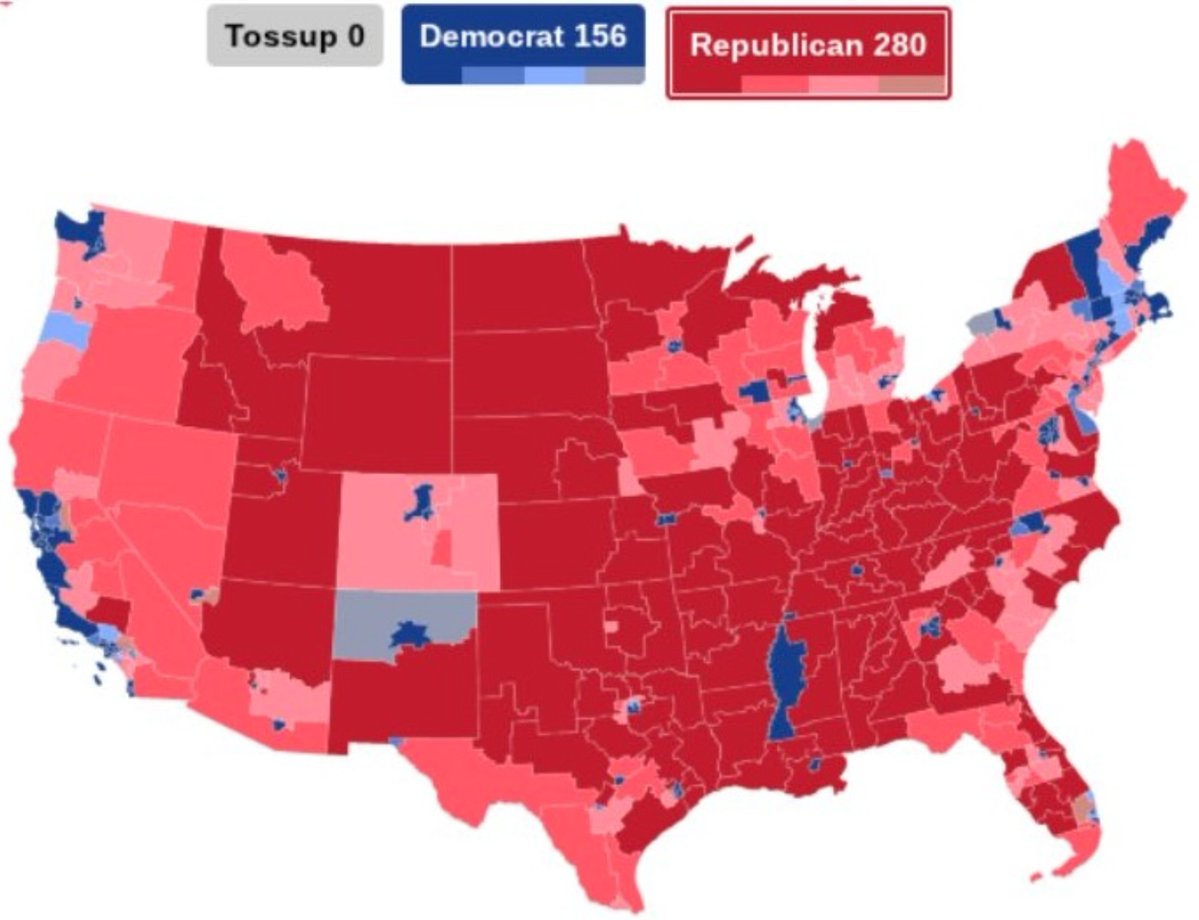
🚨 HERE'S THE CONGRESSIONAL MAP GROK COMES UP WITH IF YOU PUT IN THE FOLLOWING PROMPTS:
** Apportion seats by population (761,000 People Per District).
** Draw compact contiguous districts.
** No odd shapes. Districts should be as regular shapes as possible.
** No partisan considerations.
** No racial considerations.
** Draw districts as closely as possible to what America's founders envisioned when they wrote and ratified the Constitution of the United States.
THE RESULT:
We get 280 Republican-held seats to 156 Democrat-held seats.
Important goals of America's founders included that:
1) Rural areas not be subsumed by urban interests.
2) Big states not overrun the interests of small states.
You can do this exercise with any AI program: Chat GPT, Google Gemini, Claude, or Grok.
So the first real audit of the GA ballots and envelopes (not a recount) is beginning right now
At the highest levels of the DOJ with a couple of the heaviest hitters and some of the best audit Investigators on the planet
You'd think the left would be really excited bc they know we aren't going to find anything
and that we're all gonna be proven wrong and feel like a bunch of idiots with egg on our face, when we see that the voters were real people
they weren't fake mail in ballots, no digital images are missing and all signatures were in place.
Except they know that's not true and that my friends is why they are throwing a fit. Expect the attack to come hot and heavy.
I think the first thing we'll see happen are a couple of leaks about the ballots
After that, I think you'll see some lower level people from inside the Fulton County Arena, who are facing a 18 U.S.C. § 1512(c)(2) charge, a felony with a 20 year sentence in a federal penitentiary,
just fold and start giving names times and places