Today we’re announcing a finding that breaks a core assumption in AI: that bigger models are harder to understand.
We show the opposite. When interpretability is built into training, models become MORE understandable as they become more capable.
See our break down of CDE's architecture, design decisions, performance tradeoffs, and debugging tips in our latest blog: https://t.co/ft3eYm0vhy
Explore the open-source code: https://t.co/J2Cr1nq2ft
Designed by Muawiz Chaudhary (@ScatteringSepoy) and Andreas Madsen (@andreas_madsen).
#MLOps #DataScience
Introducing the Causal Diffusion Engine (CDE): the inference engine behind Steerling-8B.
CDE serves an interpretable diffusion LLM with concept explanations and steering alongside every generated token, with no added latency.
Interpretability doesn’t have to slow down inference.
Where CDE falls short: batching. Each block step waits on the slowest request in the batch, and the sampler adds GPU→CPU syncs.
Next up: a forward-step runner and a sync-free sampler, which should unlock big throughput gains
Join us in shaping actually interpretable AI.
Quick-start instructions (beginner, intermediate, advanced) and fully searchable details about GuideLoom: https://t.co/jIzPAfoNOR
💻 Code: https://t.co/rMcxLSjAw0
📦 PyPI: https://t.co/Hk1JsMBzY6
✍️ How we built GuideLoom: https://t.co/zIEslIY0FT
#InterpretableAI #MLOps #MachineLearning
It’s live: the first open-sourced dataloader for training interpretable language models at scale, GuideLoom.
We’ve been using it to train models ranging from 100M params → 32B params, and now it’s yours.
GuideLoom stores your data (as documents, token streams, or token streams with annotations on spans of tokens) + during training, a PyTorch DataLoader shuffles across the entire dataset, lets every GPU read its own samples in parallel, and resumes from the exact batch after a restart.
pip install guideloom[torch]
Introducing PRISM: Prototype Language Models, language models designed to make next token predictions traceable to the pre-training data in a single forward pass! We’ll be presenting at #COLM.
At Guide Labs we've discovered that first testing small-scale models can help estimate how a property changes with compute...we're setting the stage for a new paradigm of AI design.
Opacity isn't a law of nature.
Blog: https://t.co/CqxDHeWtKe
Full technical report: https://t.co/tl7CN789eX
#InterpretableAI #LLMOps
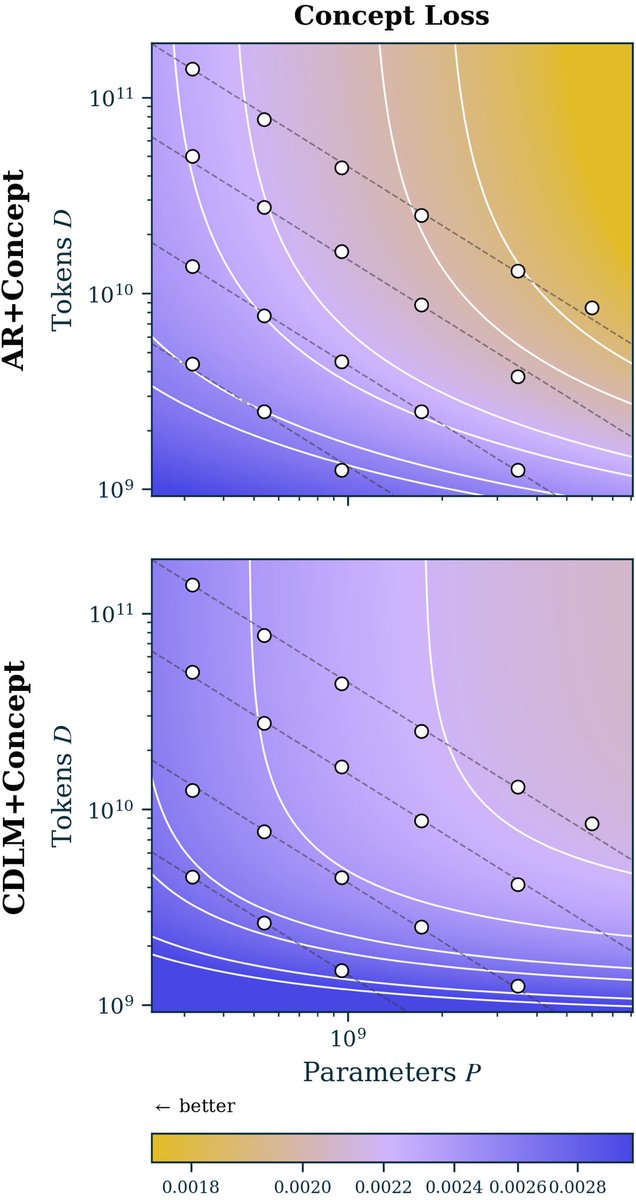
UPDATE: Steerling-8b has broken through the assumption that larger models + more data are harder to interpret →
Interpretability can be forecasted before an expensive run, and we can estimate ROI from params and data.
Instead of a black box you have to reverse-engineer afterward, Steerling-8b’s concept attribution has shown:
- the larger the interpretable model, the more disentangled its representations
- training more data makes the model’s representations more human-aligned
But a single compute number alone does not clarify how the effect of model size differs from the amount of training data. Equal-compute runs differ systematically.
Separating params v. tokens allows us to identify the impact of a specific interpretability property.
Both data + model size affect how much the model’s output depends on human-understandable concepts. When increasing compute, Steerling-8b routes a larger share of its prediction through its interpretable embeddings.