Becoming 1% better per day is 37 times better per year.
Saving ₦2,000 per day is ₦730,000 per year.
Posting one piece of content daily is 365 chances to go viral per year.
Reading 20 pages per day is 30 books per year.
Practicing your craft 30 minutes daily is 182 hours of mastery per year.
Small habits are underestimated.
This is what the Nigerian stock market looks like right now. 🇳🇬
Every bubble is a company. The bigger the bubble, the more money being traded.
That giant in the middle is FIRSTHOLDCO with ₦7.24 billion traded today alone.
This is not gambling. This is an entire economy moving in real time.
Are you in it or are you still watching from the side?
The Easiest Explanation of Market Indices in Nigeria
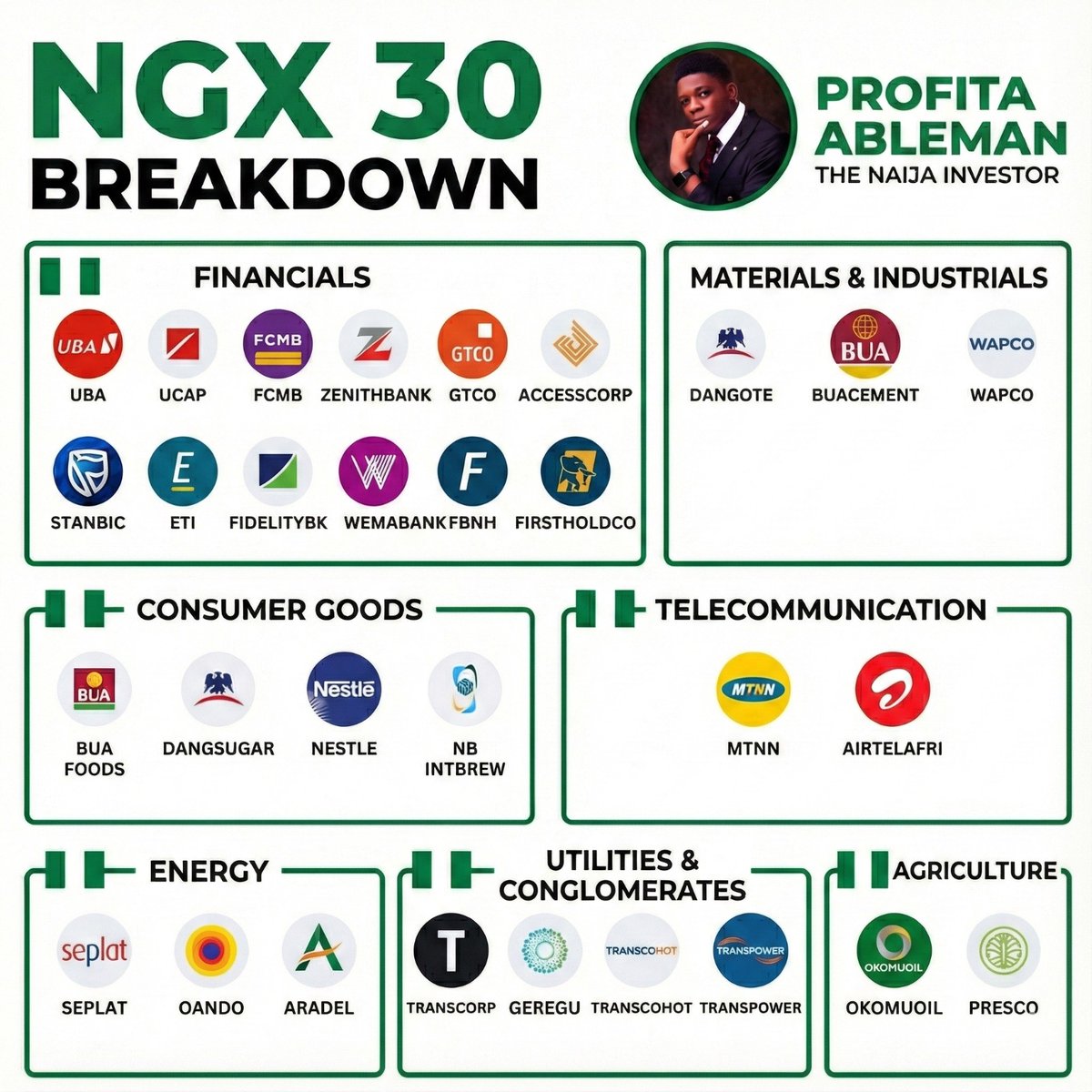
Terms like NGX30, NGX Banking Index, or NGX Oil and Gas Index and assume they are complicated.
A market index is simply a scorecard that helps you see how a group of companies is performing.
Think of it as a report that measures the strength of a particular section of the market.
CEO CASHOUT?
MD/CEO of Zichis Agro Allied Industries Plc just sold 5,000,000 shares worth over ₦183 million at ₦36.69/share.
Smart investors watch insider activity closely.
Chinese cars are flooding African markets, but skilled mechanics and spare parts are still scarce.
If you have the capital, start a Chinese auto spare parts business and open an institute to train existing mechanics on how to fix these vehicles.
You’ll make a lot of money.
PiggyVest vs Cowrywise.
PiggyVest started as a savings app that added investments. Cowrywise started as an investment platform that added savings. That difference tells you where each one is strongest before you even open the app.
Current rates
PiggyVest:
PiggyBank - 18% per annum. SafeLock - up to 22% per annum, paid upfront the moment you lock.
Cowrywise:
ARM Money Market Fund currently yielding approximately 24 to 26% annually. Returns move daily with CBN MPR.
Let me is this instance:
If you save on N500,000 over 12 months
PiggyVest SafeLock at 22%: N110,000 interest. Total: N610,000.
Cowrywise Money Market at 24%: N120,000 interest. Total: N620,000.
Cowrywise Money Market at 26%: N130,000 interest. Total: N630,000.
Cowrywise wins on return. The gap is real and it compounds.
The math on N1,000,000 split across both
N500,000 in PiggyVest SafeLock at 22%: N110,000.
N500,000 in Cowrywise Money Market at 25%: N125,000.
Combined return: N235,000 on N1,000,000 in 12 months. That is money working while you sleep.
Liquidity
PiggyVest SafeLock cannot be broken before maturity. Breaking it means forfeiting every kobo of interest earned. That is the point. It protects you from yourself.
Cowrywise Emergency Plan lets you access funds within 24 hours if life happens. More flexible.
Dollar savings
PiggyVest Flex Dollar pays up to 7% per annum. Cowrywise dollar mutual funds offer comparable or slightly better yields. Check both on the day you are ready to move.
Minimum to start
Cowrywise accepts as little as N1,000 in naira funds or $10 in dollar funds. PiggyVest has no meaningful barrier either. You can start both today regardless of how small your capital is.
Security
Cowrywise is SEC regulated with funds held by Zenith Nominees. PiggyVest is CBN licensed and insured. Both are legitimate. Neither is a scheme.
My verdict
Use PiggyVest SafeLock for emergency funds, short term goals, and financial discipline. The upfront interest and lock feature are genuinely powerful.
Use Cowrywise for investment capital you want earning maximum naira returns inside a regulated mutual fund with real asset managers behind it.
The smartest move is not choosing between them. It is using both intentionally with different roles in your portfolio.
Rates are dynamic and move with CBN decisions. Always confirm current rates on both apps before committing capital. Not financial advice.
There are several asset management firms offering mutual funds for you to invest in.
As a Muslim, it’s important for you to confirm that you are investing in their shariah compliant option, especially when using a conventional asset management firm like Stanbic, United Capital, Arm asset mgt etc
An alternative will be to invest with a non-interest asset management firm, the likes of One17, Marble Capital, Lotus Capital etc.
Suggested five stocks for students:
Wema Bank
TIP
Lafarge Africa (WAPCO)
GTCO / Zenith Bank
MTN Nigeria
These stocks offer a good combination of dividend-paying companies and dividend growth opportunities, making them suitable for students who want to start building long-term wealth while earning passive income.
Dangote Cement is planning a dual listing on the London Stock Exchange. A $13 billion Nigerian company about to sit alongside BP, Shell and Unilever. Let that sink in.
10% of shares will be sold to international investors. Citigroup, JPMorgan and Standard Bank are already advising. Listing could happen by September.
This same company made ₦421 billion profit in Q1 2026 alone. Full year 2025 profit was ₦1.53 trillion, up 109%. The stock is already up 70% this year.
And Dangote isn’t stopping there. He’s also planning to list the refinery on the NGX, offering a 15% stake.
This is what building in Africa looks like.
Aliko Dangote just announced plans to invest in 20,000 MW of power generation in Nigeria.
For context: Nigeria’s entire grid delivers just ~4,300 MW to 220 million people.
One man is planning to outproduce the state by nearly 5x.
This isn’t philanthropy, it’s strategy. His refinery, cement plants and fertilizer empire bleed cash on diesel and an unreliable grid. Owning 20,000 MW means cheaper energy, captive supply, and a moat no competitor in Africa can cross.
When the state fails to deliver, the biggest private players stop lobbying and start building. Dangote is becoming a sovereign function in everything but name.
Will it feed the grid or just power his empire? Either way, it changes Nigeria.
FirstHoldCo Plc has tabled plans to raise up to N253 billion in fresh capital, a move aimed at taking its total share capital and share premium to N1 trillion. https://t.co/ZqOzqEmQ3D
Why do I think the pressured 🇳🇬 banks will bounce back?
This is the question on everyone’s mind. I like to think that what we are seeing is banks going through a balance sheet clean-up cycle.
Almost all the major banks recorded significant impairment charges in 2025:
• Zenith Bank – ₦742 billion
• UBA – ₦331 billion
• First HoldCo – ₦826.3 billion
• Access – ₦523 billion
• GTCO – ₦66 billion
Out of the five Tier-1 banks, only GTCO declared a dividend. That should raise eyebrows, but perhaps not for too long.
These banks needed to bite the bullet and stop carrying bad loans on their books. Painful as it was, the clean-up was necessary.
So, what is the recovery path?
Let’s look at the numbers.
The core earnings of these banks are still relatively strong. Combined interest income rose by 17.66% to ₦14.49 trillion, up from ₦12.31 trillion in 2024.
UBA and GTCO generated more income from investments in securities than from lending. However, Access, First HoldCo, and Zenith Bank still earn more from lending than from securities.
That said, the gap is narrowing as banks continue to increase their exposure to government securities. For instance, Zenith Bank recorded higher securities income in Q1 2026 than it did in Q1 2025.
Looking at the cash flow statements in Q1 2026, First HoldCo and UBA both recorded negative cash flows. However, for banks, negative operating cash flow does not always signal weakness the way it would for non-financial companies. In some cases, negative operating cash flow may simply reflect aggressive asset growth or temporary liquidity positioning. Still, it is something we should monitor closely (let's see their Q2 results)
Bottom line:
The core earnings of these banks are still relatively stable (although Access Bank may raise some concerns).
• A huge chunk of bad loans have been cleared
• Banks are fully recapitalized
• Balance sheets are becoming cleaner and more transparent.
That creates a stronger foundation for future growth.
So, while the pressure is real today, I believe the recovery of these banks is inevitable. It is only a matter of time.
I don't enjoy having these conversations tbh.
If giving out loans is more attractive than holding T-bills, these banks will gladly do it.
Good Banks are run to reflect the present economic reality.
Instead of telling the banks to stop holding T-bills (which the government benefits anyway), why not reduce the incentive and watch banks adjust to the reality.
It's that simple.
Stock investing is a game of volume.
If you have just ₦500K to invest, don’t spread it too thin by buying 20 different companies. That is ₦25K in each stock.
Even if all those companies have solid fundamentals, you’ll get more value by focusing on fewer picks. A good rule of thumb is to stick to focus on <10 companies.
As you grow your portfolio, keep building within that range. If you want to add new high-potential stocks, sell off your weakest performer and rotate into stronger ones. That way, your money is working harder for you, and you’re not just collecting plenty of “token” holdings that don’t really move the needle.