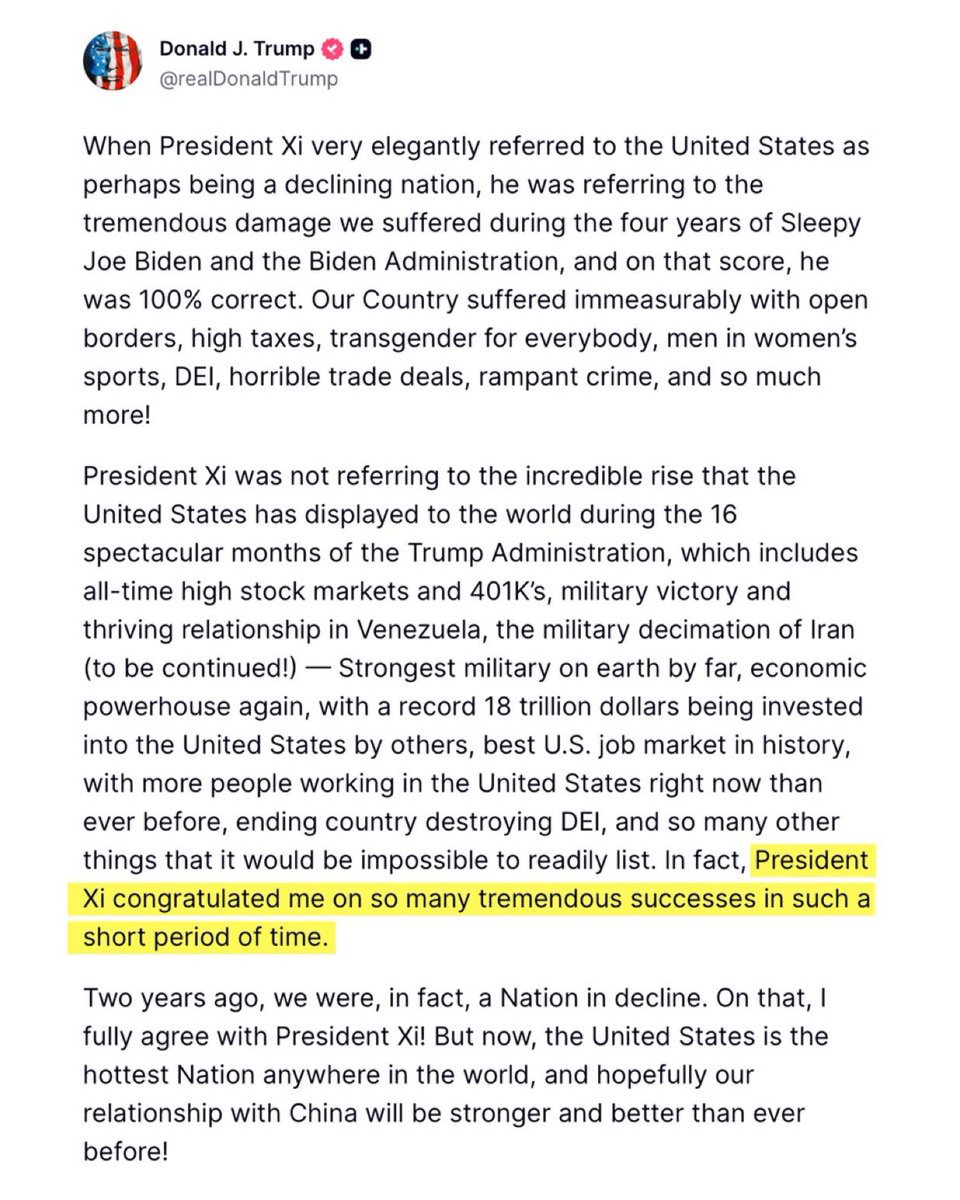
The expression often used by Xi, “the East is rising and the West is declining,” was commented on by Trump in a post where the American president claimed that Xi considered the U.S. a “nation in decline” due to the previous administration’s policies (Biden).
He added that now, under his new management, Xi is supposedly “impressed” with the American recovery. Just between us, Trump proved Xi right when he rebutted the Chinese statement in such a superficial way, failing to understand that the Chinese are referring to an entire era that goes far beyond economics.
But what can be done about it? It would require a whole structural shift in thinking, and on several fronts: less militarism and more global investment ties. China is catalyzing the West’s decline with a broad network of global investments, which contrasts sharply with the inertia in Europe and America caused by political crisis.
Thank you Emma Confrere for this excellent article on Mixue… yet another Chinese success story.
Mixue reflects a broader shift in China’s consumer sector. Competitive advantage is increasingly driven by operational design, supply chain strength, speed and scale, rather than traditional brand building logic. Luckin Coffee, which has overtaken Starbucks in China, along with Shein, Miniso, Pop Mart and Proya all follow a similar pattern. This stands in sharp contrast to Western models, which have traditionally been built around brand storytelling.
At its core, low cost is often misunderstood. It reflects not weakness, but a high degree of operational sophistication.
This shift is also making China one of the world’s leading talent pools for industrial and logistics capabilities, something many Western players would do well to reflect on.
🇫🇷🇺🇸🇺🇦 French analyst Emmanuel Todd, says that the US' defeat in Ukraine isn't like Afghanistan or Iraq but that it represents what he calls "America's first major strategic defeat of its history."
Global Wealth and Power are Pivoting to the East
History’s wheel is turning. China builds, India rises, BRICS surpasses the G7—while America punishes allies and empowers its Enemies.
In the West, the year 1492 is remembered for two episodes: Columbus’s arrival in the Americas and the fall of Granada, last stronghold of Moorish Spain. But its larger consequence was geopolitical: the compass needle swung westward, ushering in a centuries long reversal in global fortunes.
Wealth that once streamed toward Asia turned into rivers feeding Europe’s ascent.
Silver, gold, sugar, and spices from the Americas acted like jet fuel. They powered science, industry, and empire. Spain, France, Britain, and the Netherlands—naval and commercial predators—rose on the tide, hollowing out the Ottoman world and diverting trade from India and China to the New World.
Today another hinge of history is swinging. Washington’s unspoken fear of a 21st century turn is no less dramatic: economic gravity shifts eastward, led by China and—critically—India.
Beijing’s gamble in the 1990s—to let capitalism breathe, to draw in foreign capital, and to pour trillions into domestic infrastructure—proved as consequential as a century of US industrial growth.
The Belt and Road Initiative, worth more than $1 trillion, is less an infrastructure plan than a circulatory system of steel and concrete veins, designed to redirect the lifeblood of trade back across Asia, Africa, and the Middle East.
In contrast, Washington failed to invest in fast sealift or high speed rail, leaning too heavily on military power.
For the last 25 years, America exhausted itself in deserts and mountains, fighting costly wars that drained trillions, cost thousands of U.S. lives—yet delivered little of enduring strategic value.
Worse still, the technology of war is no longer America’s private domain. Precision strikes, robotics, artificial intelligence, persistent surveillance from seabed to space—once rare advantages—are now widely available, even to mid range powers.
The oceans that once carried American commerce and projected US power have become potential minefields. To move lumbering, World War II style forces across the Pacific, Atlantic, or Indian Oceans today is not just dangerous. It borders on suicidal behavior.
History’s cruel truth remains: the last major war seldom looks like the next.
The battle-space of the future is uncharted, yet America’s Armed Forces and its National Military Strategy remain deeply mired in the past.
The erosion of U.S. military advantage cannot be viewed in isolation; it reflects the widening gap between Washington’s appetite for global hegemony and America’s declining economic strength.
Partly because of Washington’s exhaustion, India has been forced to pick up the slack as a net security provider in the Indian Ocean.
At the same time, India has borne the brunt of fighting Pakistan backed insurgents, incurring heavy casualties just as America did.
India is a member of the Quad alliance with the US, Japan, and Australia, and the United States conducts more military exercises with India than with any other country.
Yet Washington recently imposed duties of 50% on Indian goods—more than double the 15% rate applied to Taliban run Afghanistan and far higher than the 19% levied on Pakistan.
This, even though both regimes sheltered and enabled militant networks that killed American soldiers for twenty years. The paradox is beyond belief: the firefighter is fined more heavily than the arsonist.
At the same time, India carries an outstanding $35 billion order book for Boeing passenger jets supporting 150,000 American manufacturing jobs in Charleston, South Carolina, and Everett, Washington. Yet India is penalized at America’s border.
The deeper problem for the United States is structural. Military dominance can no longer disguise economic erosion. According to the IMF, BRICS now outweighs the G7 in global GDP.
Measured by purchasing power parity (PPP), China’s economy is worth $40.7 trillion, India’s $20.5 trillion, while the U.S. stands at just $29 trillion.
China and India together: $61.2 trillion — more than double the U.S. total. This is not a forecast. It is today’s reality.
The turning point came in 2022, when Washington responded to Russia’s invasion of Ukraine with sweeping sanctions.
The effect of weaponizing the Dollar was profound. The dollar looked less like a safe harbor and more like a trapdoor.
From Riyadh to Delhi, from Brasília to Beijing, capitals saw the risk of conducting commerce in a currency that could be switched off at will. De-dollarization, once a theoretical debate, became urgent strategy.
No surprise, then, that nations across Africa, the Middle East, and Latin America line up to join BRICS and the Shanghai Cooperation Organization (SCO).
They are dissatisfied with a Western order they view as inequitable and extractive. India straddles both worlds—deepening its bond with Washington through the Quad while cultivating ties with Moscow and Beijing in BRICS and the SCO.
Prime Minister Modi’s presence at the recent SCO summit in Beijing alongside President Xi and President Putin reminded Washington that India’s compass will not lock on one direction.
History’s lesson is clear. Trade routes form habits: habits build markets; and markets endure longer than armies. Empire is not lost in a single battle but in the slow corrosion of those habits.
The Ottomans discovered this too late. Nations that consume more than they produce, that intimidate rather than innovate, ultimately sow the seeds of their own decline.
The dollar’s dominance is already eroding. Trade settlements in yuan, rupees, and other currencies increase by the month. The shift is not only monetary: it is strategic.
But the world should remember what American innovation can achieve. From the heartland came inventions and technologies that transformed global life in the last century—from aviation to semiconductors, from biotechnology to the digital revolution.
These capacities still command respect, and if revitalized, they can once again help anchor U.S. prosperity in a multipolar age.
History’s wheel is turning again. Some nations will rise with it. Others risk being crushed beneath its weight.
If Washington seizes the opportunity to adapt—if it makes its business inside the new global order one of commerce and trade rather than unrelenting military intervention—Americans may yet avoid the fate of the Ottomans. But the course correction cannot come soon enough.
🇨🇳 Beijing to spend 1 trillion yuan on developing artificial intelligence technologies
China immediately responded to Trump's recent announcement of huge US investments in projects related to AI development (about $100 billion with a gradual increase to $500 billion).
But if in the US this is a story about private business, then China at the state level has obliged the Bank of China to allocate 1 trillion yuan (about $137 billion).
The funds will be used to:
- Development of new technologies in the field of strong AI (AGI) .
- Modernization of infrastructure for AI research and implementation.
- Creating international partnerships aimed at expanding Chinese technologies .
REFERENCE: The so-called strong AI (AGI) is the next stage of technology development.
Artificial Narrow Intelligence (ANI) — solves one problem, specializes in one area (AI as we know it).
Artificial General Intelligence (AGI) - instantly solves most of the diverse tasks that a person is capable of.
China already leads in a number of tech areas, including AI surveillance, e-commerce algorithms, and Big Data developments. Research estimates that the global AI market will reach $15 trillion by 2030.
The competition in the AI sphere between the two largest economies in the world has long gone beyond technological or economic rivalry. Now it can be regarded as a new global geopolitical confrontation, because in the near future fast and accurate calculations of huge amounts of data will be in demand and possible all over the world. But whose technologies and calculation models will be used to perform the calculations will be shown by the result of this confrontation.
And it seems good that artificial intelligence, which over time can replace most officials and economists, doesn’t give a damn about Korkunov and other weaknesses of human nature, but in whose favor will foreign AI (be it the US or China) make its calculations and give recommendations is a rather interesting question.
dva_majors
Liang Wenfeng, DeepSeek's founder, built his career and education 100% in China—no US, no overseas detour.
This is China’s future: homegrown talent leading the way. 🇨🇳 #ChinaInnovation#HomegrownLeadership
Goodbye ChatGPT
It’s only been 5 days since Deepseek R1 dropped, and the World is already blown away by its potential.
13 examples that will blow your mind (Don't miss the 5th one):