Your AI agent can now learn the entire Hashnode GraphQL API in one command:
npx skills add Hashnode/gql-skill
Every query, every mutation, auth, and which ops need Pro. Works with Claude Code, Cursor, Copilot, and more.
🔗 https://t.co/s0AG9S2Z1g
Mac keyboard shortcuts look like sixty unrelated key combos. Most of them are one system that macOS inherited from Emacs through NeXTSTEP, and Apple documents the bindings without ever mentioning where they came from.
That framing changes how you learn them. Control+A, Control+E, and Control+K move and delete the same way in a Slack message, a Safari address bar, and any native text field. One model, applied everywhere, with two predictable breakpoints: terminals, where Control+D ends your shell instead of deleting forward, and Electron apps.
The underrated one: Command+Backtick cycles between windows of the same app. Most developers alt-tab past the window they want daily without knowing it exists.
https://t.co/zWICJVYoMf
MCP's new revision removes protocol-level sessions, the initialize handshake, and SSE resumability. The reasoning is sound: stateless requests mean load balancers and gateways can route MCP traffic without sticky sessions.
The migration is the hard part. It breaks in both directions. A new client against an old server fails, and an old client against a new server fails differently, with unexplained 400s on one side and silently wrong semantics on the other.
The SDKs make it concrete: TypeScript v2 shipped on 28 July, Python is still on a release candidate. A TypeScript v2 server with a Python v1 client fails today, not in some future deprecation window.
Roots, Sampling, and Logging also start a twelve-month deprecation clock, and the spec's suggested replacements are notable: pass directories as tool parameters, call your LLM provider directly, write logs to stderr. A protocol telling you to route around its own abstractions has learned something.
What breaks and how to migrate, on both sides: https://t.co/e5UDwvuRkO
Two things about Claude Opus 5 that most coverage got wrong.
It isn't a price cut. Opus 5 costs $5/$25 per million tokens, exactly what Opus 4.8 cost. "Cheaper frontier model" compares it against Fable 5 at $10/$50, which is a tier difference, not a discount.
And the effort parameter has five levels, not three. The bigger catch: switching effort mid-conversation invalidates your prompt cache. A low-effort request that misses cache costs 38% more than a high-effort one that hits it, so toggling effort per request to save money can do the opposite.
Even when it works, effort cuts output tokens only. A 40% output reduction saves 18% on a write-heavy workload and 3.6% on a read-heavy one.
https://t.co/mSAZ8WsxC3
Kimi K3 came first in the Frontend Code Arena, ahead of Claude Fable 5 and GPT-5.6 Sol. Push a million tokens each way and K3 bills $18 where Fable 5 bills $60.
The "largest open-source model ever" framing is premature though. Moonshot hasn't published the licence, and as of 27 July there's no K3 repo on their Hugging Face. K2's licence was modified MIT, not MIT, so anyone planning commercial use is guessing.
Also worth knowing before you get excited about self-hosting: the weights alone need ~1.4 TB of GPU memory. The $3/$15 API undercuts the hardware for almost everyone.
https://t.co/HP9Pa4ZNQ2
LLM rate cards hide the two rules that actually move invoices.
Anthropic's models from 4.7 onward tokenize about 30% heavier. Same listed price, ~30% bigger bill, invisible unless you log token counts.
And long context: OpenAI and Google surcharge it (2x input, 1.5x output past a threshold), Anthropic doesn't. GPT-5.6 Sol is 9% pricier than Opus 5 on a normal coding request. Feed both a 300K-token repo and Sol costs $3.09 against Opus 5's $1.55.
The vendor rankings flip depending on your workload shape. Verified rates for 12 models: https://t.co/wNvY6PkQhw
Hashnode now has an official skill for AI agents.
npx skills add Hashnode/gql-skill
That's it. Claude Code, Cursor, or Copilot can publish to your blog, edit old posts, manage drafts, upload cover images.
Why a skill instead of just pointing agents at our GraphQL docs? Because agents kept getting the details wrong. They'd paste access tokens into chat, retry calls that were never going to succeed, ask a feed for 500 posts when the API caps a page at 100. The skill bakes those rules in, so the first request works.
Write your draft wherever you write. Then: "publish this to my Hashnode blog."
https://t.co/KFtUFXA289
Every post on Hashnode now has a "View as Markdown" button.
One click, raw markdown, ready to paste into your editor, your notes, or your favorite LLM.
Read the post. Grab the source. No scraping required.
How it works :
Send "Accept: text/markdown", and the article URL returns markdown instead of the rendered page.
Agents that ask for markdown get markdown; everyone else gets HTML.
Humans can try it too.
Add .md to any article URL:
https://t.co/IqLfAGuUPO
Every Hashnode article just became agent-compatible.
AI tools now get a clean markdown version of any article, served through content negotiation. No setup, nothing for the author to do.
Your writing now reaches both humans and the agents they rely on. ✍️
🔗https://t.co/PhJp5m6xNS
A brand-new blog starts with zero search authority. An article on Hashnode doesn't.
It ranks in search and gets cited by AI engines from day one. Hashnode Pro builds on that reach:
→ Your own custom domain
→ GraphQL API and headless mode
→ AI writing tools in the editor
→ Webhooks, GitHub backup, bulk import
→ Hashnode branding removed
Today we rebuilt Hashnode around the one thing that matters most: your writing.
Log in and you land on your drafts, articles, and publications. The feed now lives at /feed.
Cleaner design, dark mode by default.
🔗 https://t.co/tOgIDvXeUw
🚀In case you missed it: Hashnode Pro is live.
Your blog, leveled up. Custom domains, the GraphQL API, headless mode, AI writing assist, webhooks, GitHub backup, scheduled publishing, and many more
Pay monthly, or save with an annual plan. Upgrade in seconds from your dashboard 👇
https://t.co/46IL4PwddA
We're aware of an issue affecting draft creation right now.
Our team is investigating and working on a fix. We'll share an update as soon as we have one.
Thanks for your patience.
🚀In case you missed it: Hashnode Pro is live.
Your blog, leveled up. Custom domains, the GraphQL API, headless mode, AI writing assist, webhooks, GitHub backup, scheduled publishing, and many more
Pay monthly, or save with an annual plan. Upgrade in seconds from your dashboard 👇
https://t.co/46IL4PwddA
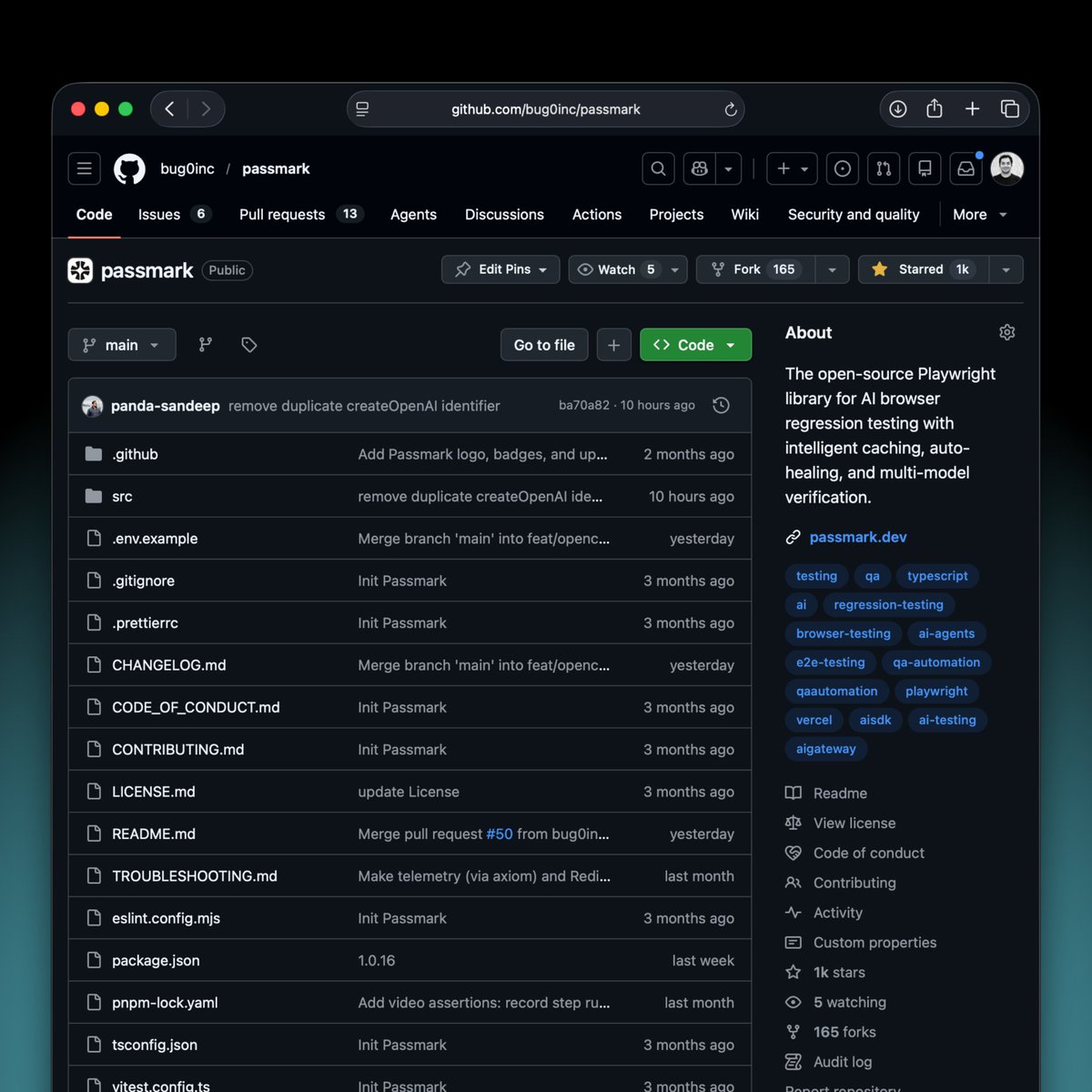
new in passmark 1.0.14: video assertions.
- set video: true on an assertion.
- passmark records the test and runs assertions
- captures toasts, snackbars, or anything a single screenshot misses.
(thanks to page.screencast in @playwrightweb 1.59)
https://t.co/BAgRgrvrJx