Unfortunately, hospitals are gaming the current system outlined in executive orders and department regulations. As a result, "A large portion of middle-class wealth in America is just locked up in hospital cash reserves."
https://t.co/BkXdHO4g5Y
Today, along with 31 fellow economists from across the political spectrum, I sent a letter to the US Senate urging action on the Braun-Sanders bill to codify in law a requirement for hospitals to post actual prices.
https://t.co/ouxDZ5kMh8
If true transparency were unleashed, the savings that could be achieved by open competition in the healthcare market would be astronomical-- as much as $1 trillion. See the full letter here:
https://t.co/ouxDZ5kMh8
💼 Profit margins tell a revealing story. Hospitals (both for-profit and nonprofit) consistently have higher profit margins than insurance companies. This suggests that hospital pricing plays a big role in driving up insurance premiums. 6/10
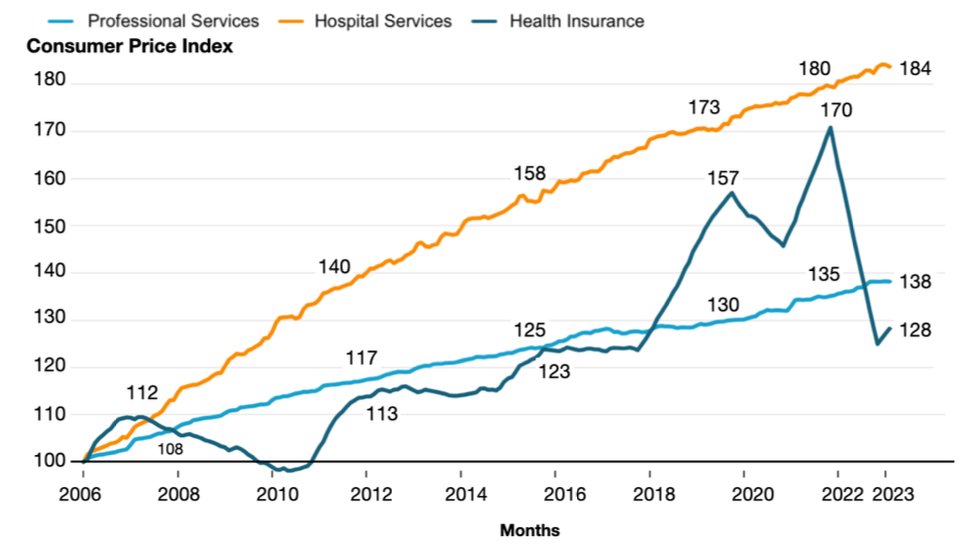
🏥Hospital prices are rising faster than insurance premiums and professional services. From 2006 to 2023, the hospital price index shot up significantly, leading the charge in overall healthcare cost increases. 4/10
💵 First things first: Let’s get the numbers! Since 1999, family premiums have increased by 314%, while workers' contributions have soared by 326%! Meanwhile, wages? Only a 111% rise. 2/10
🚨📈 Over the past 25 years, the cost of employer-sponsored health insurance has skyrocketed! But why is this happening? In a recent #HAScholar@Health_Affairs piece, Vivian Ho (@HealthEconTX) & I do some investigation. 1/10 🧵
@jsuliburk gave us the idea for this paper, @sbmcclure helped us get the data, and @mauracoughlin and Marah Short were the analytic experts. Important findings for large cities that need to insure adequate trauma care when money is tight.
JUST OUT: Do hospital trauma center upgrades lead to better outcomes for patients?@MauraCoughlin, Marah Short, @SBMCCLURE, @jsuliburk, & @HealthEconTX’s working paper studies Texas insurance claims to track changes in spending, mortality, & readmissions. https://t.co/6EOqLlS0VD
@Soleil_Shah and @tradeoffspod featured our @Health_Affairs paper finding that nonprofit hospitals with more profits raise their cash reserves, but not charity care.
From 2012 to 2019, nonprofit hospitals increased their average profits by $16 million per hospital.
What happened to their charity care spending?
This week on @tradeoffspod, I break down a new @Health_Affairs paper by @HealthEconTX on this topic.
https://t.co/W39zkaNAv0
@DrZackaryBerger @_Eric_Reinhart It's not in the article appendix. Eric is pulling the numbers straight from the online NASHP Hospital Cost Tool, which is where the data comes from.
@_Eric_Reinhart Here are some of the #'s for 2019 (the last year of our study sample) :
Cash Reserves/Charity Care/Operating Profit
NYU Langone $3.0b/15.7m/579m
NY Presbyterian $8.3b/43.2m/1.1b
Stanford Health Care $4.0b/33.8b/1.5b
Houston Methodist $5.8b/45.8b/590m
Here are some of the #'s for 2019 (the last year of our study sample) :
Cash Reserves/Charity Care/Operating Profit
NYU Langone $3.0b/15.7m/579m
NY Presbyterian $8.3b/43.2m/1.1b
Stanford Health Care $4.0b/33.8b/1.5b
Houston Methodist $5.8b/45.8b/590m