@YouTube is taking another step towards becoming TV faster than TV can become YouTube.
Last week, YouTube announced the largest hard bundle of any US streamer. Starting in Q1'27, every US YouTube Premium subscriber will get Peacock Premium at no additional cost: @NFL games, theatrical movies, Real Housewives, Law & Order, SNL, either through authentication or native ingestion in the YouTube app.
Why it matters to both sides, as well as competitors:
For @peacock, it's their largest wholesale partnership to date. We estimate it will add ~20M US subs to Peacock at launch, potentially pushing them past 70M vs Netflix's 86M US subs.
For YouTube, it's the third "yes and" transformation. Just as YouTube moved into TVs without losing ground on mobile, and created a massive subscription business without losing ground on advertising, they are now adding premium TV, Film and sports without losing ground with creators.
The deal has the potential to do for YouTube Premium what NFL Sunday Ticket did for YouTube TV. But about the timing, and the economics? And how is this different from a typical cross-company bundle or an Amazon Channels distribution deal? All your questions answered in this week's issue of Streamonomics (link under my name).
Which streamer do you think is next to do a similar agreement with YouTube and when?
@netflix says engagement is now about "quality, variety, quantity." I expect a new question will come up: incrementality.
We've been crunching numbers, statements, and talking to people for the third edition of "What We Watched: Streamonomics" (out this week as a deck, with added context in the newsletter). Investors are trying to decide whether Netflix can reaccelerate revenue through a series of incremental steps. Podcasts, live, pricing and free tests, becoming a platform for other streamers.
Video podcasts are "definitely incremental" per Ted Sarandos, capturing daytime viewing and over-indexing on mobile. Licensed content continues to be more cost-efficient than originals. But are these new hours, or simply hours shifting from one content bucket to another?
The bigger picture:
→ Licensed content now leads originals in viewing hours, as Netflix is adding more new licensed titles than before.
→ For the most successful originals, second-seasons are retaining audiences at rates consistent with last year.
→ @YouTube, @instagram and TikTok are the only three scaled video platforms with more viewing hours and growing faster than Netflix - and all three are mostly free. To compete with them, Netflix has a narrow set of options.
This week's Streamonomics includes Owl & Co's proprietary analysis of What We Watched, with additional data points on engagement per subscriber, what share of sign-ups those live events are driving, and which shows added viewing hours. What content category do you think delivers the most incremental viewers for Netflix?
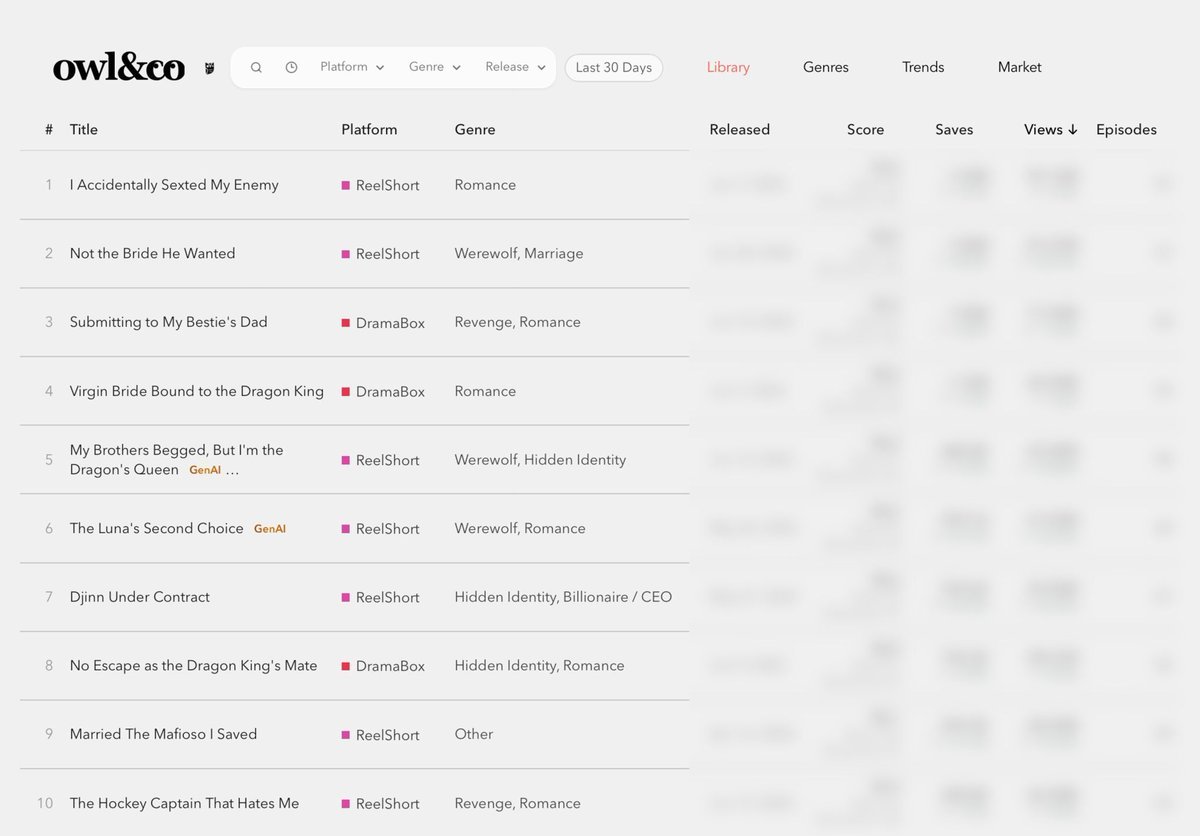
Owl & Co's Vertical Index is now tracking 30,000 microdrama titles across 10 apps: Views. Genres. Whether they're AI-generated. Release cadence and volume. No one else has this data.
The top 10 most-viewed microdramas over the last 30 days tell a familiar story: all from @ReelShort_TV and @DramaBoxer, the same way any SVOD original ranking three years ago was a sea of @netflix shows.
But since we started tracking TikTok's microdrama app, PineDrama, the leaderboard changed. Notably, the platform is free, ad-supported, and aggregates views across two apps (although that makes comparisons trickier: Vertical Index clients can toggle any included platform on or off).
This is what platform shifts look like before everyone notices them. As I wrote recently for @Variety, Vertical Video is the third audiovisual language, now worth $150B. Microdramas are to vertical what soap operas were to TVs in the 50s. Vertical news, comedy, reality, documentary, animation are already emerging.
As Netflix kicks off the Q2 earnings season this week, I expect they won't be alone in getting questions or making comments about vertical video. Which format do you think breaks through next?
@benfritz@jtoonkel “Shows and films from a certain genre” they wouldn’t share with you, or they were embarrassed to see in print? I struggle to think of a genre they don’t carry 🤔
Next Friday I'm taking my family to see Christopher Nolan's The Odyssey. Phones off, full attention on a giant screen, the shared experience film was built to deliver.
Christopher's brother Jonathan pivoted to cinematic TV (Westworld, Fallout), where value compounds over multiple episodes rather than scarcity.
But there's a third language now, and few from TV and film are speaking it yet. I first called Vertical the third audiovisual language in 2025: not a format, or genre, or aspect ratio. The thesis has only sharpened since.
Vertical video has its own talent, aesthetics and economics. Outside China it's on track for $150 billion in revenue this year. @Meta's Reels alone ran $50B last fall, more than @netflix's entire global business. @amazon, Alphabet, @comcast, @Disney, Meta, Netflix and @ParamountPics all called out their vertical products or announced new ones during the Q1 earnings season. As questions about engagement are top of mind in Q2, expect more attention.
None of this threatens The Odyssey. The mistake isn't betting on film, or television, or the phone. It's believing there are only two languages worth speaking.
My full argument is in Variety: https://t.co/nV9ILoKhfG
Which of the leading streamers do you think figures out vertical first?
From Hollywood to Wall Street, everyone is talking about @netflix's engagement.
Wells Fargo called the stock a "fallen angel" last week: forward P/E at -2 standard deviations below the 2023-current average. Investors are worried engagement is slowing as a harbinger of long-term revenue growth slowing. @Lucas_Shaw on Sunday reported that viewers are dropping off in between seasons - which as Streamonomics readers know, is more of a challenge for Netflix because of its over reliance on serialized shows.
In this week's Streamonomics, I analyze some of the data behind the concern. Our preliminary findings indicate Netflix Top 10 viewing hours declined ~4% YoY in 1H26 (though doesn't mean overall viewership has dropped as much, or at all). We've observed only 11 shows crossed 100 million viewing hours in a month, and only two crossed 200 million. Meanwhile, @instagram and TikTok are adding time spent at a neck breaking pace.
Netflix will release its 1H26 "What We Watched Report" next week with Q2 earnings. We've been tracking their self-reported viewership since 2021, and we're already preparing our next analysis for Owl & Co clients.
Two years ago this month, I sent the first issue of Streamonomics to a handful of people who had signed up before it even had a name. Sixty issues later, the number of readers has grown exponentially. There's a team and a data practice behind it now, with the same rigor we bring to client work. Thank you for following along.
Netflix has found its way out of every rut they've had, ultimately coming back stronger. For one, I expect them to still report record revenue and profits and raise guidance. What do you think Netflix does first to turn this around?
@businessbarista Don’t forget Level 0, “there’s a problem but I won’t tell anyone because [multiple options, could be employee or company/boss related]”
Nearly six years after Quibi’s collapse, Vanity Fair speaks with the creators, producers, and executives turning Jeffrey Katzenberg’s idea for vertical video apps into a $150 billion business—and Hollywood’s newest farm system https://t.co/Z4IZR24cL6
TV never had a scalable way to go after SMBs, the way Meta and Google do. That's changing: Walmart's $1.4B deal to acquire https://t.co/JNnA0ZZuJ3 follows Pinterest's acquisition of tvScientific.
Ten companies capture ~60% of US podcast ad revenue, and there's a vibrant long tail under them. What do the fastest-growing ones have in common, and what is a podcast publisher worth?
The Global Podcast Economy Report from Owl & Co, now in its second year, maps what most models miss: video revenue, consumer support, and the ancillary lines that rarely make it into a pitch deck.
The public edition has been quoted by @Bloomberg and multiple fundraising decks. The subscriber edition provides the answers that drive deals:
→ The 10 companies capturing ~60% of US ad revenue, and their direct vs programmatic mix.
→ Where the ~40% long tail sits, and who's positioned to consolidate it.
→ Implied revenue multiples by archetype, and the valuation logic behind recent deals.
→ How $2B+ in consumer revenue is actually flowing: @Patreon, publisher-direct, or platform premium.
→ What's accelerating, what's saturating, and what's stuck at the vertical level.
Built from 300,000+ data points across 1,600+ publishers and conversations with 100+ operators and experts worldwide. Available for individuals, teams (companies under 1,000 employees), and enterprise (link in comments.)
If you're making bets on podcast M&A, positioning for an exit, sizing the market for a client, trying to go after individual shows, or figuring out where your company sits in the competitive stack, this is the data set.
What question about the podcast space are you most interested in?
The attention economy added $2.6T in enterprise value over the last three months. The scoreboard is green, and maybe that's the problem.
In this week's Streamonomics, my half-year report on what I wrote in December: what played out, what didn't, and what's shifting underneath the surface while everyone's celebrating record streaming profits and a box office running 14% ahead of last year.
What's inside:
→ The Attention 20 index: @Disney's EV is now 70% of @netflix's (up from 51% in April). AppLovin has closed to 95% of Comcast's.
→ @instagram's TV play: Yesterday's announcement of horizontal video, episodic content, and Samsung TV rollout (and why I predicted eight months ago they'd eventually need to license TV and film to make a meaningful dent)
→ Vertical video on track for $150B in revenue globally ex-China this year.
→ AI on the Lot drew 2,000+ attendees last month, a barometer for enthusiasm and acceptance of AI solutions in Hollywood. Studios stay careful in public, but the use cases keep growing in private.
→ Fox's $22B @Roku deal, Disney's AI ad tools targeting SMBs, and why free streaming may be accelerating past paid.
Just as it was tempting to buy into the 2022/23 pessimism, it's tempting to look at the last six months and miss the seismic shifts happening underneath.
What do you think has been the biggest story of 2026 so far?
Fox just paid $22B to re-enter the platform business.
Years after divesting DirecTV and Sky, Fox sat out the early streaming wars. But quietly, it built back a position in streaming: Tubi, Red Seat Ventures, Fox One, and an investment in vertical video platform Holywater. The strategy was clear—accelerate share of engagement and revenue from streaming, in free and paid forms.
The @Roku deal accelerates all of it. Roku operates the leading connected TV operating system with 100m monthly active users globally, The Roku Channel, and a channel store that competes with Amazon Channels, and tens of millions of Roku-billed subscriptions. Of Roku's $5B trailing twelve months revenue, 49% came from advertising and 39% from subscriptions.
Expect to hear more about Roku's self-serve advertising platform, which has the potential to expand the company's TAM well beyond the large advertisers that were traditionally TV's bread and butter. As I wrote back in December, generative AI creative tools are allowing SMBs who had been locked out of video advertising to enter the market. (They are the key driver of @Meta's Reels business growing from $10B to $50B run rate just over two years.)
In the US, the combined company will be one of the top players measured by the @nielsen distributor gauge. Remember that Nielsen's gauge measures only TVs; Fox also understands the need to be a player in mobile, as it was one of the first US players to make an investment in a vertical video platform.
What's the first move you'd make as the combined company?
Vertical video is on track to generate $150B in revenue ex-China in 2026, up 42% year-over-year.
Yesterday, 250 operators, investors, and builders gathered in Hollywood for the first Vertical Media Summit, a working session where the category's biggest questions got real answers.
"First came Film. Then came TV. Talent pools, aesthetics, business models were born miles apart.
Vertical is the third audiovisual language", from my opening keynote.
What we learned:
→ At least three vertical-native companies are now billion-dollar businesses by revenue. Joey Jia, co-founder and CEO of ReelShort, told me on stage that 75% of their revenue already comes from subscriptions. The IAP-first model is evolving faster than most expected.
→ TikTok and Sundance Collab announced a micro-series writing program, unveiled by Dawn Yang. The largest vertical native platform in the world is now commissioning original scripted.
→ COL Group's Timothy Oh announced "Mapogo: The Lion Throne," the first premium vertical wildlife documentary. Vertical is branching into genres nobody saw coming.
→ Holywater Tech previewed exclusive behavioral data from a first-of-its-kind study conducted with Owl & Co: male viewership and younger audiences are surging. Full study drops next week.
Rich Greenfield put it plainly from the stage: "Take vertical video seriously or be disrupted."
The room included @YouTube, @Google, CAA, @NBCUniversal, Fox, East West Bank, WaterTower Ventures, LionTree, and dozens of producers, investors, and founders building what comes next.
Thank you to our moderators Mary Ann Halford and @natjarv, our sponsors East West Bank, Talent Systems, and MonkeyPaw Post, and media partner @Variety.
One ask: We announced phase one of the Vertical Economy Report, the first systematic effort to map how value flows through this category. If you are or want to be in the space, complete the survey linked below, and we will share the core findings with those who contribute while helping you make connections.
The companies that treat vertical as a format will miss the boat. The ones that treat it as a language will build the next decade of enterprise value.
If you're trying to figure out where you fit, that's what Owl & Co does. Let's talk.
My full keynote and other highlights coming up in the next issue of Streamonomics.
https://t.co/oz8Plny0H7