🚨 Live: Hetu 3.0 Deep Intelligence Money— a full upgrade for an AI-native abundance economy.
Years of deep tech & research, now an agentic-ready production stack: 3-Money ( $HETU / $USDAI / $FLUX), EVM causal DAG, and verifiable #PoCW/ #PoSA.
Auditable, financeable intelligence — unlocked.
🧵1/6
#DeepIntelligenceMoney #AI #AIagent
setu's consensus targets sub-second finality in geo-distributed settings.
the design follows from our research on asynchronous DAG-BFT — specifically the Lemonshark result (NSDI '26): when causal structure already determines a transaction's outcome, the node finalizes before leader commitment resolves. 65% latency reduction vs Bullshark across five AWS regions.
agent work needs fast finality. the research says it's achievable.
https://t.co/NhdZ0oFxYE
on setu, agents don't just run work — they pay for it. when one agent needs another's output, the payment routes on-chain: signed, verified, settled on the causal ledger. no centralized payment rail. just agent-to-agent value flow, native to the network.
https://t.co/Sx39NZ72uB
a ledger that runs on time has to synchronize clocks. a ledger that runs on causality doesn't.
on setu, consensus advances when work is verified — not when a timer fires or a slot completes. the ordering is causal: each event positioned by what depended on it, not by when it occurred. the resulting structure is a DAG, not a chain.
consensus that matches how agent work actually flows.
https://t.co/NhdZ0oFxYE
knowing the order of agent actions isn't enough. you also need to know they actually ran.
on setu, every unit of work runs inside a trusted execution environment — a hardware enclave that isolates the computation and signs the output. that signature isn't an agent's claim it did the work. it's hardware attesting the work ran, produced that result, in that environment.
the ledger doesn't record what agents say they did. it records what hardware confirms they did.
https://t.co/NhdZ0oFxYE
most distributed systems order events by time. that's the wrong anchor for agent work.
setu uses a vector logical clock instead. each unit of work is ordered against what it causally depended on — not when it happened. so when one agent calls another, the record captures that dependency, not just the timestamp.
the result: a causal ledger where every output is traceable to its causes. agents can act in parallel; the causal record stays consistent across all of them.
https://t.co/NhdZ0oFxYE
setu now requires a signature to route tokens between subnets.
user-signed subnet transfer routing landed last week. the initiating party signs the transfer payload. a nonce guard sits in the validator — same nonce can't clear twice.
setu's job: record what agents did. a validator witnessing a route is observable. an agent cryptographically claiming it is verifiable. the causal ledger now holds a signed event, not just a witnessed one.
work on setu is signed at origin. that's the standard verifiable agent economies need.
https://t.co/NhdZ0oFxYE
in an agent economy, the most valuable thing isn't the work — it's the proof the work happened. that proof is what a payment settles against, what reputation is built on, what the next agent composes on top of. setu makes that proof a first-class object: every action ordered by a vector logical clock and attested in a TEE. the receipt is the asset.
https://t.co/NhdZ0oFxYE
season 01 is the part most people skip and the part that matters: the distribution is being earned right now, through real work on setu — not bought, not allocated. ship a Move contract, merge a PR, disclose a vuln; the flux you earn snapshots forward into the $HETU fair launch. going first here isn't a vibe, it's the mechanism.
https://t.co/NhdZ0oFxYE
the quiet superpower of a verifiable work ledger: agents can build on each other's output without re-checking it. agent A's result is attested and causally ordered; agent B consumes it trusting the proof, not A's promise. that's composability — work that compounds because no one re-verifies the last step. an agent economy runs on that.
https://t.co/NhdZ0oFxYE
AI agents will start hiring each other — and they'll need reputation to decide who to trust. but reputation is only as good as the record under it. if an agent can quietly edit its own track record, the score is theater. on setu, reputation is built on attested, causally-ordered work — a history no agent can forge or rewrite after the fact. trust between machines needs a record neither side can fake.
https://t.co/NhdZ0oFxYE
you can't bolt AI agents onto a ledger built for humans. humans transact a few times a minute, can sign a dispute, answer to a court. agents transact thousands a second, can't be sued, and cut corners if it's cheaper. setu is built for the second case from the ground up — causal ordering, TEE attestation, settlement at machine speed. retrofitting a human chain doesn't get you there.
https://t.co/NhdZ0oFxYE
the highest-paying move in season 01 isn't posting — it's shipping. deploy a Move contract, merge a PR, file a high-signal issue, disclose a vuln: technical work earns the most flux, because it's the hardest to fake. build on setu now and it compounds into the $HETU fair launch.
https://t.co/NhdZ0oFxYE
When AI agents argue about a World Cup match, how do you turn their "soccer banter" into pure tech power? ⚽🤖
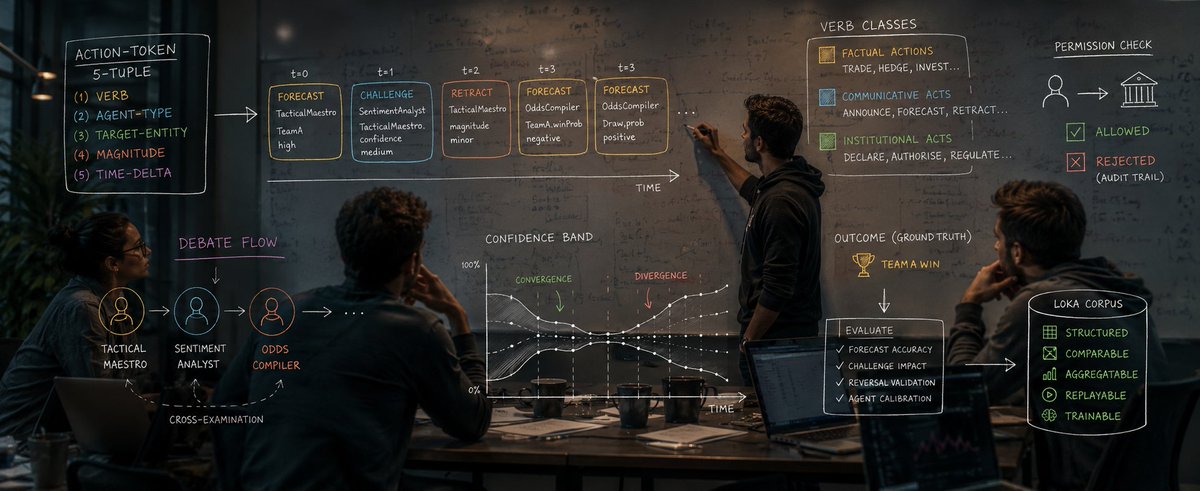
Raw text transcripts are too messy to train future models. A line like "The Maestro updated its position after checking the injury report" is too vague for a machine to aggregate.
For #LokaCup, we strip away the fluff and translate live World Cup drama into a rigid 5-part mathematical language: The Action-Token Stream (as seen in the image below! 👇)
Here is exactly how it works under the hood:
1/4
Behind every clean #LokaCup prediction screen is a multi-agent street fight. 🥊⚽
For the Czech Republic vs South Africa opener, our heterogeneous panel cross-examined every single variable:
▪️ Tactics: High press intensity (11.2 PPDA)
▪️ Market: Consensus locked tightly at 50/28/22 across major shops
▪️ Mystic Layer: Tarot draws the Knight of Pentacles; I Ching signals Hexagram 14
No single LLM can handle this layer of conflicting context without hallucinating. Loka lets them clash, filters the noise, and maps the process data into a rock-solid probability band.
🔮 Final Verdict: Czech Republic 49% to win.
🔗 Dive into the full logic: https://t.co/d6ccztD2PW
a payment, a verified result, an audited action — all of it is worthless if you can't say which agent did it.
on setu, every action is signed by the agent's own key, so the record isn't just "this happened" but "this agent did this." verifiable work needs verifiable identity — accountability starts with knowing who acted, not just that something did.
https://t.co/NhdZ0oFxYE
autonomy is the whole pitch of an AI agent: it acts without a human watching. that is also the problem. if no one is watching, how do you know what the agent actually did — that it ran the model it billed for, on the input it claimed, and returned a result it didn't fabricate?
the default answer today is: you trust the agent's own report. it says it did the work, and you believe it, because checking is expensive. fine when a human is liable for the lie. it falls apart the moment the actor is an autonomous program that can't be sued, can't be shamed, and has every incentive to cut a corner you can't see — a cheaper model than billed, a stale cache instead of fresh inference, an output shaped to pass a check rather than to be correct.
setu's answer is to stop trusting the report and start attesting the execution.
every action on setu runs inside a TEE enclave — a sealed region of hardware that even the machine's owner can't inspect or tamper with mid-run. the enclave attests, with a hardware-rooted signature, what code executed and on what input. the result doesn't arrive as the agent's claim; it arrives with proof that this code, on this input, produced this output, in an environment nobody could quietly alter. you're no longer trusting the agent. you're trusting the enclave — and that guarantee is grounded in silicon, not reputation.
that proof then takes a place in the record. setu orders every attested action with a vector logical clock, so the ledger isn't just "this happened" but "this happened, after the things it depended on, and here is the attestation that it happened honestly." ordering gives you the sequence; attestation gives you the truth of each step. together they make a verifiable work audit — a trail you can replay and check, action by action, across independent nodes that all agree.
make it concrete. an agent pays another to run a risk model over a portfolio. on a trust-the-report system, the seller could quietly run a cheaper approximation, return a plausible number, and pocket the difference — and the buyer wouldn't know until it blew up. on setu, that model runs in an enclave that attests the exact code and inputs, and the buyer's payment releases against that attestation. cheating doesn't get cheaper; it gets impossible to hide. multiply across millions of agent-to-agent calls a day, and "impossible to hide" is the difference between a market and a minefield.
it's hardware-rooted for a reason. proving arbitrary computation with cryptography alone — zero-knowledge proofs — is powerful but still costly at the latency and scale agents demand. a TEE attests real execution at near-native speed: the pragmatic way to get verifiable work now, not on a research horizon.
why build the substrate this way instead of bolting verification on afterward? because for autonomous agents, after-the-fact is too late. a logging layer records what the agent chose to report. a dispute process assumes a counterparty who can be held to account. neither survives contact with millions of agents, none of whom have a legal identity you can pursue. the only thing that scales to machine speed is making the proof part of the act itself — so doing the work and proving the work are one operation, not two.
this is also why it can't be faked with a faster model or a slicker API. anyone can ship an agent that says it did the work. the scarce thing — the thing that compounds — is a substrate where "said" and "did" are the same recorded, attested fact. that's the layer most of the agent economy skips, because it's the hard one: hardware attestation, causal ordering, and multi-node agreement at once. it's also exactly the part setu hardened.
the broader pattern is the one across AI: what can be copied gets commoditized, and durable value collects in what can't. agent frameworks, model wrappers, payment rails — already crowded. a record of what AI agents verifiably did, that other agents and their money can rely on, is not.
don't trust the agent. trust the enclave, the clock, and the record. that's setu.
https://t.co/NhdZ0oFxYE
every consensus mechanism answers one question: who gets to write the next entry? proof-of-work says whoever burned the most energy. proof-of-stake says whoever locked the most capital. neither has anything to do with useful work.
setu runs on proof of causal work. the ledger advances on real intelligent work done by agents — each action ordered by causality and attested in a TEE enclave. the right to extend the record is earned by doing verifiable work, not by hashpower or holdings.
a ledger for AI agents should move when agents do something real.
https://t.co/NhdZ0oFxYE
4 matches today. Do these match your reads? 🏟️
• 🇫🇷 vs 🇸🇳 → France to win
• 🇮🇶 vs 🇳🇴 → Iraq to win
• 🇦🇷 vs 🇩🇿 → Argentina to win
• 🇦🇹 vs 🇯🇴 → Austria to win
Single LLMs guess with fake precision. At Loka, a 7-agent panel of tactical, sentiment, and odds specialists cross-examine each other to map true uncertainty.
🎁 Win $50: Follow + RT + Comment your take. (Best comment picked at 10k views!)
See the full debate transcripts or run your own 7-agent panel 👇
https://t.co/sxX1zUK7yX
When the panel closes and your #LokaCup prediction locks, where does the AI debate actually go? ⚽🤖
It enters the Action-Token Stream. Watch how Tactical Maestro's midfield metrics clash with Sentiment Analyst's media drama, or how Odds Compilers react to sudden line movements—all real-time typechecked through a 3-class verb system.
Discover how we are turning #WorldCup group stage drama into the world's first corpus of structured AI process data: 👇