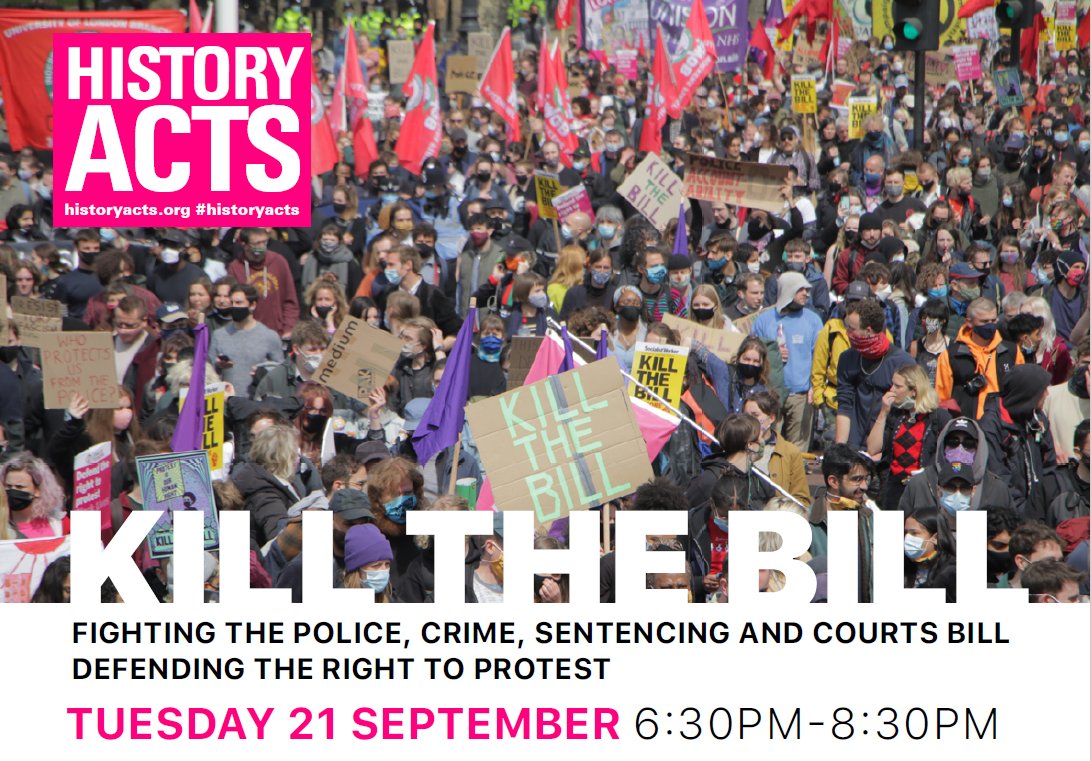
Forgot to share this so belatedly: my bit for the recent @HistoryActs event on the Police Crime Sentencing and Courts Bill and on the future of the #KillTheBill movement https://t.co/ckbE1K5i5b
First to speak is Kevin Blowe from @netpol in his second #HistoryActs appearance. He sees Policing Bill as reaction to Extinction Rebellion and Black Lives Matter. He argues the government doesn't just disagree with these protesters but is seeking to shut down debate completely
Our last activist speakers are Emmott and Moss from Sheffield Against the Policing Bill. They describe how their organising grew from bringing together different groups in Sheffield to working nationally to develop longer-term strategy of resistance #HistoryActs
Moss now explains the historical importance of organising against the Bill in Sheffield, noting the city's long activist history going back to Chartism #HistoryActs
And lastly @copwatcher notes that there has never really been a case as to why these police powers are necessary. It is important to keep challenging the language used and its ambiguities, including the recategorisation of protesters as criminals #HistoryActs
Panel wrap up with their final thoughts and next steps. @GraemeHayes highlights importance of continuing to use our voices and move through public space, continuing to campaign and organise as the Bill becomes law #HistoryActs
@emilyapple points to the power of the coalitions of different activists groups across the country who are coming together to resist the Bill. How do we go on to use these networks to build solidarity and reach people with our narratives? #HistoryActs
@SteffanBlayney asks the panel what precedents there are for successful resistance in these contexts. How can we make this solidarity work? What are useful points of comparison, what can we learn from them and how can we apply this? #HistoryActs
Panel note that Kill the Bill is opening up debates around policing more widely. They note the centrality to the Bill of the impact of protest on corporate power and the targeting of protesters taking direct action #HistoryActs
Panel responds, agreeing that it is important for activists to take back their own voices to change the narrative, rather than relying on mainstream media and social media algorithms for impact #HistoryActs
Now on to discussion, opened by historian of Met Police @MissSarahWise with some more useful C19 parallels. She asks: where are the commentators in the press and media adding their voices to resistance to the Bill? #HistoryActs
Last historian to speak is @GraemeHayes, who argues that the Bill is a first step in a larger structural battle against the Human Rights Act and freedoms of expression and assembly, with the Bill as justification that it has already been the will of Parliament #HistoryActs
First historian to speak is @james_trafford who traces colonial histories of incentivised complicity in enforcing imposed control. One strategy is to present protesters as 'enemies of the people' rather than 'enemies of the state'. #HistoryActs
@emilyapple argues activists should celebrate wins more: it can take some time for the impact of activism to become clear, but we can write our own narratives of how we want the future to look and build this through our resistance #HistoryActs
Next to speak is @emilyapple from Kill the Bill Cornwall, who shares experiences of police intimidation and surveillance intended to deter participation in protest #HistoryActs