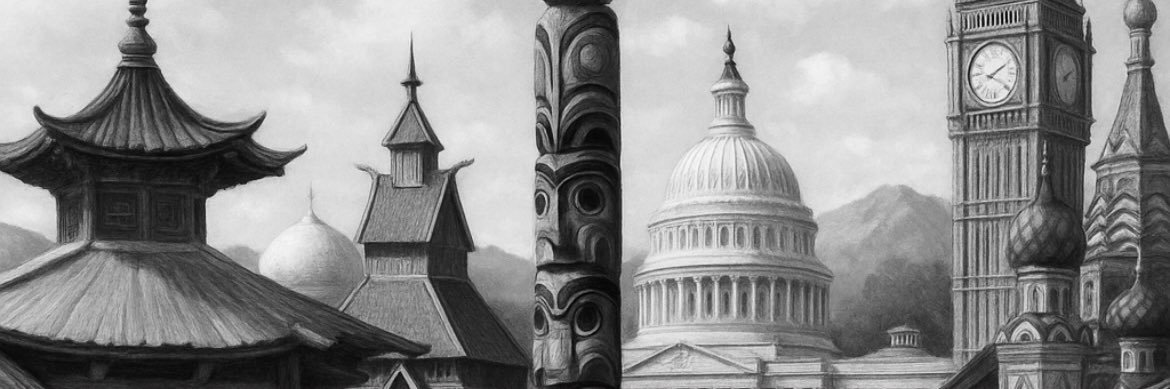
Culture, much like capital, requires mobility to thrive. By leveraging international institutions like UNESCO to codify the economic rationale for cultural promotion, states transform culture from a vulnerable social good into a robust economic sector capable of steady expansion.
Trade and culture are not inherent enemies; when rules recognize the right to cultural diversity, open markets become the engines of domestic expression.
The perceived conflict between free trade and national identity is a false zero-sum game.
When trade rules codify cultural diversity as an economic necessity—comparable to biodiversity in nature—it resolves the tension between market integration and sovereignty.
Can a 1,200-page Russian novel teach you more about economics than an MA or MBA?
I think so. I spent years studying economics only to find the most profound answers in 19th-century fiction. What do you think?
Economics operates as a method of perception. It attends to invisible regularities shaping visible outcomes.
Human history becomes legible as patterned motion rather than authored narrative.
Looking for a better way to define "the economy"?
Try thinking of it as a living, breathing pattern and not as a machine-like system you can just “fix”.
Ray, your “Big Cycle” framework is compelling, and I agree with the core claim: when there is no enforceable rules-based order, power replaces law.
But I think your analysis has a major blind spot: it treats Europe’s historical war cycle as if it is the global cycle.
The chart you cite tracks European deaths since 1500, but that framing quietly implies something deeper: that world disorder is defined by what happens inside Europe, and that the rest of the planet is essentially an extension or spillover.
Yet some of the most violent and system-shaping wars in modern history were not European wars, and were not “side theaters”:
•the Taiping Rebellion (China, ~20–30 million dead)
•the Dungan Revolt
•the An Lushan scale precedents
•the collapse cycles of the Qing and Ottoman periphery
•Partition violence in South Asia
•imperial conquest wars in Africa and Asia that were treated as “colonial administration,” not war
If we only chart Europe, we are not charting “world order,” we are charting European order, plus the wars Europe recognizes as “history.”
And that matters because Eurocentrism doesn’t just shape what we study, it shapes what we count.
A European war becomes “World War.”
A non-European war becomes “regional instability.”
A colonial war becomes “pacification.”
A famine tied to imperial extraction becomes “mismanagement.”
So I agree we may be entering a Stage 6 environment, but the deeper question is:
Stage 6 for whom?
Because for much of the world, “might makes right” never ended in 1945.
It was simply rebranded, outsourced, or enforced through capital wars, sanctions, and proxy conflicts.
Your framework becomes even stronger if it breaks out of the European dataset and treats the non-European world not as peripheral noise, but as central to how global disorder actually operates.
The post-1945 order may be dying. But in many regions, it never truly existed
This quote from Tolstoy gets to the heart of an essay I wrote recently: the idea that economics is the study of human action in its most raw form.
By looking at the "incentives and constraints" Tolstoy described, we find a way of seeing the world that formal models often miss.
Is War and Peace actually a hidden economics textbook?
Discover why Tolstoy’s masterpiece is less about history and more about the "science of human action."
https://t.co/QwWfrIHwCz
Bangladesh’s business leaders, and most of its liberals, are lending their support to the scion of a famous political family. The alternatives are deeply unappealing, one local analyst explains https://t.co/nzUKVVAXZf
Key insight from Tolstoy’s War and Peace for macroecon thinking
The movement of nations follows from the cumulative activity of participants acting under shared constraints. Large-scale outcomes arise without centralized intention. Coordination and competition scale into history
Political polarization deepens not from disagreement, but from a shared inability to explain.
When public reasoning relies on bad explanations, political conflict fails to resolve polarization because the causes that generate it are never addressed.
Trump’s transformation of the U.S. economy into one defined by state capitalism with American characteristics isn’t a betrayal of free markets. It simply exposed how fragile the ideology already was.
Democracy fails long before dictators win. It fails when citizens stop examining how they think.
“The inability to be politically self-conscious is the existential threat to democracy, not some
wannabe autocrat." - Human Action
Political commentary fails not because it is biased, but because it explains politics with the wrong units of analysis.
Personality and ideology obscure what actually governs outcomes: incentives, institutions, constraints, and information.