ANESTHESIA & ANALGESIA is the official journal of the IARS. @iars360 It provides practice-oriented, clinical research to help provide optimal care to patients.
Using comprehensive patient-reported SDoH data from a large national dataset, this study identified food insecurity and loneliness as key factors significantly increasing odds of persistent postoperative pain, whereas strong social support was protective.
https://t.co/HjWJrzsS4Y
💉Children undergoing septal defect repairs who received ultrasound-guided pecto-intercostal plane and rectus sheath blocks had less opioid use in the first 12 hours and lower pain intensity in the first 48 hours after surgery.
https://t.co/oteBO1yE1q
💛In an aborted small clinical trial of pts undergoing major CV surgery using CPB, pre-emptive administration of haptoglobin resulted in a higher change in creatinine vs administration of haptoglobin after appearance of hemolytic urine.
💛 Pre-emptive haptoglobin administration possibly increased kidney injury.
https://t.co/oKgMauEvOj
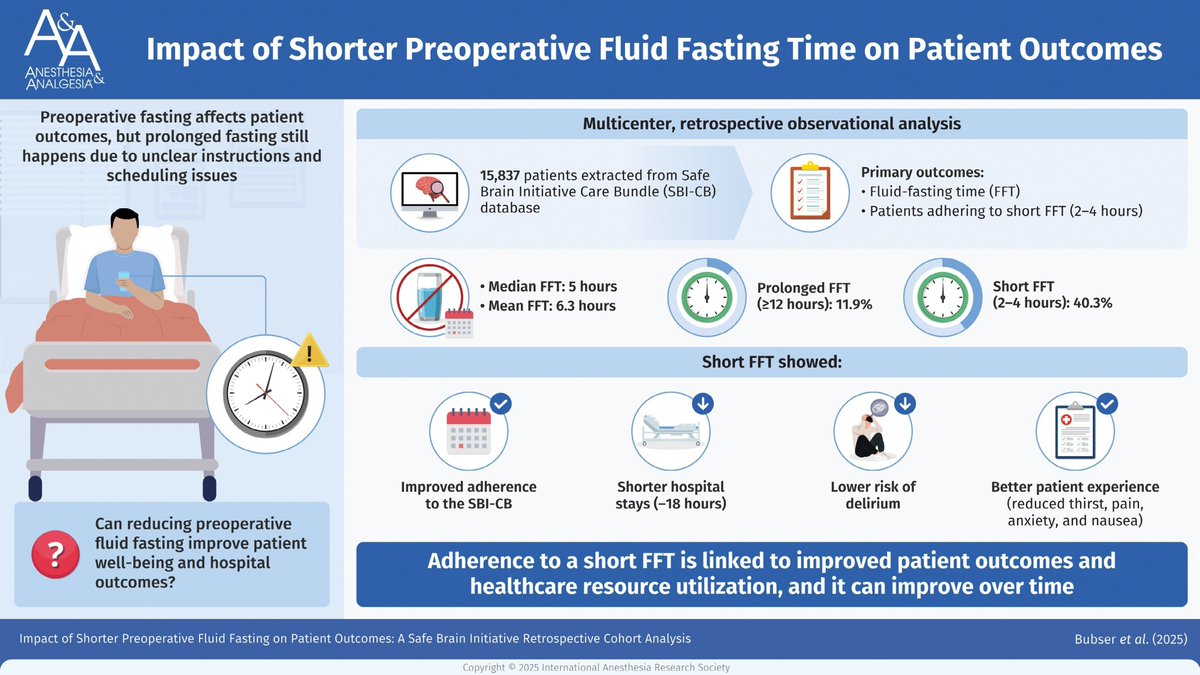
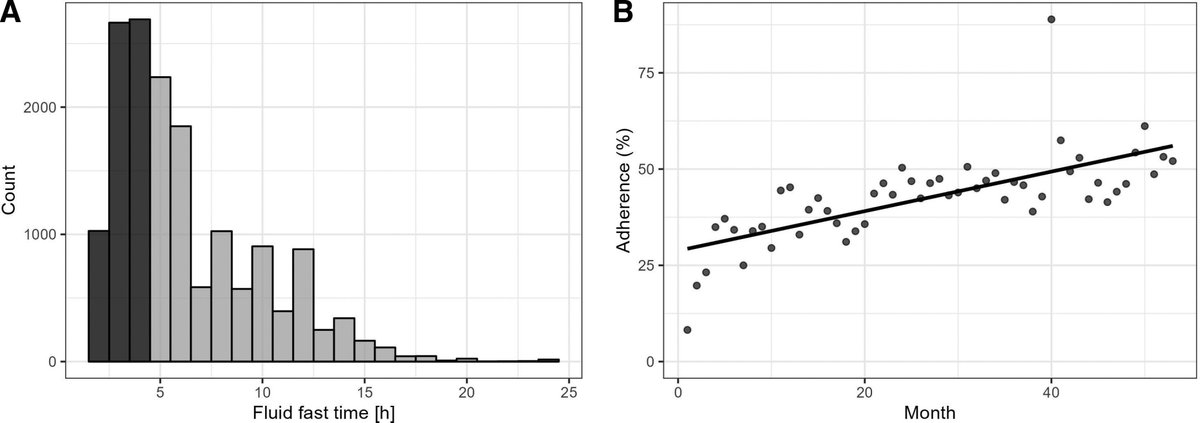
🫗Adherence to a fluid-fasting time of 2 to 4 hours was 40% and could be increased over time with evidence showing a decrease in postoperative delirium in the recovery room, hospital length of stay, and patient-reported outcomes for short (2–4 hours) in comparison with longer times.
https://t.co/nE8PYDz5kS
📈 After adjustment for patient severity of illness, the maximal cumulative and individual dosing of vasopressors in critically ill patients with shock varied between ICUs. There was no clear dosing above which survival to hospital discharge was impossible.
https://t.co/W44EFYKOVt
✔️ Error field concordance analysis addresses key limitations of 4-quadrant plot and polar plot analyses to better distinguish strong concordance, loose concordance, total noise, and strong discordance.
https://t.co/PiMquSN1fw
Don't miss the editorial "The Myth of Depth of Anesthesia Monitors: When a “Normal” Bispectral Index Does not Mean What You Think It Means" from Drs. Paul Garcia and Peter Goldstein
Anesthetic “depth” and quality can’t be reduced to a single value: BIS cannot reliably ensure both optimization and safety. Recognizing monitor limits and adjusting care will.
https://t.co/Ydpp8MOCZU
🧠Can “adequate” BIS values between 40 and 60 occur with nonzero burst suppression ratios (BSRs)?
🧠Paradoxical BIS values of 40 to 60 with BSR≥5% can occur for sustained periods, in some cases for over 2 minutes, as well as low BIS values with zero BSR.
🧠 Anesthesiologists are advised to check both index values as well as the raw electroencephalogram (EEG) to guide anesthetic management, especially when BIS and BSR contradict each other.
https://t.co/7lSXrTsL8C
Check out the editorial from Dr. Stuart Forman, "Is Our Discourse on Molecular Mechanisms of General Anesthesia Oversimplified?"
Most general anesthetics act via multiple targets and pursuing strict target specificity may be a counterproductive strategy for finding new anesthetics. Significant gaps remain in understanding how anesthetics produce their core effects and in explaining side effects and toxicities—closing those gaps will require much more research.
https://t.co/w0yiFHi8kO
Are “GABAergic” Agents Really So Selective for GABA?
In a review of 310 in vitro studies, almost all anesthetics acted on multiple molecular targets w/ similar potencies. Propofol shows greater potency at nicotinic receptors& HCN channels than at GABAA receptors.
https://t.co/WNM4KpdkGp
Have you HEARD that #neuromodulation can potentially change the #fibromyalgia#brain?
Auricular percutaneous electrical nerve field stimulation (PENFS) in veterans with fibromyalgia linked to changes in white matter integrity🧠
Check out this study by Dr. Anna Woodbury and team!
https://t.co/OYRxbemZmY
#PainMedicine #ChronicPain #Neuroscience
Can #AI I think like an anesthesiologist?
This @IARS_Journas study compares 10 large language models with a board-certified anesthesiologist and conventional search tools. See what they found.
https://t.co/4RKyDdGcVi
#ArtificialIntelligence#ClinicalDecisionSupport #Anesthesiology #MachineLearning #MedEd #DigitalHealth
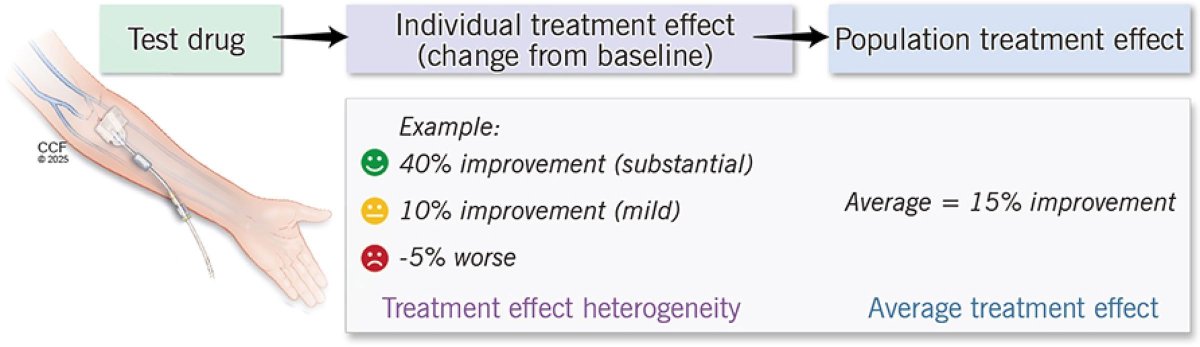
Can #AI identify who actually benefits from #steroids?
These investigators uncovered distinct #cardiac#surgery phenotypes with different responses to perioperative steroids. Are we getting closer to precision medicine in the OR?? 🤖💉
#ArtificialIntelligence#PrecisionMedicine #CardiacAnesthesia #PerioperativeMedicine #MachineLearning #anesthesia
https://t.co/1SS4YT6zBi
Congratulations to our newest group of A&A Editorial Fellows! They started on May 1.
https://t.co/XQ37GAVQUn
The A&A Editorial Fellowship is designed to mentor and to train early-career individuals interested in better understanding and more effectively contributing to scholarly publishing.
Missed an issue of The Daily Dose from #IARS2026#SOCCA2026? Catch up on highlights from the 2026 Annual Meeting, presented by IARS and SOCCA, including session takeaways, research interviews, poster previews & more. Read all issues: https://t.co/DeYI3x7B99 #TheDailyDose2026
Can #AI uncover hidden perioperative phenotypes?
Using #Machine#Learning, investigators have identified distinct #CardiacSurgery patient subgroups to test whether steroid response varies by phenotype, bringing precision medicine closer to the OR. 🧠📊
https://t.co/yY6uSuY4D1
#PerioperativeMedicine #MachineLearning #Anesthesia