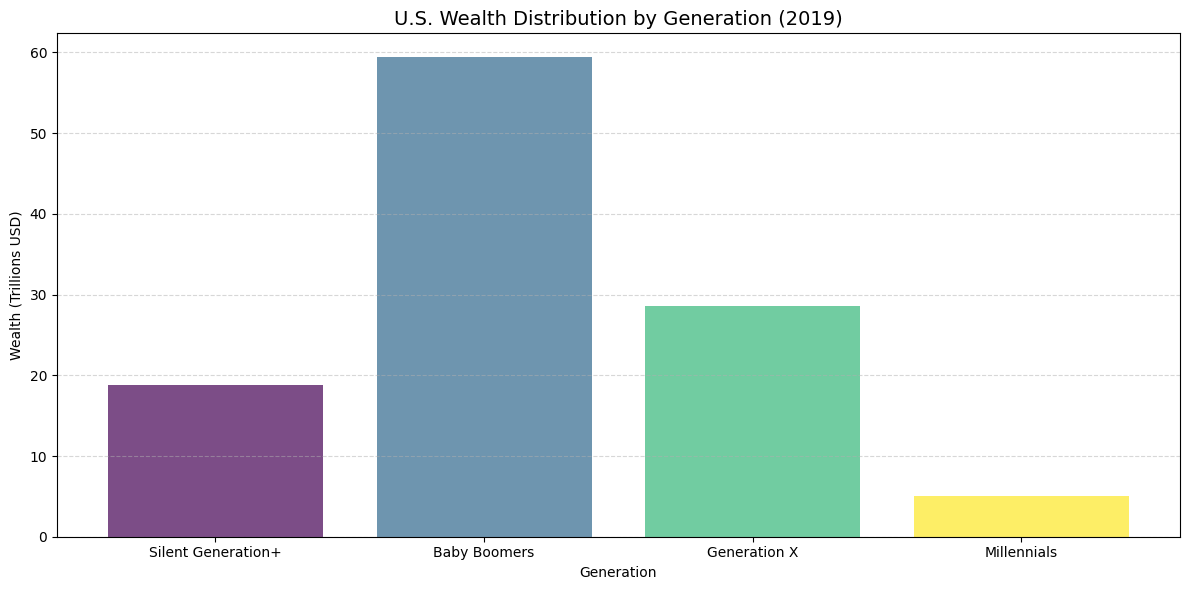
1/ millennials and gen-z are extremely cooked.
despite being the largest cohort, millennials have more than an order of magnitude less wealth (in the U.S.) than baby boomers.
saddled with student loan debt. priced out of the real estate market. priced out of having kids.
Yes, companies do routinely layer equity, debt, loyalty programs, etc. all with claims on the same cashflows or assets. But TradFi handles this fine with clear capital stacks...
The specific crypto point though: people buy Token X because they believe it gives ownership over Y (cashflows, upside, governance). Then equity often steps in front — acquisition proceeds go to equity, or tokens drive on-chain activity (e.g. through incentives) while value leaks to equity.
What do we do about this? The same thing TradFi did (but maybe codify it through... code?) — well-defined capital stacks, so you actually know what you're buying and where you actually sit in the stack!
This entire thread is downstream of Mippo lamenting the VVV token + equity split / misalignment (which, by the way, I don't think is the case — Haseeb's comments here lay it out clearly: https://t.co/BWW8MZdFK1).
But what Mippo / Blockworks are doing about it is exactly right: pushing for disclosures and transparency.
People / businesses / protocols can do whatever they want — issue tokens, then have equity, then do X, Y, and Z.
It's the free market and people will buy what they want to. But how can the market allocate resources when you don't actually know what you're buying?
The cleanest way right now is knowing for a fact there's no equity component, so when you buy the token you're not misaligned on incentives. In the future, as we get better with disclosures, codify rules on-chain through code, and integrate more with the legal system, it'll become easier to underwrite businesses that use both tokens and equity. I just don't think we're at that point yet — for 99% of crypto businesses out there, just one token suffices. Would you agree with that?
@MichaelRosmer@MikeIppolito_ I’m specifically discussing ownership over one thing (cashflows, etc.). Why should you have competing ownership structures over one thing?
There will always be a fundamental tension between equity and tokens: value created by a business / protocol cannot be captured in excess of 100%. It either accrues to equity, the token, or some split between the two.
The strongest argument for equity today is that certain jurisdictions (U.S., etc.) enforce equity rights more clearly than token rights. But that gap should narrow over time. Structurally, there is not much equity can do that a token cannot eventually do better.
Cash-flow rights, governance, seniority, bond-like features, utility-like features — all can be embedded programmatically, with less reliance on sovereign enforcement as the core source of property rights.
That is the whole point of tokens: non-sovereign-enforced property rights that can be extended into almost any economic instrument.
The main exception is where the product genuinely needs a separate utility / access / loyalty token. But most companies do not, and in many cases the cleaner argument is that utility should simply be priced in USD.
I think we largely agree. My point is simply that fully on-chain protocols generally should not have both equity and a token. Both assign claims on a finite pool of value, enforced through law, code, or both. Each has tradeoffs, but in 99% of cases you choose one — otherwise tokenholders and shareholders are competing for the same upside. Would you agree with this?
"claude fable just proved the jacobian conjecture is false"
"incredible this changes everything"
"do you know what the jacobian conjecture is?"
"no, do you?"
"no"
Every new perpetuals exchange today tries to bootstrap its own liquidity. Every new market — whether a commodity, index, single-name equity, or crypto token — needs resting bids and asks for traders to execute against. But every new market also fragments liquidity further, worsening UX as execution costs rise.
What if there were a better way? What if traders could keep the best properties of blockchains — self-custody, permissionless access, global rails, instant settlement — while inheriting, rather than fragmenting, real-world liquidity?
This is exactly what @Ostium does. TLDR: @Ostium settles trades instantly on-chain, while directional flow is hedged off-chain through partners like Jump Trading. That is what enables @Ostium to fill multi-million-dollar trades at tiny on-chain cost.
Take trader 0xaeaa...2416: they wanted to put on a large directional NDX-USD position (NDX = Nasdaq-100 index). Through @Ostium, they opened roughly $75.7M notional long and paid about $51.6K all-in, or ~6.4 bps. As seen below, the cost structure is mostly execution price impact plus explicit protocol fees — tiny relative to the size of the position. 🦋
Yeah, I agree there is separate value in the token. My point is that every example of people complaining about token / equity misalignment is when the token is trying to represent the same thing — ownership in a protocol / company, or the value that protocol / company creates.
That’s the fundamental tension. People aren’t really complaining about the second point you’re making, where the token is a utility service / product, which clearly can make sense in specific cases.
But on the first point, if you tokenize equity and it has all the rights equity has, then isn’t it still equity? Doesn’t it just inherit all the properties of equity in token form?
To me, the whole point of tokens is coordination around an asset that’s natively issued on-chain. You know exactly how much exists, you know no one can arbitrarily mint more, and anyone can build apps around that asset — financial or otherwise.
Once you move away from that and settle for “tokens are tokenized equity,” you inherit a lot of the same problems as TradFi equity: cost of issuance, centralized dependencies, permissioning, and limited composability. That’s my 2c.