The massive disconnect between local retail sentiment and international institutional reality regarding Sivers Semiconductors ($SIVE) has officially reached peak absurdity.
As $SIVE undergoes a historic macro re-rating, local bears and casual observers on social media are pushing two desperate narratives:
1. That the management team is running some sort of "scam."
2. That Sivers massive $800M pipeline is just fluffy "sales talk over coffee and business cards."
Let’s look at the actual data, the structural mechanics of the semiconductor industry, and the regulatory realities to see why the smart money is ignoring the noise and locking up the float.
🔮 Part 1: The Anatomy of an $800 Million Qualified Pipeline
During the Q1 2026 presentation, CEO Vickram Vathulya dropped a monumental update on Sivers' qualified opportunity pipeline. The numbers are staggering:
End of 2024: $276 Million USD
End of 2025: $453 Million USD (+64% YoY)
May 2026 (Last 5 months): Just shy of $800 Million USD! (+77% growth in 150 days)
To suggest this $800 Million pipeline is based on "coffee and business cards" shows a fundamental lack of understanding of how deep-tech procurement works.
First, this pipeline spans the 2026–2030 commercial window, tracking the global ramp of AI optical interconnects and next-gen SATCOM networks.
Second, an opportunity does not just "appear" in this funnel. Sivers enforces a strict, multi-stage qualification matrix:
Technical Alignment: The hardware specs must precisely match the client’s architecture.
Commercial Visibility: The customer must provide an active commercial timeline and explicit multi-year volume forecasts.
Physical Validation: The client must be actively evaluating and stress-testing Sivers’ physical silicon in their own labs.
🔬 Part 2: The Silicon Valley Pedigree vs. The "Scam" Narrative
The theory that Sivers' leadership is running a "pump-and-dump" or a "con" falls apart the moment you look at the executive roster and the board.
Sivers' leadership isn't made up of penny-stock promoters. We are looking at an elite group of semiconductor veterans with decades of high-level execution at the absolute titans of the tech world:
- GlobalFoundries
- Lumentum
- Nokia
- NXP Semiconductors
- Maxim Integrated
Are we seriously to believe that world-class executives and PhDs, who spent 25+ years building immaculate reputations in Silicon Valley and global telecom, decided to collectively throw away their careers to run a fake equity story in Stockholm? The premise is ridiculous.
🛡️ Part 3: Sovereign Vetting (The Ultimate Due Diligence)
If you still think Sivers is a mirage, you have to believe that a small design house from Sweden somehow managed to outsmart the most rigorous forensic auditing teams on Earth:
The US Department of Defense: Sivers cleared the extreme technical and security vetting required to secure millions in funding from the NEMC Hub via the US CHIPS Act for advanced electronic warfare.
The European Union: Sivers is heavily integrated into the newly released European Chips Act 2.0 framework as a vital asset for regional digital sovereignty.
The Pentagon and the European Commission do not grant dual-use defense status and millions in taxpayer incentives based on a flashy PowerPoint. They run exhaustive, line-by-line, chip-by-chip physical audits. Sivers passed them all.
💡 The Bottom Line
The Technology has been vetted and funded by sovereign entities (US & EU Chips Acts).
The Scalability is locked in with Tier-1 manufacturing giants like WIN Semiconductors, GlobalFoundries and Jabil (co-developing the 1.6T transceiver).
The Pipeline is rapidly moving into late-stage "design-in" to the tune of almost $ 800M.
The Shareholder Registry is being aggressively overtaken by international investors.
Local retail sentiment is trading on backward-looking historical data and coping with the volatility.
As always do your own due diligence.
Let me put the $8.2M https://t.co/zJgGn0bFIH order in context.
This isn't just another contract win. It's the first concrete proof that the SATCOM thesis is converting to actual revenue.
The setup that's been forming:
→ Asymmetry Research disclosed weeks ago that the market is "pricing in zero CPO upside, zero biosensing optionality, and zero SATCOM revenue."
→ Over the weekend I wrote about the second supply chain underneath $SIVE: York Space Systems → https://t.co/zJgGn0bFIH → Sivers Ka-band beamforming ICs.
→ June 5: $YSS shipped 20+ Tranche 1 Transport Layer satellites for summer Falcon 9 launch.
June 9 (today): https://t.co/zJgGn0bFIH awards $8.2M PRODUCTION order to Sivers for 2027.
The wording matters. From the official release:
"This production order represents an important milestone in our partnership with https://t.co/zJgGn0bFIH as we move from development and initial production to scaled multi-year deployment."
Translation: this isn't NRE. This isn't a development contract. This is locked-in 2027 revenue from a customer that supports US Army, US Navy, Royal Canadian Navy trials, and commercial operators Telesat, SES, and Viasat.
Some context on the order size:
→ Sivers' previous largest single order was the $3M Tachyon Networks 5G order
→ The https://t.co/zJgGn0bFIH order is 2.7x larger
→ It's specifically for the SATCOM/defense vertical the market valued at zero
→ It's earmarked for 2027 — the inflection year management has been pointing to
What this means structurally:
→ The "zero SATCOM revenue" valuation framework just got refuted by an $8.2M proof point
→ https://t.co/zJgGn0bFIH is the world's leading multi-orbit SATCOM terminal company. If their first scaled production order is $8.2M, the full https://t.co/zJgGn0bFIH pipeline is meaningfully larger
→ York Space Systems acquiring https://t.co/zJgGn0bFIH (Q3 2026 close) means Sivers becomes embedded in a publicly traded defense space prime
The second supply chain isn't speculative anymore. It's printing orders.
$SIVE $YSS
$YSS Ships T1TL Satellites to Launch Site – Major Indirect Win for $SIVE
Great news for York Space Systems, yesterday they announced the initial shipment of their second production lot of T1TL spacecraft to the launch site.
More than 20 York-built satellites are scheduled to launch this summer on a dedicated SpaceX Falcon 9.
While the headlines focus entirely on York, smart money is looking at the hidden supply chain winner is $SIVE.
Earlier this year, York Space Systems expanded its vertical integration by acquiring https://t.co/t81UZsAUvd, a leader in next-generation multi-orbit ground terminals.
Sivers Semiconductors is the single-source, exclusive supplier of critical Ka-band mmWave chips embedded inside https://t.co/t81UZsAUvd's revolutionary Hydra terminals.
As York rapidly deploys its massive Tranche 1 Transport Layer (T1TL) satellite constellation for the U.S. Space Development Agency, the demand for high-performance ground infrastructure scales in lockstep.
More operational satellites in orbit directly dictate the mass deployment of https://t.co/t81UZsAUvd ground stations.
York’s flawless execution and strong defense contract revenue guarantee the financial backing needed to rapidly accelerate the production ramp-up of https://t.co/t81UZsAUvd terminals.
Every satellite York sends into orbit strengthens the ecosystem for https://t.co/t81UZsAUvd ground terminals.
Since $SIVE hardware is hardcoded into these terminal architectures for U.S. defense applications, York's blockbuster summer launch is highly bullish for Sivers' long-term Satcom revenue pipeline.
$SIVE Sivers' moat in one sentence: Sivers provides the laser arrays for nearly every major player trying to build an alternative to the Nvidia/Broadcom duopoly.
Hmm as for life experiences:
-> Currently doing fintech stuff (helps with understanding financial statements, dilution, margins, valuations, etc).
-> venture capital stuff (Series A/B company analysis, help to understand TAM, thematic shifts, how a company could grow)
-> previously AI research building different models (idk, just technical)
-> some semi work (have some patents, worked on setting some architectures), mainly high level.
Kinda put them together, and it helps a lot with current AI themes.
This is former CEO at Ayar Labs now at NVIDIA, commenting Ayar Labs CEO announcement about NVIDIA NVLink Fusion. Connecting well into the possible opportunity in this 3rd part that Goldman has yet to model.
$NBIS is up 153% YTD and 372% over 1-year.
$SIVE $SIVEF $SIVE.ST is up 1,796% YTD and this illiquid foreign microcap has been heavily pumped by someone who has more paid subscribers than Elon Musk himself. Yet, it's "one of the best kept secrets."
@SeekingAlpha Shared my Seeking Alpha "SA Asks" expert take on undervalued AI proxies. Deep dived into $SIVE and $ALMU photonics tech.
https://t.co/corjmpHp05
A Recap of the Logic Behind Shorting Semiconductors, Plus a Few Thoughts on Monday
Most of this was already laid out in last week's weekly report.
https://t.co/sXDtY4X9JY
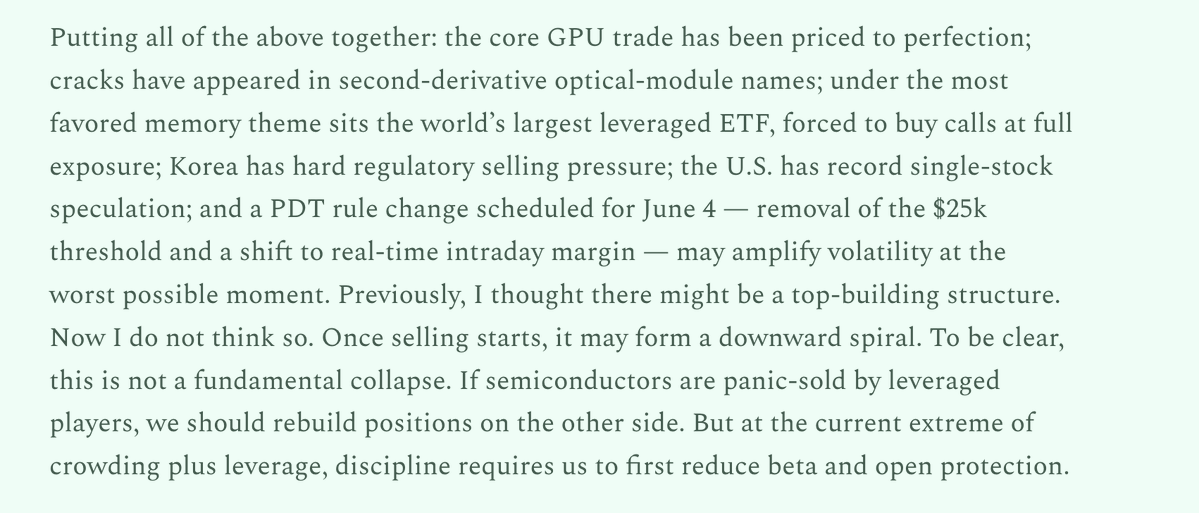
Here I'll cover just the single most important point: the prime mover of this crash was never fundamentals — it was leverage.
To gauge just how much leverage had piled up, I rely mainly on two indicators — VIXEQ and COR1M(I learnt them from @labubu_trader — supplemented by the call/put ratio and a few other sentiment indicators.
Let me first explain how these two indicators work.
VIXEQ (the Cboe S&P 500 Constituent Volatility Index) measures implied volatility at the single-stock level. VIX uses SPX index options and captures "the fear of the index as a whole"; VIXEQ instead runs a VIX-like calculation on each constituent's single-stock options and then aggregates them by market-cap weight, capturing "the fear of the average individual stock." When single-stock call buying turns extremely aggressive and speculation concentrates in names like MU, SNDK, INTC, and NOK, those single-stock options get bid up to very rich levels, and VIXEQ's premium over VIX is stretched to an extreme — the most direct read on single-stock speculation and leverage.
COR1M (the Cboe 1-Month Implied Correlation Index) measures the market's expected correlation among constituents. Index variance ≈ average constituent variance × correlation, so when individual stocks are all rising but rising independently of one another (with capital scattered across each name's own story), correlation gets compressed to rock-bottom. COR1M closed at 6.33, meaning implied correlation has already approached its historical low.
Put together, these two indicators describe the same structure: everyone is levered up, betting on mutually independent single stocks (mostly semiconductors), while at the same time many hedge funds are long semiconductors and short value stocks — so the index gets artificially flattened. The greatest risk in this structure is that any single shock can, in an instant, snap correlation back from near 0 to 1 — every name falls together, and all the leverage is forced to unwind at once. A crash, in essence, is just the process of correlation reverting to 1.
So as early as the start of last week, I had already recognized this enormous leverage risk. That is the prime mover of the decline.
As for what the trigger was — it really doesn't matter. AVGO's earnings, SemiAnalysis's negative commentary on MU, that so-called "overheated" NFP, Meta's secondary offering — these were all nothing more than that single gunshot at Sarajevo. It's exactly like silver in late January this year: Warsh taking office was also just a trigger; the real reason was that the leveraged capital loaded with unrealized gains, built up over the course of the parabolic rally, began to flee — setting off a long-on-long stampede, longs trampling longs, the more they sold the more it fell, the more it fell the more they sold. Structure determines direction; the catalyst only determines timing.
As for the short itself: I started with just a 1%-sized SMH put spread. In a market like this it's very hard to call exactly which day it cracks, but we can preset a level. Our preset level was 7495 — the HVL (high vol level). Above 7495, dealers are net positive gamma, which suppresses volatility; once 7495 breaks, positive gamma flips to negative gamma, dealers are forced to sell more the more it falls, manufacturing even greater systemic selling pressure. Adding to the short at that level carries the highest win rate. It's not about guessing the top — it's about waiting for the structure itself to flip short, for the dealers themselves to become forced sellers, and only then making the move.
There isn't much else to say.
Oh, one extra note on my view for Monday.
A systemic crisis is still brewing in the Korean market. To describe the most dangerous left tail, it would roughly look like this: if SK Hynix opens limit-down on Monday, it gives the 2x Hynix ETF (currently the world's largest single-stock ETF) no window at all to de-risk — it can't sell hedges into a locked limit-down board, can't de-lever, and so is forced to carry far more than 2x leverage into the next day. Once Hynix sells off further the following session, this ETF gets blown through entirely — possibly even liquidated — and once the panic spreads directly from Seoul to Hong Kong and on to the rest of the world, it triggers an even larger secondary crisis.
But in all likelihood, Korea will step in to prop things up. So let's pray for Korea.
Reflections from a Seven-Year Shareholder: Why Sivers Semiconductors / $SIVE Was Always Destined for Greatness
After nearly seven years as a shareholder in Sivers Semiconductors, I have watched this company evolve from an overlooked Swedish deeptech player into a force at the intersection of photonics, wireless communications, AI infrastructure, and strategic defense technologies. The recent surge in the share price is not a surprise to those of us who have followed the story closely it is the logical unfolding of a thesis many of us articulated years ago when few were listening.
From the moment I first dug into the company, its potential felt enormous and profoundly underappreciated. The technology advanced lasers for co-packaged optics in AI data centers, beamforming ICs for 5G/6G and SATCOM, and full-duplex arrays for electronic warfare sits at the heart of multiple secular megatrends. Yet for years, the market fixated on quarterly losses, development costs, and execution risks while largely ignoring the customer pipeline, partnerships, and technological edge.
Where Unicorns Are Born
This is how real winners emerge. History is clear: transformative companies are rarely discovered in consensus comfort zones. They are unearthed where sentiment is exhausted, where weak hands have capitulated, and where the narrative is dominated by skepticism. Sivers spent years in that crucible not for the faint-hearted.
You had to immerse yourself in the details: the photonics platform’s unique indium phosphide capabilities and its work with hyperscalers, AI data center players, $AAPL (sensing) and Win Semiconductors, along with key partners such as Jabil and GlobalFoundries; the wireless division’s tier-1 engagements with names like Nokia, BAE Systems, SATCOM operators and the U.S. government itself. Companies and institutions of that caliber do not collaborate, co-develop, or plan multi-year programs with you unless there is real substance and a clear path forward. That, for me, is the only validation you truly need. Add to that the expanding opportunity pipeline now approaching $800 million and strategic validations like repeat US CHIPS Act funding, and the picture becomes very clear.
Bears and headline-chasers thrive on the opposite approach. Swedish media have produced more than 50 negative articles in recent times the positive ones you can count on one hand. It is a witch hunt. They obsessively highlight risk, risk, risk, with almost no mention of the enormous potential. How can anyone take them seriously? They have no skin in the game. If they could invest successfully, they wouldn’t be working for newspapers. They pretend to be all-knowing, but the truth is no one knows exactly where technology and the market are heading. After two decades working with IT companies large and small I understand both the tech and the market. That is why I am bullish, and why this development does not surprise me.
The same goes for the short sellers. One recent 43-page “analysis” packed with incorrect assumptions and misinformation was clearly designed to create fear and doubt. I could refute every single point, but why give them more oxygen? Notably, they don’t even dare to hold a meaningful disclosed short position. That is weaker than their analysis. I put real money on the table and take real risk. Please increase your shorts. I am waiting for you to go under.
Leadership and Shareholder Transitions: A Healthy Reset
Some former insiders and larger holders have exited. I am not surprised I am relieved. They did not deserve to be part of the journey that is now unfolding, a journey that is still far from over.
Erik Fällström and his associates supported the company for many years, and for that we are grateful. But the attempts to extract personal gain crossed a line most notably trying to spin off the photonics division into a SPAC where he (via Achilles Capital / DDM) was a major sponsor, at what looked like bargain terms. The chairman and new CEO rightly put a stop to it. Shortly after, the selling began. He sold the majority of his holdings around 4 SEK. Karma is real. In parallel, Achilles Capital and its parent DDM Finance have been forced to apply for corporate reconstruction due to massive debt issues. The contrast between opportunism and long-term conviction could not be clearer.
Harish Krishnaswamy came in via the MixComm acquisition. I will not lie I like Harish. He is technically strong and has an excellent network that helped land key development agreements, including CHIPS Act wins. At the same time, I am not surprised he is selling. He has sold multiple times before, often at 4–8 SEK levels. This latest sale seems to be his chance to redeem all the earlier exits at much lower prices a kind of psychological average to finally make it feel better. Am I happy about it? No. But this is the same person who, several times right after Sivers secured major agreements, sold and killed the momentum, or sold when tax bills came due. As one of the founders, I think he simply wanted to feel that his years at MixComm finally delivered something tangible. This was the last time, and frankly, it feels damn good.
Funds that fully exited did so because they operate under strict risk mandates and manage other people’s money. That is natural and not a negative signal.
These departures represent a healthy cleansing. The right people and the right long-term capital are now aligned for the next phase.
The Path Forward
No one has a crystal ball. No one knows exactly how large the Co-Packaged Optics (CPO) market will ultimately become. But I genuinely believe people will be shocked by the speed and momentum once it really starts ramping. The combination of exploding AI compute demand, power constraints in data centers, and Sivers’ differentiated indium phosphide laser platform positions the company at the center of one of the most important technology shifts of this decade.
The current momentum validates what patient shareholders have long seen. Product ramps, pipeline conversion, CHIPS Act milestones, and potential US dual-listing preparations are tangible progress. Volatility will remain; bears will resurface. But conviction built on deep research outlasts noise.
To newer investors: Do your own work. Ignore the echo chamber of fear. Build your own mosaic from primary sources. True edges come from independent thinking. The easy path is skepticism and short-termism. The harder, more rewarding one is sustained belief grounded in analysis.
Sivers was never a quick flip. It was and remains a multi-year compounder for those willing to look beyond the noise. The diamond was always there for those with the eyes to see it. The journey is far from over, and the best chapters are still ahead.
Stay bullish. Stay informed. And above all, trust the work you’ve done.
$SiVE , good news ladies and gents, Institutional ownership has shown up for JP Morganchase as they crossed the 5% mandatory reporting threshold.
Official form:
https://t.co/0bQmLDWAkm
@aleabitoreddit@Sofigoodboy I owe all Protean funds and I’m really happy with them, and Richard Bråse isn’t stupid, but if any of his funds short $SIVE I’m selling all of my assets in the funds