The International Food Policy Research Institute (IFPRI), a @CGIAR Research Center, seeks sustainable solutions for ending poverty, hunger, and malnutrition.
#NowReading Perceptions, quality, and uncertainty in Ghanaian fertiliser markets
🖊️ By Seth Asante, Kwaw Andam, and Andrew M. Simons.
🔗 https://t.co/w0eIfiaApv
@CGIAR@IFPRI_Africa
🆕 #Blog From evidence to action: Strengthening women’s voice and resilience in Nigeria
🖋️ By @kkosec, Lucia Carrillo, and @oliverkirui.
An IFPRI-led dialogue highlighted evidence that women in northern Nigeria need real influence over decisions, not just participation, to help communities prepare for and recover from crises: https://t.co/TOUuN3dTt7
@CGIAR@IFPRI_Africa
🔔 HAPPENING NOW! 🔔
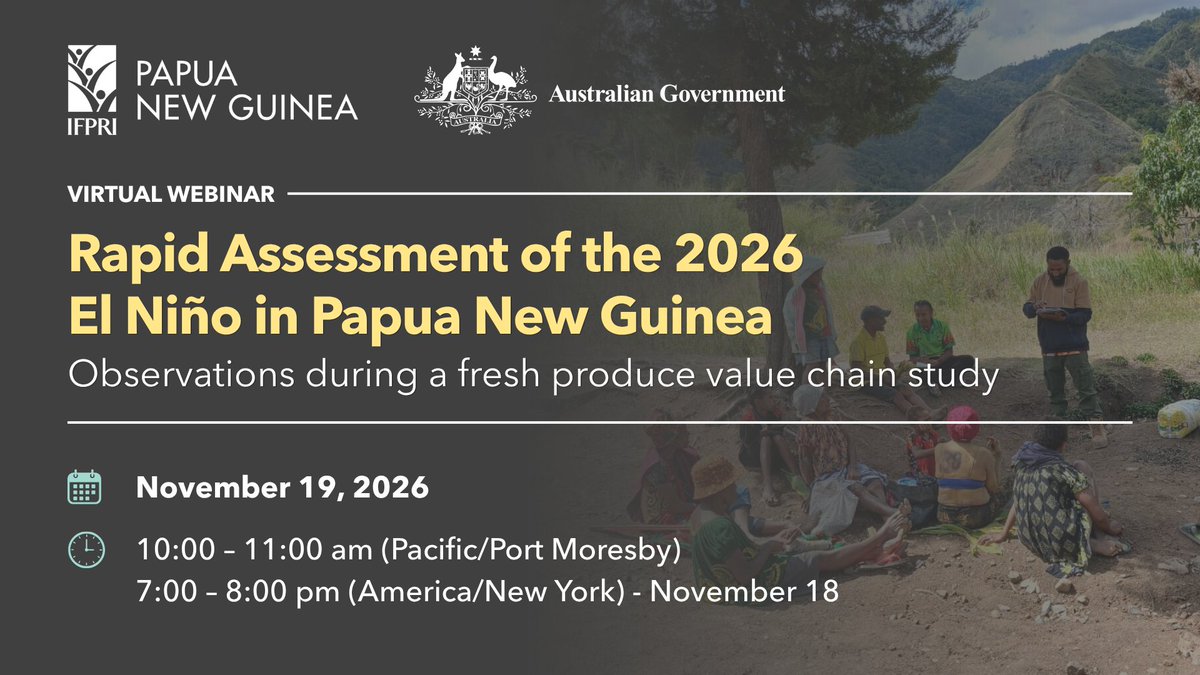
📌Rapid Assessment of the 2026 El Niño in Papua New Guinea: Observations during a fresh produce value chain study.
📆November 19, 2026, 10:00 – 11:00 am (Pacific/Port Moresby)
🗨️Speakers include Belinda Monoi (NARI), Emily Schmidt, and Kwaw Andam
🎫 https://t.co/eWv5Towdqc
@CGIAR@dfat@ACIARAustralia
No single intervention will end obesity, says a new JAMA report coauthored by @PMenonIFPRI. Also this week: new studies on disaster #resilience and #AI for dietary assessment. Read the latest Weekly Reads from IFPRI! 📰 https://t.co/55oKn8Yr5c
@CGIAR
A recent IFPRI event explored how overlapping shocks are raising food security risks. Conflict-driven disruptions and a strong El Niño could increase food, energy, and fertilizer prices, putting additional pressure on vulnerable countries.
Learn more in this recent blog by Catherine Gavin: https://t.co/J8lxRY4tyY
@CGIAR
📢#NowReading Lessons from a collaborative project in Tamil Nadu show how local leadership, shared decision-making & investment in technical skills can strengthen locally led research governance and support climate action.
👉Read more about the project:
https://t.co/3nfgXjDnBo
🚀It’s here! The 1st edition of the #NePAA newsletter is out📰
Get new research, events & publication insights from across South & SE Asia, all in one place.
Join us as we work toward building more sustainable & resilient food systems🌾
📩Read & subscribe: https://t.co/96EfILOMQD
💧 IFPRI's @ClaudiaRingler will participate in this online webinar today:
📌 Water, Food and Nutrition: Africa's Agenda for the 2026 UN Water Conference
⏰ 14.00 to 15.30 (UTC +1)
🔗 Learn more and register here: https://t.co/jC50Z3mTE2
@CGIAR@FAO
🌾🌽🌾#NowReading Aggregate gains and crop-driven trade-offs in the carbon and nitrogen footprints of China's interprovincial trade in rice, wheat and maize
In this new study, Zhi-Jie Jia, Zhi-Heng Qin, Yong-Qiang Xu, Ruo-Chen Li, Paul Behrens, @DrTimThomas, Xin Zhao, and Hai-Lin Zhang found that interprovincial trade reduced national production-stage greenhouse gas (GHG) emissions and reactive nitrogen: https://t.co/cTzTcJrQOn
@CGIAR
🆕 #IFPRIBlog: El Niño and rising global prices: How vulnerable is Ethiopia in 2027?
✏️ By Emerta Aragie & Chris Hillbruner
👉 https://t.co/9kFf45BYat
@CGIAR@IFPRI_Africa
🌱 💧 Small-scale irrigation is one of the most cost-effective levers available for transforming smallholder agriculture in sub-Saharan Africa.
Nigeria's agrifood system anchors the non-oil economy—contributing roughly 40% of GDP and about two-thirds of employment—yet production remains overwhelmingly rainfed, leaving some 41 million agricultural households exposed to an increasingly erratic climate.
A demand-supply linkage event in Jigawa State brought key actors together to address this challenge, Learn more in this recent blog by
Hyacinth Edeh, Bedru Balana, Maryam Abdullahi, and @oliverkirui: https://t.co/51PETErSkA
@CGIAR@IFPRI_Africa@IFPRI_Nigeria
A major agenda setting paper on #obesity prevention and treatment published today in JAMA.
Congratulations to all experts and editors involved, including @PMenonIFPRI.
@CGIARnutrition
📢 #JAMASummit Report: #Obesity affects more than 1 billion people worldwide and nearly half of US adults.
The JAMA Summit Report on Obesity assesses obesity as a chronic disease with cardiometabolic, kidney, hepatic, pulmonary, musculoskeletal, reproductive, oncologic, and mental health consequences, along with social and economic harms related to stigma, discrimination, and bias.
The report indicates that the obesity epidemic has been shaped by changes in food production and marketing, reduced physical activity, disrupted sleep, and broader social and economic conditions. These pressures are not distributed equally, with higher obesity prevalence among socioeconomically disadvantaged populations.
➡️ Read the JAMA Summit Report on Obesity: https://t.co/yUsky7LtVk
#ObesityWeek #OW2026
📢 HAPPENING TOMORROW!
📌Rapid Assessment of the 2026 El Niño in Papua New Guinea: Observations during a fresh produce value chain study.
📆November 19, 2026, 10:00 – 11:00 am (Pacific/Port Moresby)
🗨️Belinda Monoi (NARI), Emily Schmidt, and Kwaw Andam
🎫 https://t.co/eWv5Towdqc
@CGIAR@dfat@ACIARAustralia
🆕 #Blog One year of closed borders: How food import dependence and regional conflict have fueled rising poverty in Afghanistan
🖋️ By @S_Zaki_
Afghanistan depends heavily on its neighbors for food: in 2024, Pakistan and Iran supplied 42% of its food imports, and much of the rest reached the country through their ports and roads.
The closure of the Pakistan border in October 2025 and the Iran war from February 2026 disrupted both routes. Less than half of the goods Pakistan had supplied were replaced, and consumer price inflation rose from 2% in September 2025 to about 8% in August 2026.
A simulation suggests that these price increases have pushed up to 2.7 million more Afghans below the poverty line and further reduced living standards for those already below it.
Read more here: https://t.co/rlu2OVUluJ
@CGIAR
💧 Water, food security and nutrition are deeply interconnected.
IFPRI's @ClaudiaRingler will participate in this online webinar on Water, Food and Nutrition: Africa's Agenda for the 2026 UN Water Conference on Wednesday, 18 November, from 14.00 to 15.30 (UTC +1).
Learn more and register here: https://t.co/4MLNyrFR6F
@CGIAR@FAO
#NowReading A Comparative Analysis of Food Consumption Data From 24-h Dietary Recall and Household Consumption and Expenditure Surveys in Tanzania
🖋️ By Fanny Sandalinas, Rie Goto, Lilia Bliznashka, Fusta Azupogo, Mohammed Osman, Joyce Kinabo, Deanna K. Olney, Sonja Y. Hess, Evangelista Malindisa, Kidola Jeremiah, and Edward J.M. Joy.
🖱️ https://t.co/QDKmrI3GRS
@CGIAR@IFPRI_Africa
For many rural farmers—and especially for women— access to digital tools is shaped by literacy, phone ownership, language, and entrenched socio-cultural norms.
Learn more in this recent blog by Nelson Mganga, Gertrude Nalubinga, and @EliotJonesGarc1: https://t.co/H3fGb6Rnmr
@CGIAR@farmradio@CGIAR_Data #IFPRIonAI