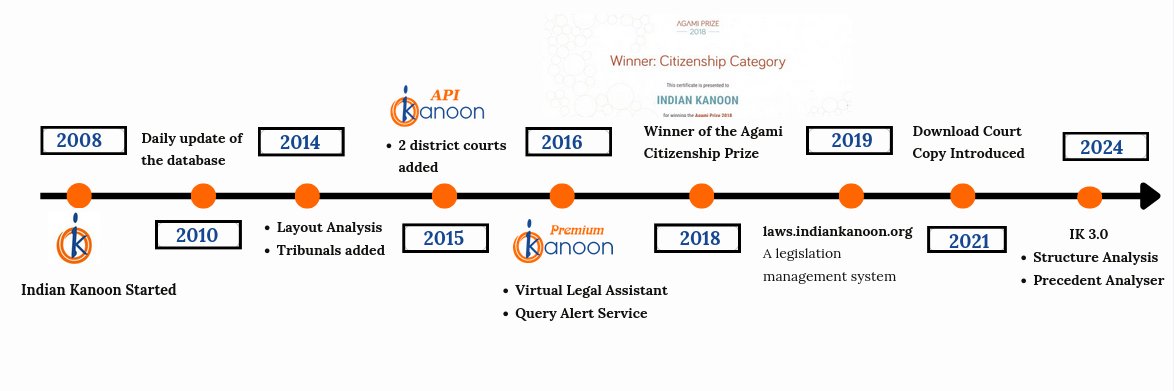
Introducing Prism – a suite of 8 cutting-edge legal research and drafting tools built on our robust database of 4+ crore legal documents, designed to transform how legal professionals work.
Have a legal query? Ask Prism🌈 https://t.co/AthpPUSPpI
@KanoonGPTAI Our API service is available here for AI bots that many are already using https://t.co/P7rfg2fdUC
We can't stop anyone from building whatever they want to build.
I've taken subscription of Indian Kanoon. It is so massively helpful and it beats SCC at times.
Let me rephrase it. It beats the hell out of SCC at times.
You get court copy just like that too.
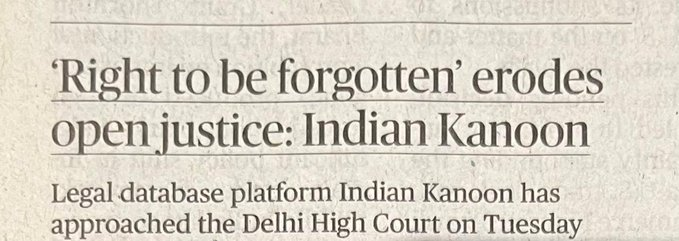
A recent Delhi HC judgment directed @indiankanoon, search engines such as @GoogleIndia@MicrosoftIndia@XCorpIndia to disable name-based searches for court orders in certain cases. The records still exist. But, try finding an Indian court record on the internet without using the litigant's name (!) The Supreme Court is now hearing appeals against the judgment. The right to be forgotten is a compelling idea. But should it create an obligation for everyone else to forget that a case happened?
My column in @ThePrintIndia last week argues that disabling name based searches and masking litigants' names in court records has adverse consequences for commerce, research and access to justice. Moreover, public records shouldn't be harder to access merely because they're uncomfortable. Video explainer here, written version in thread:
https://t.co/631QnX6YOr
Arguments for the Appellant, @indiankanoon, are being led by Sr. Adv. Arvind P. Datar, with the matter briefed by IFF Counsels @apar1984, Uzma Sheikh, @namanbasoyaa, and Pragya Jain.
IFF is grateful to Arvind Datar Sir for his immense support and guidance.
'No One Knows Case Numbers': Delhi High Court Questions Restricting Name-Based Search Of Judgments In IndianKanoon's Appeals
#RightToBeForgotten#Judgments@indiankanoon
https://t.co/3HFSxZ7BYI
#HearingUpdate: 4 Letters Patent Appeal LPA Nos. 581, 582, 583 & 640 of 2026 filed by @indiankanoon concerning the Right to be Forgotten (RTBF) are listed tomorrow, 13.08.2026, before DB-VIII of the Delhi High Court, comprising HMJ C. H. Shankar and HMJ Vinod Kumar.
A very powerful set of arguments were presented by our Senior advocate Mr. Arvind Datar, Apar Gupta and the team before the Delhi High Court Division Bench today. The arguments were rooted in the Constitution and the public right to know. The matter is posted for hearing on merit on September 2nd, 2026.
#HearingUpdate: 4 Letters Patent Appeal LPA Nos. 581, 582, 583 & 640 of 2026 filed by @indiankanoon concerning the Right to be Forgotten (RTBF) are listed tomorrow, 13.08.2026, before DB-VIII of the Delhi High Court, comprising HMJ C. H. Shankar and HMJ Vinod Kumar.
#HearingUpdate: The RTBF LPAs filed by @indiankanoon were re-notified today as the regular Bench was not sitting. It will now be listed in the Sup. List on 19.08.2026 before the DB of HMJ Hari Shankar and HMJ Vinod Kumar.
The arguments for Appellant @indiankanoon are led by Sr. Adv. Arvind P. Datar and briefed by IFF Counsels @apar1984@namanbasoyaa and Uzma Sheikh. IFF is grateful for Arvind Datar sir's immense support and guidance.
The Division Bench agreed to prepone the matter. The batch of appeals has now been listed for preliminary hearing on 13 August 2026. Arguments for @indiankanoon, were led by Sr. Adv. Arvind Datar, instructed by IFF counsels @apar1984, @namanbasoyaa, and Uzma Sheikh.(2/n)
Sr. Adv. Arvind Datar, appearing for @indiankanoon, submitted that impugned judgment presently operates only against the Appellant, while other legal databases continue to function unrestricted. An earlier hearing of the connected appeals was sought on this basis. (1/n)
This is good.
In this judgement, the HC has hyperlinked all the precedents to either SC website or @indiankanoon . (Even if citations are of SCC :P).
Link of LL article:
https://t.co/ZVkRpNW9s4
My piece in @the_hindu today where I argue that accessibility of the law is a major problem as laws are scattered across websites and Govt still uses decades old format of PDF to print Gazettes. We need to modernize and adopt Open Standards for bridging the democratic deficit.
A large part of legal research is in understanding the judgments that one cites for precedent and sometimes even how to critique the precedents that opposing lawyer uses to support their views. It is a laborious task and involves thinking about the judgment along with other precedents around that decision.
While lawyers acumen and knowledge in the field is hard to replicate, we have built a tool called Case Recast AI, that audits a court order based on the legal context that existed up to the day the order was passed. You get an issue-by-issue verdict with traffic-light soundness ratings (🟢 Sound → 🔴 Vulnerable), a dedicated look at the questions the facts raised that the judgment never reached, and the alternative holdings the record could have supported — including ones no party or judge ever argued. Each authority it cites carries a verified Indian Kanoon link, so you can check the reasoning against the source in one click.
We store an analysis that is generated and it stays consistent across users. You can follow up with your own questions on any issue, gap, or alternative holding. We believe that the tool is useful only after you have fully read the judgment. Hence, we ask every user to accept a short one-time notice before their first recast to understand the recast better and we also remind users to verify everything before relying on it.
Hoping you all enjoy Recasting the cases!