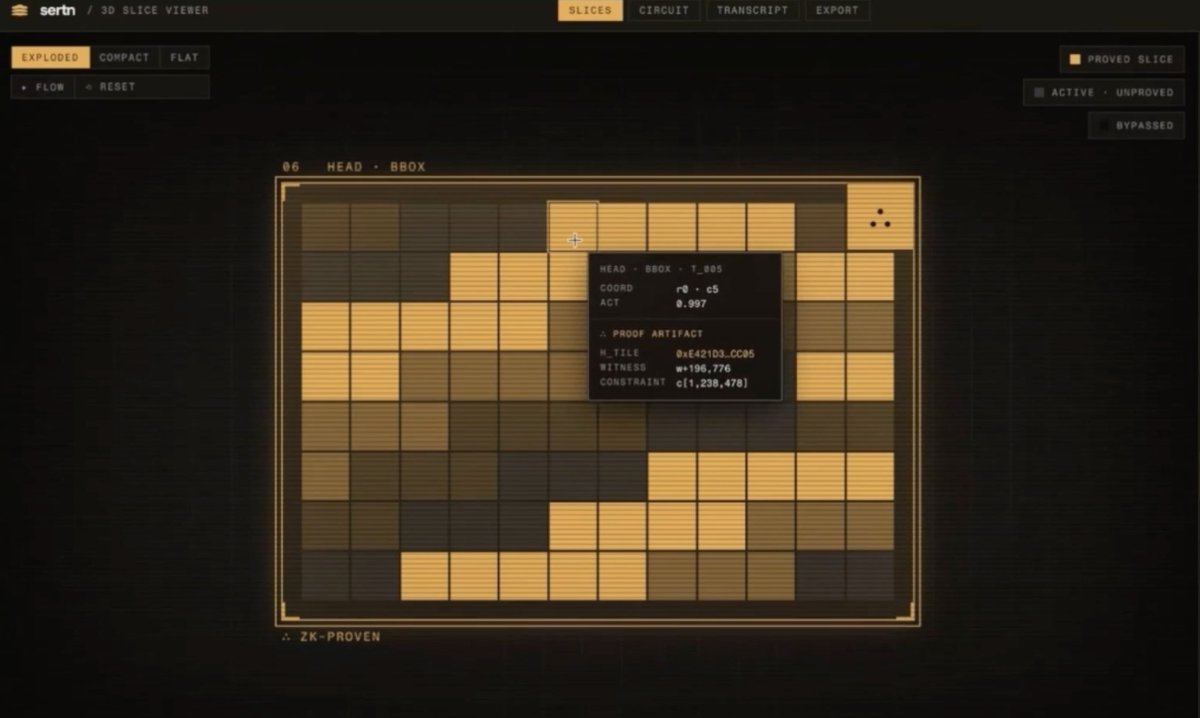
1/ Most AI systems can tell you what a model predicted. Very few can show exactly how it arrived there.
This is a look inside Sertn’s Proof Inspector: a 3D layer for verifiable inference.
From the original frame → activations → proof artifacts → final detections.
NVIDIA is increasingly positioning its next generation hardware around AI agents, not just AI models.
For years the conversation was: "How do we train better models?". Now it's: "How do we operate autonomous systems safely at scale?".
Very different challenge.
Anthropic's IPO filing is another sign that AI is becoming infrastructure, not experimentation.
As the industry matures, governance, auditability, and verification matter more.
The bigger AI gets, the harder "trust us" becomes as a strategy.
SpaceX, Anthropic, and OpenAI are all being discussed as potential IPO candidates.
That says something important about where the market is. Investors are no longer valuing AI purely on research breakthroughs. They want durable businesses, revenue, and production adoption.
2/ But we also focus on something that's often missing from AI deployments: verification.
Instead of relying solely on logs, Sertn can attach a cryptographic proof to an inference, helping create a verifiable record of what happened.
As AI moves into operational environments, trust becomes part of the product.
1/ What is Sertn?
At its core, https://t.co/I6i7xyyRCJ is a computer vision platform built for real-world deployment.
Teams can annotate data, train models, deploy computer vision workflows, and monitor results from a single environment.
Major publishers are continuing to challenge how AI models are trained.
Whether the courts ultimately side with AI developers or rights holders, one thing is becoming clear:
Provenance, transparency, and verification are moving from nice-to-have features to business requirements.
Everyone is talking about AI agents.
Far fewer people are talking about verification.
As AI systems move from copilots to autonomous workflows, the question shifts from "Can it do this?" to "Can we trust what it did?"
That's where the next wave of AI infrastructure will be built.
https://t.co/Xg3Ro0easr
Loss curves provide a really low bandwidth picture of what's really going on within models. With this visualizer, it becomes easy to understand what specifically needs to be done to improve the model.
Computer vision is becoming easier to deploy.
Trusting the output is still hard.
At Sertn, we're building a workflow that brings annotation, training, deployment, and verifiable inference together in one platform, helping teams move from experimentation to production with confidence.
https://t.co/iDkNXZRMUU
2/ Instead of digging through logs, users can explore how individual classes evolve throughout training.
Rich class diagnostics make those insights accessible even to non-computer vision users, helping teams quickly understand model behavior and potential areas for improvement.
1/ Training a model isn't just about accuracy.
It's about understanding 'what the model is actually learning' and where it is struggling.
Sertn's Model Art visualizes class performance in real time, helping teams identify underrepresented classes, missing samples, and training blind spots before they become deployment issues.
https://t.co/iDkNXZRMUU
For years the industry focused on model training. Now we're watching billions of dollars flow into:
* data infrastructure
* deployment
* inference
* governance
* verification
SN2 Dsperse has now surpassed 1B+ proofs completed.
Proof throughput continues to accelerate, with peak volume reaching 19.4M proofs/day as larger models become increasingly practical to verify at scale.
Verifiable inference infrastructure is moving into production.
https://t.co/qv3NBYgmZy
2/ The difference between output logging and runtime proof is where most enterprise AI governance breaks down.
Inference Labs makes inference itself the evidence.
Not a record of what happened. Proof that it couldn't have happened any other way.
1/ Regulators, auditors, and legal teams are all asking the same question in 2026: "Show me what happened and show me the control path behind it."
Logging outputs isn't enough. That's not an audit trail. That's just observing an outcome.
2/ A hospital can license an FDA-cleared CV model and quietly serve a cheaper one.
No patient, no auditor, no regulator can tell the difference today.
Verifiable inference is how that changes. That's the problem Inference Labs exists to solve.
1/ Over 40 bills introduced across 25 US states this year require clinical oversight of AI tools.
Utah now mandates disclosure when AI reviews authorization requests.
The question no law has answered yet: how do you verify which model actually ran?
2/ Every major enterprise is now being asked to prove their AI did what they said it did.
Most can't. They have logs. Logs can be altered.
Cryptographic proof of inference can't be. That's the foundation Inference Labs is building.
https://t.co/91z1UYbDP9
1/ Salesforce just launched a product whose entire value proposition is an audit trail for AI agent actions.
Not the AI itself. Just the record that it ran correctly.
When Salesforce builds around a trust gap, that gap is real and it's large.