The biggest quantum bets aren't building quantum computers. They're building quantum factories.
IBM: $10B, America's first quantum chip foundry. CHIPS Act: $2B across nine companies - for fabs, not research. France: €1.55B the next day. QuantWare: $178M to sell QPUs as standalone products.
The pattern nobody's talking about: this money builds quantum processing units and component supply chains, not complete machines. The industry is componentizing, following the classical semiconductor playbook.
The gap that creates? Systems integration. Who assembles a QuantWare QPU, Bluefors cryostat, Qblox electronics, and NVIDIA interconnects into a working quantum computer?
Meanwhile:
• Microsoft's Majorana 2 hit 20-second qubit lifetimes on a fabrication path incompatible with every fab being built
• OQC raised £260M betting on vertical integration against this trend
• D-Wave published a gate-model roadmap
Full analysis in Quantum Unfiltered #8: https://t.co/pAfPHhjA9U
@projecteleven Thrilled to join. Making digital assets quantum-safe is one of the hardest security (and governance) challenges ahead, and you're the team doing the real work.
Every headline says China built the "world's first dual-core quantum computer." 200 qubits. Zero published fidelity data. Zero peer review. Two state-media sources. The gap between the headlines and the evidence is wide.
CAS Cold Atom Technology in Wuhan announced Hanyuan-2, a 200-qubit neutral atom system using two rubidium isotope arrays (Rb-85 and Rb-87) in a single cabinet. They call this "dual-core." Every English-language article traces back to two Chinese state-media reports: Science and Technology Daily and the Global Times.
What's missing from the announcement: gate fidelity, error rates, coherence times, qubit connectivity, algorithm demonstrations, peer review, independent verification. All of it.
The predecessor system (Hanyuan-1, 100 qubits) at least published fidelity numbers: 0.999 single-qubit, 0.98 two-qubit. Hanyuan-2 provides nothing comparable. A step backward in transparency while claiming a step forward in capability.
For context: Atom Computing built a 1,180-qubit neutral atom array in 2023. QuEra demonstrated 3,000-atom arrays and 96 logical qubits (published in Nature). Pasqal hit 1,000 qubits in 2024. Against that, 200 qubits with no benchmarks is years behind the frontier.
The question nobody is asking: can the Rb-85 array actually entangle with the Rb-87 array? If not, this is two independent 100-qubit machines in one box. The "dual-core" label borrows prestige from classical CPUs without the engineering substance to justify it. And dual-species Rb-85/Rb-87 traps in academic research go back to 2006. Mixed-species CNOT gates between the two isotopes have been demonstrated. The concept has scientific merit, but "world first for a quantum processor" requires a more careful definition of what's actually new here.
What would change my assessment: published interspecies entanglement data, demonstrated error correction where the auxiliary core improves logical qubit performance, two-qubit fidelity approaching 0.997+. None of these have been shown.
The real story is the trajectory. China has a commercially deployed neutral atom company with government backing, domestic supply chains, and export customers. That matters.
This individual product announcement, stripped of its "world first" packaging, does not.
https://t.co/Cf4GDH1VND
Also, I’m just catching up with X drama.
Congrats on controlling all these “Cloudflare, Google, quantum researchers, governments and regulators, military, most of Fortune Global 500, insurers, thousands of startups, many VCs and Angels…”
I’m surprised you didn’t find a better way to monetise all that power.
Cloudflare, Google, quantum researchers, governments and regulators, military, most of Fortune Global 500, insurers, thousands of startups, many VCs and Angels….
Crypto bros: “Nah, Bitcoin protocol reveals the fundamental nature of time, settles one of the oldest questions in fundamental physics, and proves quantum computers are impossible”
While Bitcoin 2026 was giving its main stage to a pseudoscience-spewing VC arguing that Bitcoin's block interval disproves quantum mechanics, @projecteleven, @apruden08 and @conordeegan were finishing 110 pages of actual engineering on the quantum threat to blockchains.
I reviewed the report. It is one of the best single-document summaries of this problem I've seen.
It traces the collapse in quantum resource estimates; maps the specific vulnerability profile of Bitcoin, Ethereum, and stablecoins. It proposes a concrete three-phase migration framework with realistic throughput analysis.
Two original contributions stood out. First, EdDSA chains (Solana, Sui, Aptos) may have a structurally cleaner PQC migration path than ECDSA chains (Bitcoin, Ethereum) because of how RFC-8032 derives signing keys from seeds. Second, PQC Suite B proposes replacing the hash functions inside NIST's post-quantum signature standards with BLAKE3 for 20–30% performance gains - meaningful for blockchains where every signature sits in the critical path.
The report has limitations I flag in my review. The Q-Day model inflates suppression factors and is anchored to RSA-2048 rather than the ECC-256 that actually secures blockchains. Project Eleven builds post-quantum infrastructure for blockchains, so they have a commercial interest. They asked me to review the report before publication, and it cites my CRQC Quantum Capability Framework...
But the engineering work is solid. And the contrast with what was on offer at Bitcoin 2026 is hard to ignore. The people doing this work are not the ones getting the airtime. That needs to change.
https://t.co/uOlzaiszzC
I never cover funding rounds. But I made an exception for QuantWare's $178M Series B.
Not because of the money. Because Intel Capital + IQT backing the only company fabricating modular quantum processors on an open architecture at industrial scale validates the QOA thesis.
Full analysis: https://t.co/cP8RN0w7hb
Some of the industries investing the most in quantum computing will wait the longest to see returns. And the cryptographic threshold sits below most grand-challenge applications on the capability ladder. Your encryption breaks before quantum transforms your industry.
I mapped every major fault-tolerant resource estimate to the real-world problem it solves. Updated through today's Q-CTRL practical quantum advantage result.
https://t.co/bNH3rnyQmp
You quote EY saying late adopters of breakthrough tech fall behind permanently; then you list various major UK companies already investing in quantum; and then even praise the government's approach... and then conclude: ignore it. That's three arguments against your own headline.
Also, unlucky timing with Q-CTRL just today showing real quantum advantage... I.e. pre fault-tolerant quantum computers are starting to deliver real results today.
And if we're comparing risks (you mentioned asteroids). The UK's own NCSC has told organizations to begin preparing, with a 2028 milestone. Quantum isn't just a technology to adopt. It's a threat to defend against.
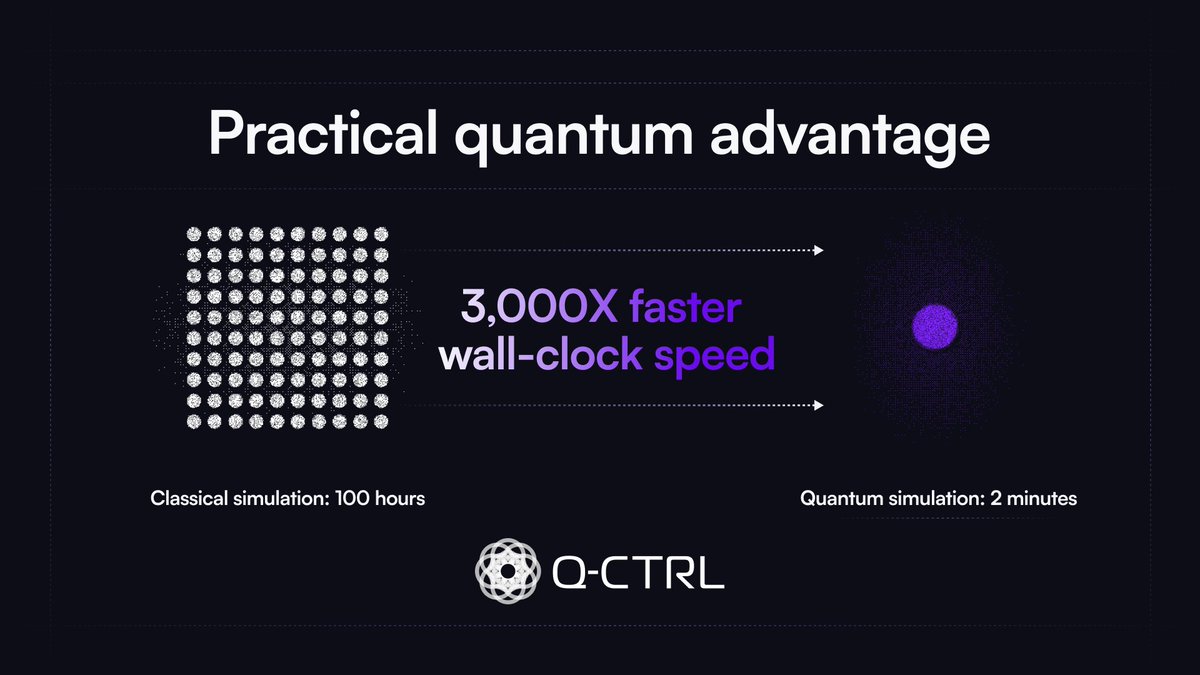
Practical quantum advantage is here. Q-CTRL just ran a 120-qubit physics simulation on IBM Heron in under 3 minutes. The best classical tool needed 160+ hours.
I usually poke holes in claims like these. This time the claim holds. But the real story isn't the physics. 🧵
3/ But here's what physics coverage will miss: for procurement offices and national quantum strategies, the question isn't "is this theoretically optimal?" It's "can a quantum computer do something useful faster than my current tools?"
That answer just changed.
Correct me if I'm wrong, but if all other factors are the same across all chains, then the ranking is based only on the age, market cap and preparedness, right?
The correct statement would then be "Bitcoin has the most to lose and the slowest governance".
I agree with everything you say. I just disagree that it means that it is "most vulnerable" - implying some kind of technical vulnerability assessment.
IT'S HERE!
@qctrlHQ & @IBM bring you Practical Quantum Advantage!
A real problem that people pay actual $ to solve today is 3000X faster on a #quantumcomputer than the industry-standard alternative
Positive ROI is here for quantum!
https://t.co/ljewwLUfRN
Yes they are. They all already have, are hiring, or looking for some great senior people. But that’s focused on market positioning and (slow) capability building. Once the demand is massive and most services are commoditised, they will scale it and dominate.
But today that one senior person cannot service a large number of clients. Physics PhDs that know how to calibrate a quantum computer are not fungible - you can’t deploy them to be ESG consultants tomorrow. And yesterday’s ESG consultants won’t be calibrating QCs today.
Without that fungibility (which is facilitated by commoditisation and templatization), and/or without a huge backlog of demand, the big firm economics doesn’t work.
@SimplyBitcoin If the strongest argument that the Bitcoin community can put on its biggest stage to support "quantum threat isn't real" is this pseudoscientific philosophy-cosplaying BS, maybe it's time to reconsider the conclusion.