In this #InfoQ#podcast, @clare_liguori explains the philosophy behind the #OpenSource Strands Agents SDK, lessons from building and operating agents at scale, and where model-driven agent architecture is headed next.
🎧 Listen now: https://t.co/2xRG4Fi0ES
#AIArchitecture#LLMs
In regulated industries, AI security & privacy guidance often arrives after the decisions do. Most engineers are navigating that with no external peer group making the same calls.
Check out the InfoQ AI Security & Privacy cohort with Katharine Jarmul: https://t.co/O9UP3FQIP4
Here is the trap I am watching teams walk into with AI coding agents.
Someone points an agent at a service, and in an afternoon it generates more code than the team would have written in a week.
Then the next three weeks are spent quietly discovering that the agent dissolved the boundaries they had spent years defending.
It did not do anything wrong but It did the only thing it could because It had no idea why those boundaries existed.
That reason was never written down anywhere, it lived in the heads of the people who built the system.
This is the uncomfortable heart of harness engineering, all the scaffolding we build to steer these agents is really just one thing: encoding the context the system needs so it produces work you would have signed off yourself.
And that turns out to be genuinely hard, because articulating the why behind a distributed system, clearly enough that something without your context can act on it, is a skill most of us never had to practise.
We always had humans to fill the gaps.
Garbage context in, garbage architecture out but now at machine speed!
Getting good at this is the whole reason I facilitate the architecture cohort for InfoQ, where senior engineers are made to explain their real decisions to peers who do not share their assumptions. It is the exact muscle AI now demands.
Next cohort starts 13 August, link in the comments.
#architecture #distributedsystems #ai #softwarearchitecture @InfoQ
I sat down with Thomas Betts on the @InfoQ podcast to talk about what it takes to go from demo to production agent:
- why more if statements make your agent worse
- how to achieve high accuracy and low cost with small models and just-in-time guidance
- what observability means when every hop is inside the agent
https://t.co/aRStZ6cVgo
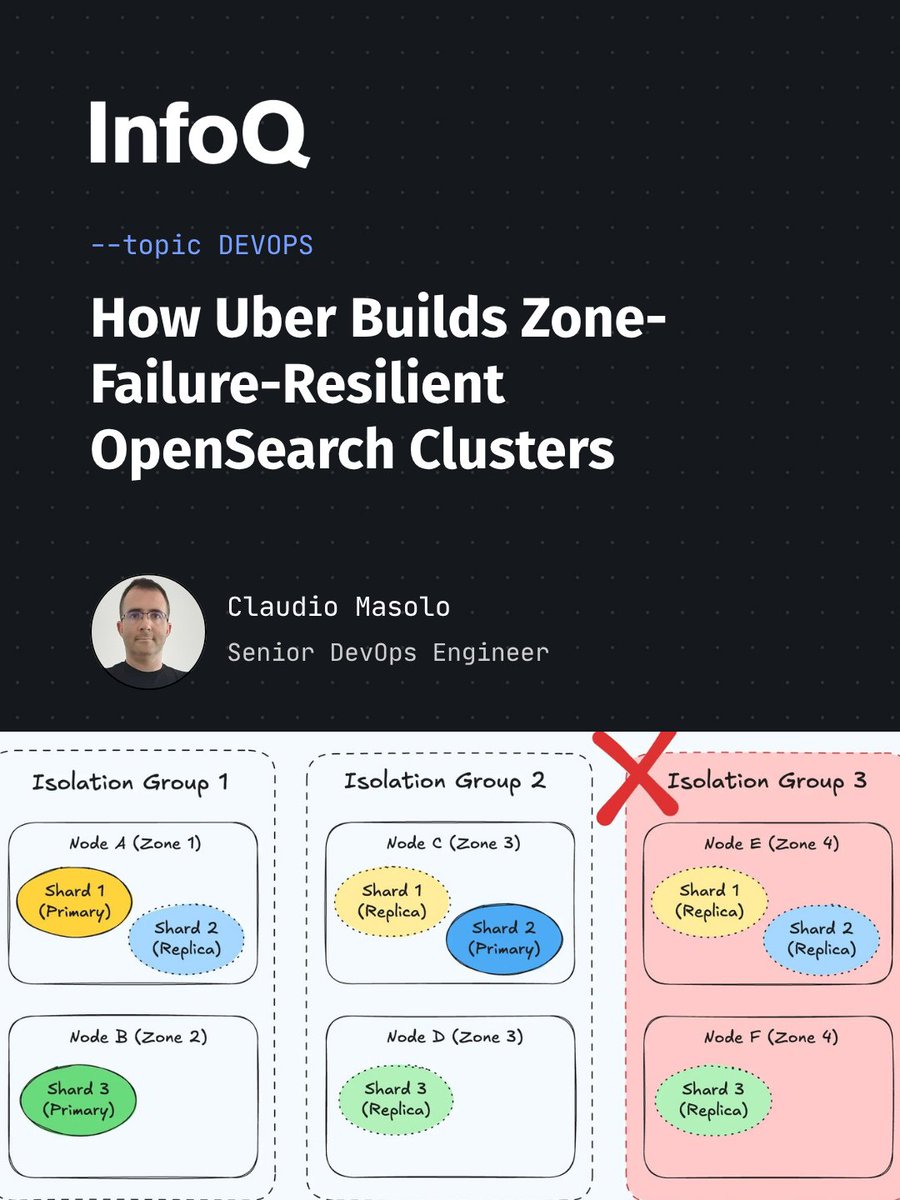
#Uber shared how it keeps #OpenSearch running through zone outages using built-in shard allocation and its isolation-group system on the Odin orchestration platform - maintaining both query and ingestion capabilities.
Read more on #InfoQ 👉 https://t.co/yHeyzsryn8
#DevOps
Is #RustLang 5x more expensive & slower to develop with than Kotlin or Go? This #InfoQ talk challenges that myth 👉 https://t.co/jshBbi7KUF
Learn how Rust’s compiler, borrow checker, and compile-time safety shorten the developer feedback loop - reducing total engineering costs.
AWS released a self-hosted gateway for Claude Code & Claude Desktop that centralizes identity, policy, telemetry & spend caps.
It routes inference directly to Amazon Bedrock or Claude Platform on AWS.
👉 https://t.co/k0uSMXXwNa
#AWS#Claude#CloudArchitecture#AI#InfoQ
A proud moment for all of us at #InfoQ: we make a cameo several times in "The Java Story" documentary.
Even better, many of the people featured in the documentary have also been QCon speakers over the years.
https://t.co/1TYI6qh6r9
Moving 50 TB of data without disrupting production is no easy task.
See how #Netflix used #RocksDB SST files to redesign its data ingestion pipeline:
➤ Deployment time: days → 30 min
➤ Infrastructure costs: -70%
Watch now ➤ https://t.co/V7regAT7uj
#DataEngineering
Migrating to #MicroFrontends promises scalability and faster delivery - but the journey isn't simple.
@lucamezzalira shares lessons on:
🔹 Architectural boundaries
🔹 Incremental adoption strategies
🔹 The trade-offs and pitfalls
🎬 Watch now: https://t.co/EE5haELIAV
#WebDev