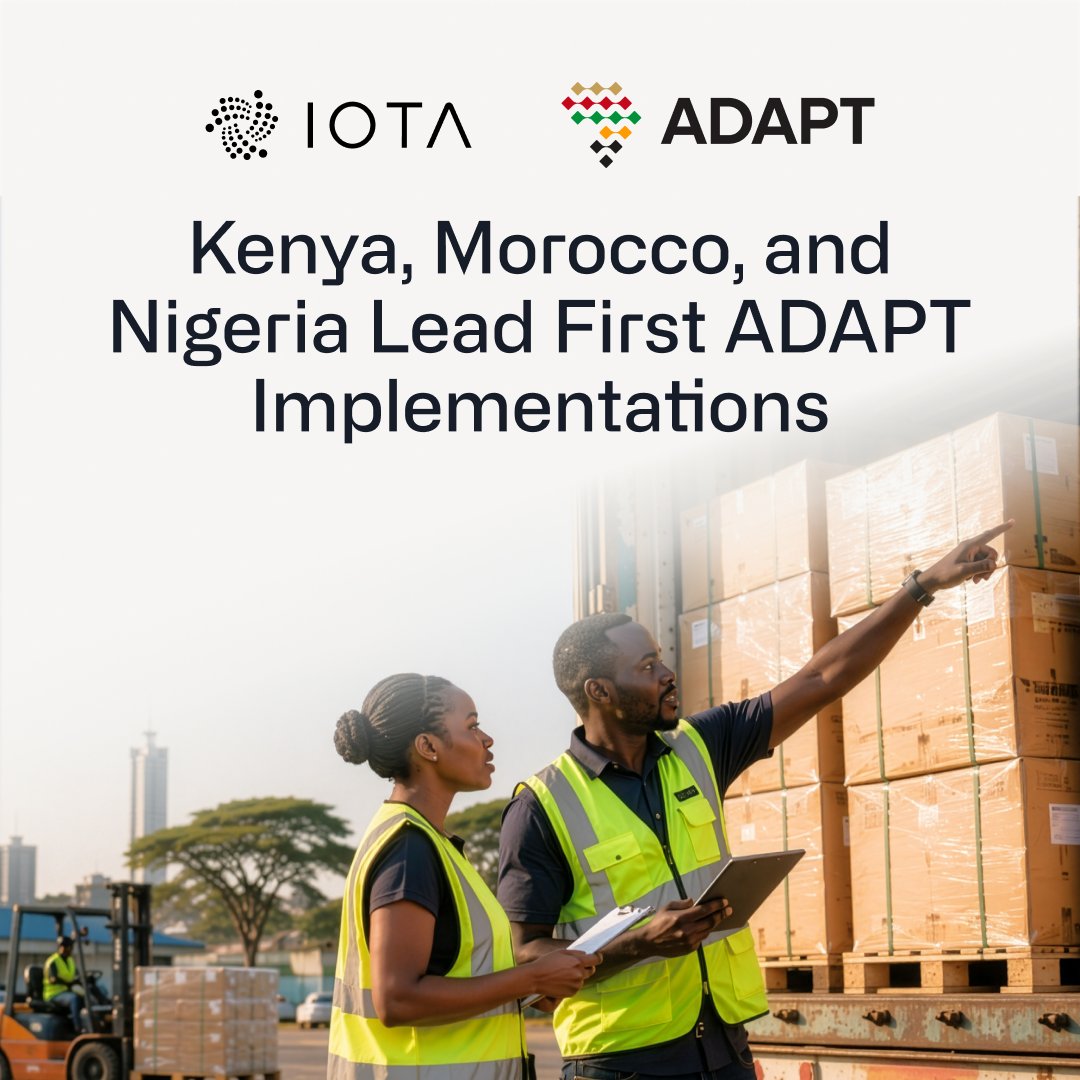
Kenya, Nigeria, and Morocco have been selected as the first countries to implement ADAPT - the Africa Digital Access and Public Infrastructure for Trade initiative.
Yesterday, I received a delegation from the Tony Blair Institute for Global Change (@institutegc) and the IOTA Foundation, led by TBI Nigeria Country Director, Obianuju Uchenna and Senior Advisor Alban Odhiambo.
We discussed streamlining cross-border trade through ADAPT (Africa Digital Access and Public Infrastructure for Trade) - a strategic initiative by the @afcftasecretariat to operationalize the Protocol on Digital Trade. This critical infrastructure will lower trade costs, accelerate customs clearance, and unlock new markets for Nigerian businesses.
#WeMove🇳🇬🇳🇬🇳🇬🌍🎯 #HMIndustryTradeInvestment #FMITI
"Africa isn't just catching up - it's leapfrogging, getting ahead of other countries."
@DomSchiener, Co-Founder of IOTA, on the opportunity ADAPT represents for Africa to build world-leading digital trade infrastructure.
In Kenya, we connected to 34 different government systems.
Getting their data. Putting it on chain.
Making it verifiable. Making it shareable.
That's what real-world adoption looks like.
The ShimmerBridge on ShimmerEVM, powered by LayerZero, will be discontinued on August 28, 2026.
We strongly recommend that all holders of bridged assets on ShimmerEVM (incl. tokens like LUM and DEEPR) bridge them back to a supported network before this date.
#Shimmer
In an ideal world, a port can trust where the data comes from.
Not because someone said so.
Because the origin, the authenticity, and the integrity of the data can be proven on-chain.
@JensLundNielsen Trust, interoperability, collaboration. That's the basis of the recently announced ADAPT implementations.
Learn more on our blog:
https://t.co/TTuPARhnoP
"International trade is a teamwork. What IOTA brings is interoperability - one common way of sharing data so people can trust it and know who they're working with."
@JensLundNielsen, Head of Global Trade & Supply Chains, on what IOTA brings to ADAPT.
If you want to get deeper technical knowledge of our protocol, and specifically Starfish - @kowei1995 has got you covered with this excellent article. Have a read!
Hi all 👋 Sharing a research note I put together recently — on how the Mysticeti consensus protocol diverged into Sui's Mysticeti V2 and our own Starfish at @IOTA. I used LLMs to help structure the technical narrative and the result was surprisingly clear, so sharing both the method and the content.
The starting point: Mysticeti v1's betDrop explicit certification, let the DAG structure itself act as a "virtual certificate," and push BFT latency down to the theoretical lower bound of 3 message delays. This buys extremely low latency — but the cost is two open gaps: liveness lacks a rigorous proof, and dissemination is fragile at scale.
The two diverging paths
Sui → Mysticeti V2: Concludes the consensus core is already near-optimal, and instead targets the pre-consensus transaction validation that sits outside consensus — optimizing for happy-path latency.
IOTA → Starfish: Concludes the core's dissemination / liveness is the actual problem, and uses erasure coding + DAC to put the certificate back into the core in a cheaper form.
https://t.co/YOcpsFHPlj
We're not competing with national trade systems.
We're building the international highway between them.
A country like Vietnam or Singapore isn't going to trust data from a Korean national system by default.
IOTA changes that - because the trust is in the infrastructure, not just the relationship.
The IOTA standard? High performance & low impact.
We’ve built a powerful, energy-efficient network that drives scalable digital innovation without the heavy carbon footprint.
See the data and tech behind our green infrastructure here: https://t.co/vHnvsIuBx4