Earlier this year, our 2026 Anti-Roadmap set a bold challenge: Become AI's interface to the physical world
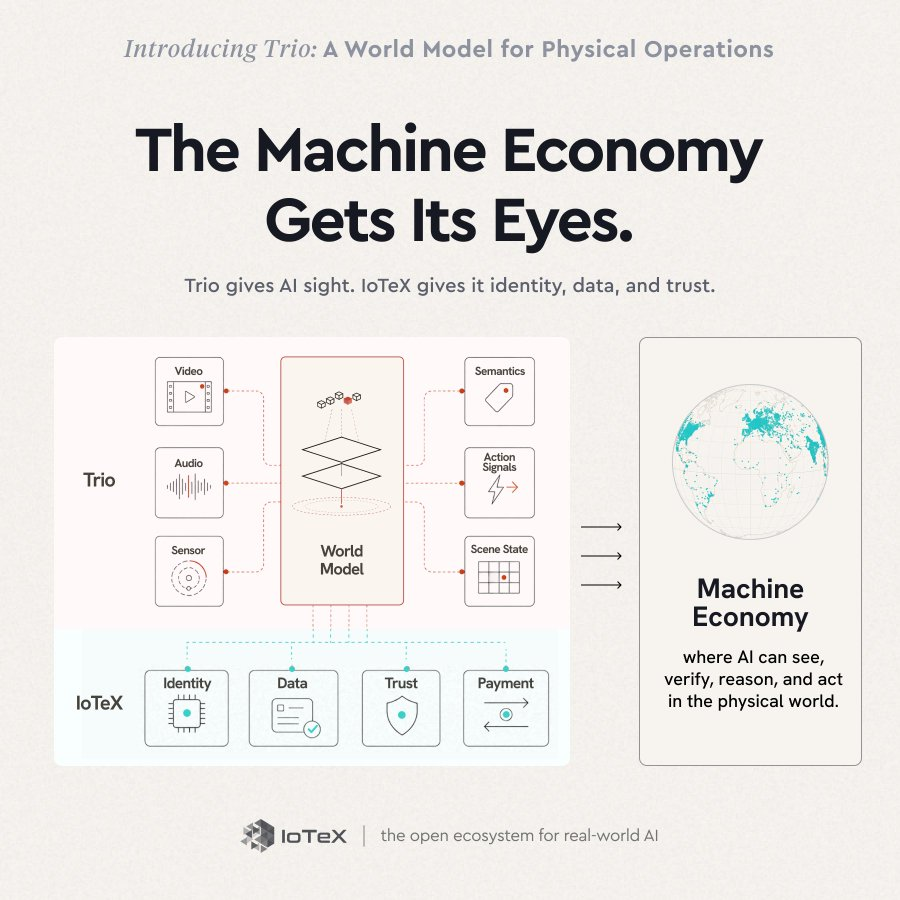
Today we share our answer: Trio, a world model for physical operations by MachineFi Lab & IoTeX core team.
AI learned language first. Now it's operating the real world.
Behind every block on IoTeX, there's a builder.
iotex-core, the Go engine powering Real-World AI, is 100% open source. The community keeps showing up:
-120+ open-source contributors
-3,500+ pull requests
-100+ releases
The infrastructure for Real-World AI, built in the open👇
The biggest AI summit in SF is happening this weekend, and the IoTeX team will be on the ground. 🌁⚡
We're looking forward to connecting with the top minds shaping the next era of real-world AI at @agisummitai.
Who else is heading out? Let’s connect! 👇
Trio-Lumen turns plain English into a live perception rule in under a minute:
1️⃣ Language compiles into a structured detection rule
2️⃣ Real-time tracking (~30ms) + VLM semantic judgment per subject
3️⃣ Every alert fires as a structured event — frame, zone, track ID
Zero labeling. Zero training. Zero CV pipeline.
For Developers: Perception becomes a programmable primitive — any camera turns into an event stream you can build on: automation, safety, agent workflows grounded in real-world observation.
This is world-model-powered physical understanding, in production. 🎥👇
Most cameras record the world. They don't understand it. 👁️
Meet Trio-Lumen — point it at any RTSP feed and just tell it what to look for in plain English (e.g., "flag anyone in the loading dock after hours").
It runs frontier vision models 24/7, turning raw video into a live, queryable world-state: who's where, what they're doing, and where they're heading.
🧠 Under the hood, Trio is the world model we are building for the physical world (perceive → represent → predict):
🔹 Perceive (The Eyes): Plug in any frontier model (YOLO, DINOv2, V-JEPA) to extract data from pixels.
🔹 Represent (The Brain): Outputs land in Trio-Retina (open-source), organizing raw video into one structured, queryable database.
🔹 Predict (The Intuition): A dynamics head that learns the patterns of your space to anticipate what comes next.
This is how AI actually connects to the physical world: not as a black box, but by making reality readable. Stop watching your video feeds and start talking to them.
Try it out here 👇
AI conquered the digital world — language, code, images.
Now it's coming for the physical one.
Today we're launching Trio: a world model for physical operations.
AI learned language first. Now it's operating the real world.🧵🧵
Earlier this year, our 2026 Anti-Roadmap set a bold challenge: Become AI's interface to the physical world
Today we share our answer: Trio, a world model for physical operations by MachineFi Lab & IoTeX core team.
AI learned language first. Now it's operating the real world.
Where @iotex_io is heading?
At IoTeX, we’re exploring several concrete directions:
- verified real-world data from devices
- GPU compute for batch / latency-insensitive AI workloads
- identity for machines and AI agents
- verifiable AI execution pipelines
- agent payments and onchain settlement
This is why EVM parity, account abstraction, rollups, and cross-chain readiness matter.
Real World AI needs real infra.
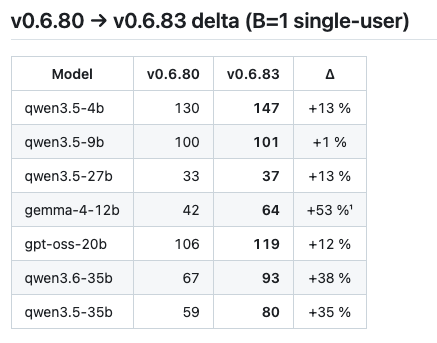
Massive performance leap in rapid-mlx v0.6.83 🚀
We fused the top-p sampler into a single lazy-graph segment, completely bypassing mlx-lm's two-compile closure chain bottleneck.
The result? The entire hero table is up 12-53%, with Gemma-4-12b flying at +53%. Pure edge inference efficiency. 🔥
Everyone's running open models now — so we made running them a lot cheaper. 🚀
Meet QuickSilver Pro: the cheapest API for top open-source LLMs.
Same OpenAI — compatible SDK, zero lock-in.
20% under OpenRouter, up to 75% under Together AI & Fireworks.
👉 https://t.co/3yZcvEqBXB 🧵