The comparison points one way.
Ethereum is still working to connect its own rollups to each other. Solana outsources connections to third-parties. Zcash deliberately stays apart.
NEAR is the only one of the four with a production system for connecting all of them, without asking any of them to give anything up. Chain Signatures doesn't wrap another chain's assets or route them through a NEAR chokepoint. It lets a user act natively on their chain of choice, with each chain keeping its own security and sovereignty.
In an industry that has spent a decade fragmenting, NEAR's bet is that the connective layer, not any single destination, is where the durable value accrues.
Read the full report: https://t.co/JS3M4UHwsg
NEAR runs two production systems that together make it the connective layer of this comparison.
First, Chain Signatures: using MPC threshold signing, a single NEAR account can produce valid signatures for Ethereum, Solana, Zcash, and 30+ other chains, turning that account into a smart wallet on every one of them.
No bridge. No wrapped asset. The account signs once on NEAR, the signature is natively valid on the destination chain, and custody and settlement stay on that chain's own security.
It moves authority, not assets.
Second, NEAR Intents, a multichain transaction protocol where a user or agent declares a desired outcome ("swap Token A for Token B"), a competitive network of solvers executes it, and a Verifier contract settles it atomically.
Intents accepts signatures from near:native , ethereum:native , @trondao , solana:So11111111111111111111111111111111111111112 , stellar:native , the-open-network:native, and passkey wallets, so users arrive from whatever ecosystem they already live in.
Chain Signatures supplies the cryptographic reach. Intents supplies the usable settlement layer on top.
Zcash is purposefully isolated. Its privacy guarantees depend on shielded pools staying self-contained, and the bridges that do connect it carry deanonymization risk.
For zcash:native , isolation is a property of its threat model, not a gap in its roadmap. Zcash deliberately stays apart.
And yet, NEAR Intents has become a leading venue for moving in and out of ZEC, more than $1.5 billion in cumulative volume, and Zcash's own flagship wallet, Zashi, taps NEAR Intents for private swaps into fully shielded ZEC. Confidential Intents runs those swaps inside a TEE-backed private shard, preserving the very privacy that makes bridging anywhere else a liability.
Even the chain that most wants to stay separate connects through NEAR.
Each chain's runtime matches its broader philosophy:
Ethereum optimizes for composability and accepts a dangerous default. Solana optimizes for throughput and accepts bounded composition. NEAR optimizes for safety and horizontal scale, historically at the cost of easy atomicity, a cost it is now engineering away.
Three bets. One destination. The question is which is already built for the agent economy.
Read the full report: https://t.co/JS3M4UHwsg
On a protocols execution environment:
The runtime and concurrency model decide which applications are even possible, and how cleanly they compose.
Sequential vs. parallel, synchronous vs. asynchronous calls, deterministic vs. variable gas. These aren't implementation trivia. They determine whether complex, multi-contract, multi-agent workflows run predictably and affordably or collapse under contention and reentrancy risk.
As agents begin executing real work across many contracts at once, safe parallelism is the difference between toy applications and dependable automated commerce.
Double clicking on solana:So11111111111111111111111111111111111111112 :
Solana's Sealevel executes non-overlapping transactions in parallel within its single shard, the source of its throughput.
But calls between programs (CPI) remain synchronous and capped at limited depth. So Solana gets parallelism across independent transactions while inheriting synchronous semantics within one, bounding composition depth to contain the risk.
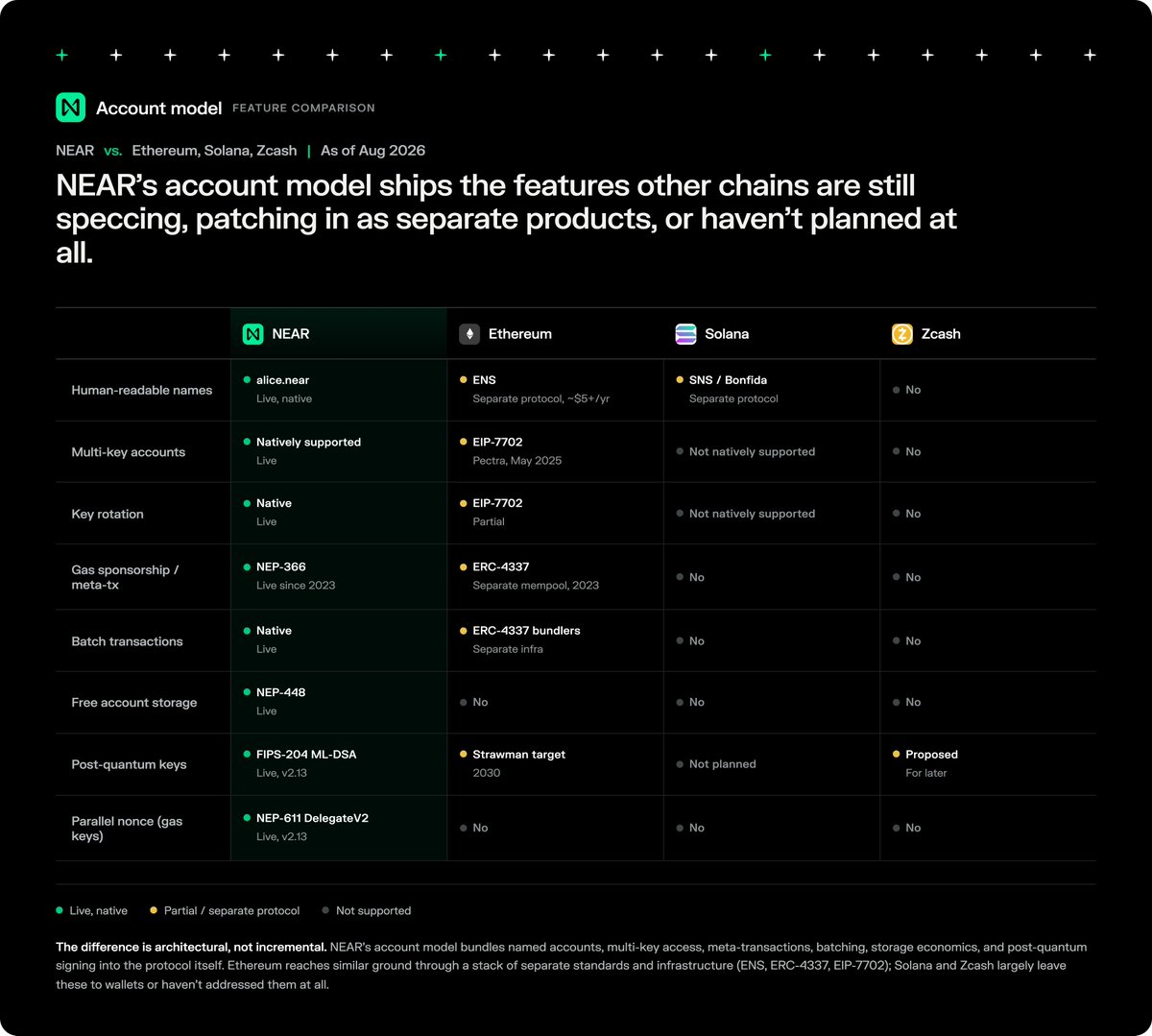
The comparison table reads as a column of checkmarks. The more important story is what those checkmarks cost each network to earn, or whether it can earn them at all.
Each chain's early choice about its account model now bounds how far it can extend. And that's why the account keeps coming up: it's the foundation every other story like chain abstraction, agents, and post-quantum, builds on.
Read the full breakdown below: https://t.co/JS3M4UHwsg
The account is the atomic unit of identity, ownership, and control. Its design decides everything a user, or an agent, can natively do: key recovery, scoped permissions, gas sponsorship, batching, basic identity.
A thin account (a bare keypair) forces all that logic up into wallets and middleware. A rich native one turns the account into a programmable identity.
That difference is what lets an agent act for you with narrow, revocable authority, instead of demanding all-or-nothing custody of your keys. It's the safety property the agent economy depends on.
Ethereum shows what it looks like to retrofit a rich account model onto a design that didn't begin with one.
Its base unit is the externally owned account, a bare keypair, so gas sponsorship, batching, session keys, and social recovery have all had to be built on top. ERC-4337 built account abstraction outside the protocol; EIP-7702 added delegation at the consensus layer.
Now there's an unresolved standards fight over what native account abstraction should even be, and none of it has shipped.
Ethereum will get there. But account abstraction is genuinely hard to add after the fact, and it's paying that cost in years and standards debates.
Solana's account model is robust and fast, but comparatively inflexible.
Accounts are base58 public keys, with state cleanly separated from programs, excellent for parallel execution, but offering none of the native identity ergonomics a richer model provides: human-readable names, scoped access keys, protocol-level sponsorship.
ZK Compression opens a path to rent-free compressed accounts, but it's a mechanism layered on top, not a property of the base account itself.
Zcash sits almost entirely outside this axis, and that's by design.
It inherits Bitcoin's UTXO model: shielded and transparent pools of unspent outputs. No accounts, no programmable keys, no contracts in the sense the others mean.
Not a deficiency, a different design for a different purpose: private payments, not programmable identity.