JAC is a leading UK vaping brand. Standing for quality, performance and reliability, we design our own hardware in-house, in the UK. Technically, the best vape
Check out this cool throwback to when JAC Vapour was featured on GQ Magazine in 2016 as one of the 10 coolest things in the world that week! 😎 #ThrowbackWednesday#JACVapour#GQMagazine
https://t.co/oWqtvhM7aW
The UK Vaping Industry Association (UKVIA) has today expressed its shock and dismay at the Tobacco and Vape Bill Committee’s decision not to invite the vaping industry or vapers to give evidence, calling it “fundamentally undemocratic.”
Last week, the political website @GuidoFawkes reported its surprise at seeing that the 16-member committee contained no MPs who voted against it. The make-up of the Bill’s committee has also drawn criticism from industry commentators, who have labelled it “ludicrously one-sided”.
John Dunne, Director General of the @Vaping_Industry, said: “Over the last few months since the vaping consultation which led to the proposed ban on disposables, we have tried to engage with the government on numerous occasions to present our perspectives. Instead, it is clear that the government feels we are trying to derail or slowdown their plans, which could not be further from the truth.
“Whilst we do not agree with the disposable vapes ban, we accept that it is going to happen as the government feel this is the best way to tackle youth vaping, albeit this category has been instrumental in helping smokers quit. However, the government is walking blindly into a bigger problem that the Bill could address with an amendment – that being the widely predicted rise of illicit vape products in the wake of such a ban that will pose a significant public health risk to children and adults alike.
“That’s why we’ve been pushing for the introduction of a vape retailer and distributor licensing scheme to tackle this issue and deal with the unintended consequences of the ban on single use vapes, not to overturn the ban. The Secretary of State for Health and Social Care only last week referred to this scheme as the line the industry is now taking, which showed absolutely no respect for our commitment to regulate our own industry. The government has completely ignored that we have been pushing for such a scheme for the last few years. The absence of a retailer and distributor licensing scheme will, if not taken on board, represent a missed opportunity for an otherwise landmark piece of legislation. If the government ignores our warning, we will ensure we hold them to account for the impacts of an out-of-control black market, as they are now seeing in Australia.”
The UKVIA is broadly supportive of the aims of the Tobacco and Vapes Bill and the impact it is expected to have on reducing smoking and youth vaping rates. However, in addition to pushing for the licensing scheme, it is also concerned that the absence of a statutory requirement for the Government to consult before making regulations poses a significant risk of arbitrary decision-making. The UKVIA has therefore submitted two amendments for the Bill committee to consider, including the call to introduce the licensing scheme, along with the need for future Governments to undertake a statutory consultation with both industry participants and the general public prior to use the powers as granted by the Bill.
Added Dunne: “You really could not make this up – the committee does not include any MPs who opposed the 2nd reading of the Bill, nor has it invited anyone from the industry or vapers themselves to give evidence on the Tobacco and Vapes Bill – our office has tried to make contact on a number of occasions so I could represent the industry’s interests, but to no avail. Instead, many of those asked to give evidence have publicly criticised vaping in one way or another. Not only does this risk the Bill not facing proper scrutiny prior to its third reading, but it is fundamentally undemocratic, with the people this Bill will impact the most not being able to provide evidence on how the Bill can be improved.”
Following the non-inclusion of the vaping industry and vapers to give evidence to the Bill’s Committee, the UKVIA has written to both Preet Gill, Shadow Minister for Primary Care and Public Health, and Lord Markham, Parliamentary Under Secretary of State at the Department for Health and Social Care, expressing its disappointment at the approach being taken and asking them to challenge the selection process.
The UKVIA has also written to Dame Andrea Leadsom, Minister for Primary Care and Public Health, pointing out the undemocratic approach to the selection process to give evidence to the Tobacco and Vape Bill’s Committee. At the same time it highlighted to the Minister the “growing list of decisions by the Department of Health and Social Care to exclude the UKVIA from any meaningful collaboration with the Department.
The UK Vaping Industry Association (UKVIA) has welcomed a vaping report by the @RCPhysicians. It has applauded the medical body’s evidence-based balanced view on the need to deal with key challenges such as youth vaping and the environmental impact of the category, without undermining the role that e-cigarettes play in helping adult smokers quit their habits and ensuring former smokers turned vapers don’t relapse.
On the back of the report, E-cigarettes and Harm Reduction: An Evidence Review, the trade body urged government to take note of the RCP’s recommendations and its warning that “vaping underutilised by people who want to quit or reduce smoking represents a large, missed opportunity to reduce morbidity and premature mortality.”
It also challenged the government to come up with the evidence, as the RCP has done so in its report, to provide vaping impact assessments around restrictions on flavours, packaging and product presentation and retail displays. In particular, the trade body warns the government that “if it reduces flavours significantly or bans them in future, it is doing so against the advice of one of the most respected and eminent medical bodies in the UK.”
The UKVIA praised the RCP for its support on actions that it has been putting forward for a number of years including a vape licensing scheme; the need to deal with inappropriate flavour descriptors and packaging images which appeal to children; and a wider remit for the Medicines and Healthcare products Regulatory Agency (MHRA) to tackle malpractice by vaping businesses at the product approval stage.
Said John Dunne, Director General of the UKVIA: “We are absolutely on the same page as the RCP in looking at doing everything to discourage young people and never smokers from taking up vapes and focussing on ensuring as many of the 6.4 million smokers that remain in the UK make quit attempts using vape devices.
“There are two sides to our industry – the legitimate one (the majority) and the illegal one (the minority). The former wants to do what vaping was intended for originally – to support smokers to give up their habits and drastically reduce the exposure to the harm associated with conventional cigarettes by taking up vapes which have been approved for sale in the UK by the regulators. I know that I speak for the good side of the industry in welcoming ongoing research that the RCP is recommending to ensure smokers and vapers feel reassured about the relative safety of the category versus smoking.”
The UKVIA warmly welcomed the RCP’s recommendations to:
· include reduced risk messages on cigarette packs to focus on getting smokers to switch over to vapes;
· ensure access to a variety of flavours to encourage uptake of e-cigarettes for smokers to quit;
· ensure trained specialists are available in all healthcare settings to offer support for smoking cessation using vapes;
· give the MHRA a wider remit in the product notification process, from random sampling of products for independent validation of content and emissions data, to checking that vape companies have registered with environmental agencies via producer compliance schemes;
· focus vaping campaigns on those who are likely to experience the most benefits, including smokers with mental disorders, the most socio-economic disadvantaged and people living in social housing, thereby reducing smoking related health inequalities;
· look at trends in smoking to vaping transitions to inform local tobacco control;
· sufficiently resource Trading Standards to effectively enforce e-cigarette sale legislation and reduce underage sales;
· introduce a retail licensing scheme to reduce access to e-cigarettes amongst young people.
Concluded Dunne: “It is clear that the RCP sees a major public health prize in vaping and its up to the industry, regulators, enforcement bodies and policy makers to ensure that this is fully realised; and that e-cigarettes do what they do best and help the remaining smokers in the UK give their habits up in the coming years and enable the government to achieve its smoke free ambition.
“Whilst we support the majority of the RCP’s recommendations, it’s also fair to say that there are some points that we would like to clarify with the medical body. These include their views on product visibility, packaging, pricing and taxation to ensure that these do not become a barrier to take up amongst adult smokers by conflating smoking with vaping and making e-cigarette use unaffordable for the socio-economic disadvantaged.”
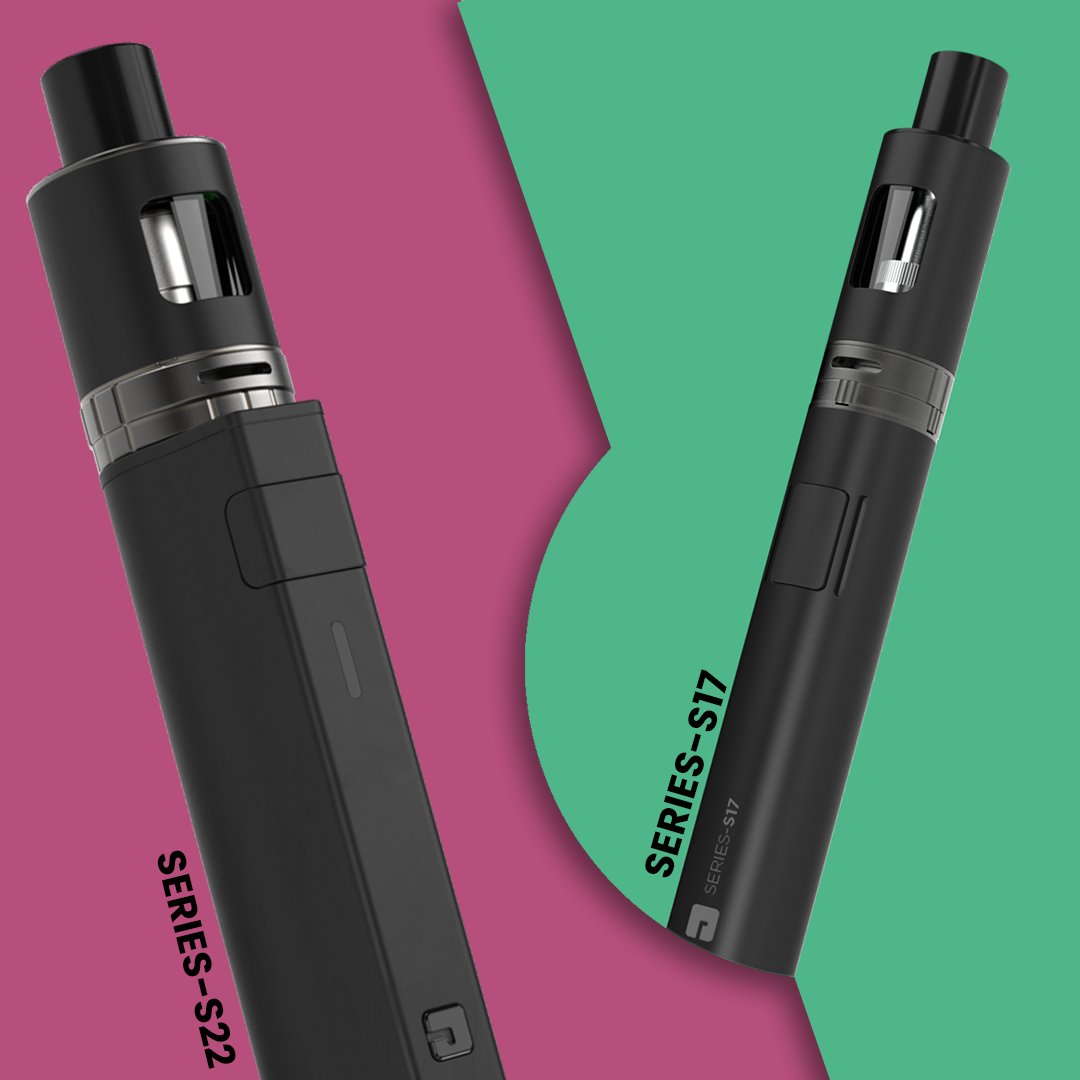
Treat your sibling to one of our SERIES-S Siblings to celebrate #NationalSiblingsDay!
Choose from the sleek and compact SERIES-S17 or its big brother, the powerful SERIES-S22. Both provide an incredible vape experience, adjustable airflow and long battery life.
“Vaping and smoking are not the same.”
Debbie Robson, Senior Lecturer in Tobacco Harm Reduction at @KingsCollegeLon highlights the differences between vaping and smoking, as well as addressing common misconceptions.
The vaping tax is an unusual take on “levelling up”. Levelling up the tax burden so poorer people pay more to protect their health; a regressive tax that aggravates health inequalities. Public health activists backing a vape tax need to give their heads a shake.
👀@CMO_England
Chancellor Jeremy Hunt will today announce the Spring Budget, which is expected to bring in a new levy on vaping products.
Vaping is shown to be one of the most effective stop smoking tools available for adult smokers and, in turn, helps drastically reduce cost of care the NHS provides to smokers – research from Brunel University London estimates that the NHS stands to save £500 million if just HALF of adult smokers made the switch.
There is no sense in making it more difficult for adults to stop smoking by essentially penalising those who want to use a proven less harmful alternative, which is why UK Vaping Industry Association (UKVIA) has been strongly advocating against the introduction of any new levies on vaping products and has written to the Chancellor to express our concerns.
UKVIA spokespeople are scheduled to make regular TV and radio appearances throughout the day to further warn against the dangers of such a move – which could also drive black market sales by widening the price gap between legitimate and illegitimate products.
Watch this space for more updates.
#budget2024 #Vapetax
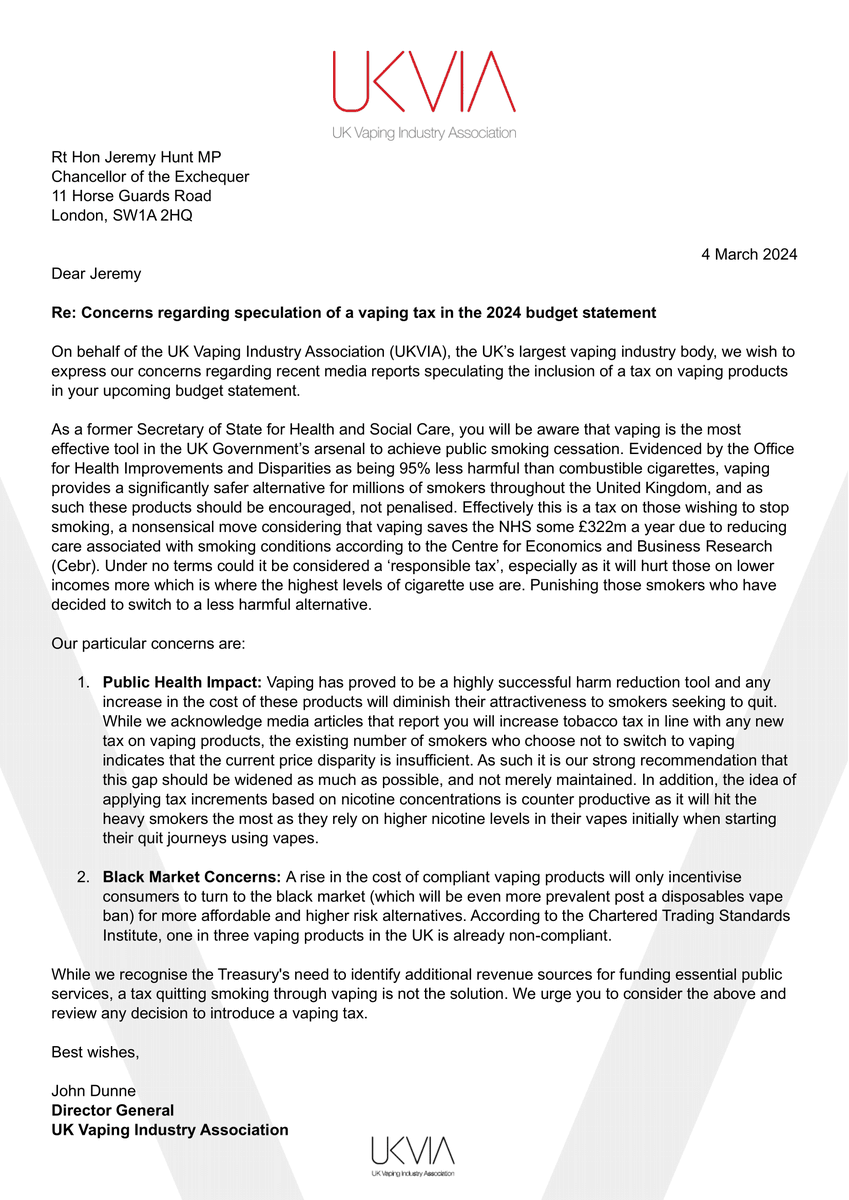
As Chancellor Jeremy Hunt finalises the Budget speech he will deliver to the House of Commons tomorrow at 12.30pm, the UK Vaping Industry Association has expressed concern at the negative impact any new vaping taxes would have.
UKVIA Director General John Dunne has written to the Chancellor to point out that vaping is the most effective tool in the Government’s arsenal to achieve public smoking cessation, and with smoking killing 250 people in the UK each day, vaping should be encouraged and not penalised.
Essentially a tax on vaping would be a tax on those who want to stop smoking and the UKVIA urges the Chancellor to think again.
Dunne wrote: “Under no terms could it be considered a ‘responsible tax’, especially as it will hurt those on lower incomes more which is where the highest levels of cigarette use are and ultimately punishing those smokers who have decided to switch to a less harmful alternative.”
The UKVIA is particularly concerned that increasing vape tax rates would negatively impact public health and lead to an increase in the black market.
The letter says: “Vaping has proved to be a highly successful harm reduction tool and any increase in the cost of these products will diminish their attractiveness to smokers seeking to quit.
“A rise in the cost of compliant vaping products will only incentivise consumers to turn to the black market (which will be even more prevalent post a disposables vape ban) for more affordable and higher risk alternatives.
“According to the Chartered Trading Standards Institute, one in three vaping products in the UK is already non-compliant.”
#Budget2024 #vaping #Vapingindustry
We believe that banning flavoured e-liquids is not the answer.
If a flavour ban is enforced, we would expect to see an increase in people switching back to smoking, along with a rise black market product use.
Agree? Sign below:
https://t.co/tOyWmzn7MY
"The industry is desperate for government to enable Trading Standards to enforce the law and stop vapes getting in the hands of children; if they ban flavours or disposables, it will not only encourage an unregulated black market.. " https://t.co/fYrlcpc9VC
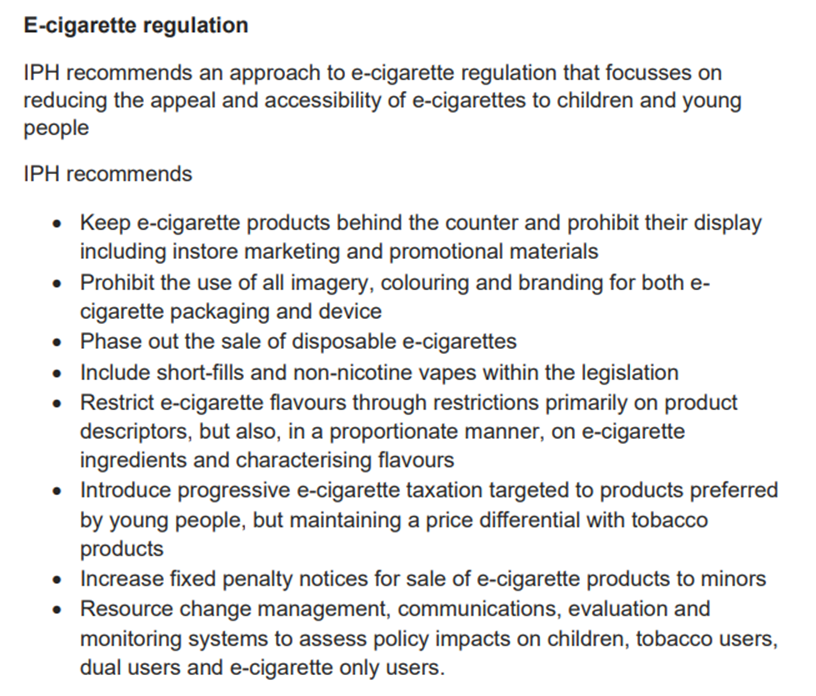
IPH welcomes UK govt plans to ban disposable vapes & introduce new powers on vape flavours, plain packaging and shop displays
IPH supported a ban on disposable vapes in response to the 2023 UK consultation on smoking and vaping – read IPH’s submission >>>https://t.co/JfN3GsoeEk
@MDavis_2020@CaeruleanSea@7Sec4 It is already illegal to sell to under 18s. Trading Standards do not currently appear to have the muscle to fine or punish unscrupulous retailers, who are acting out with already tight laws.
@julescamoore@BBCBreakfast No, selling to under-18s is illegal, precisely because this is a regulated market. It's the enforcement, not the regulations, that need more muscle.