Founder/CEO of @acumen: solving tough problems of poverty. Author of "The Blue Sweater" and "Manifesto for a Moral Revolution."
Builder for Human Dignity.
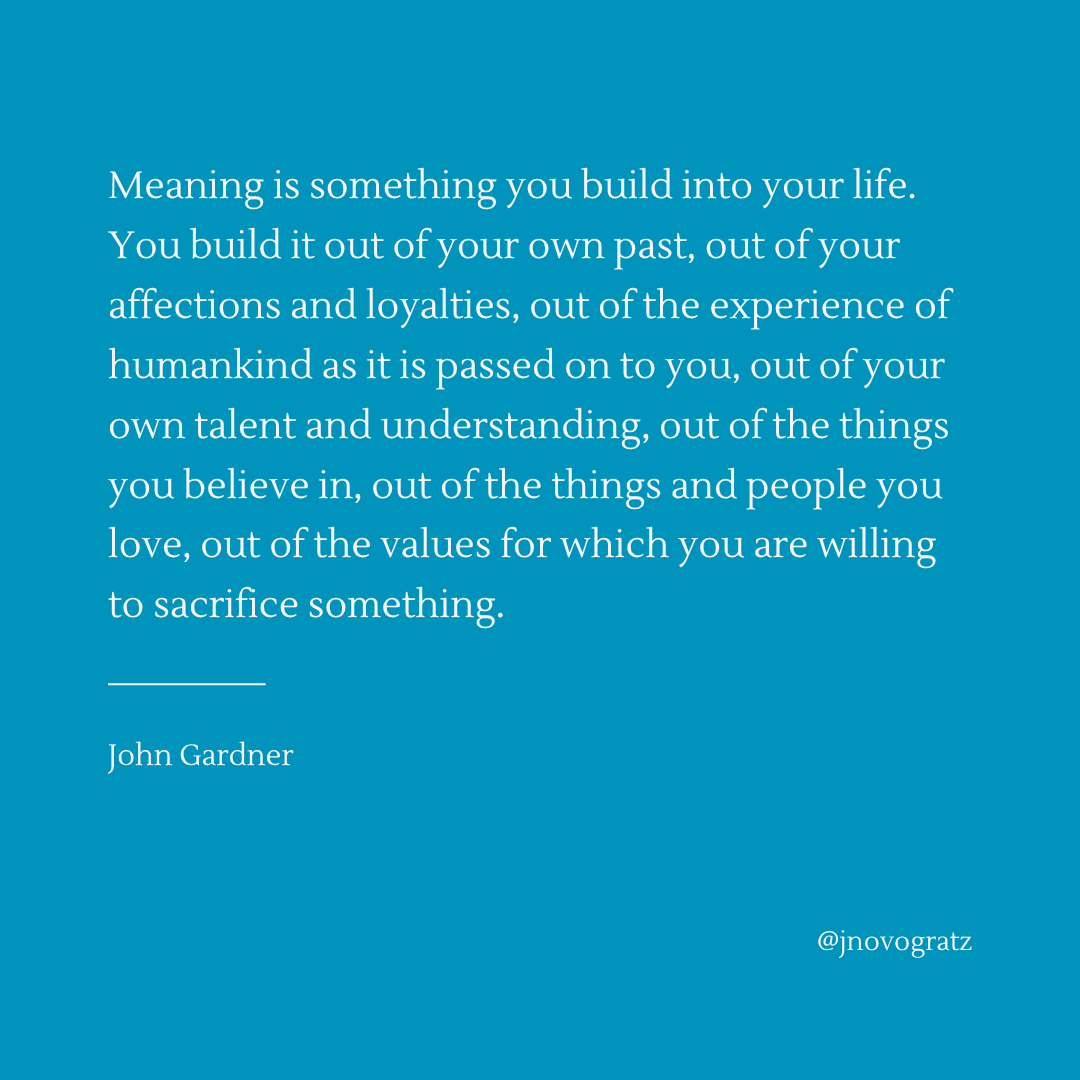
Thirty-five years ago, at my business school graduation, I listened to John Gardner speak about living a life of meaning. I've kept his words close and shared them with many.
Now, celebrating at @StanfordGSB with cherished friends, I'm struck by how quickly life goes. We only get one life. We don't need to wait for meaning. It is here for us, waiting to be built.
We rarely know how our words and actions will affect other people. John's words shaped me, and they still shape my choices. Maybe that's part of the mystery of a meaningful life: what we offer can ripple far beyond anything we'll ever see.
Meaning is something we build. And sometimes, without knowing it, we help others build theirs.
Climate week has always been a full stretch for us at @Acumen with panels, meetings, conferences and everything in between, and I'm only now starting to sort through what I saw and heard. A longer reflection will be coming soon, but in the meantime, our social media team followed me around for a few days to capture what the week actually looks like behind the scenes.
#ClimateWeekNYC #ClimateWeekNYC2026 @ClimateGroup_US
To be of use — and I dare say, to be effective at making change — requires us to go beyond ourselves, to think about other people's success and not only our own.
It can feel thankless, and sometimes it just is. You give your energy to outcomes you don't own and won't be credited for.
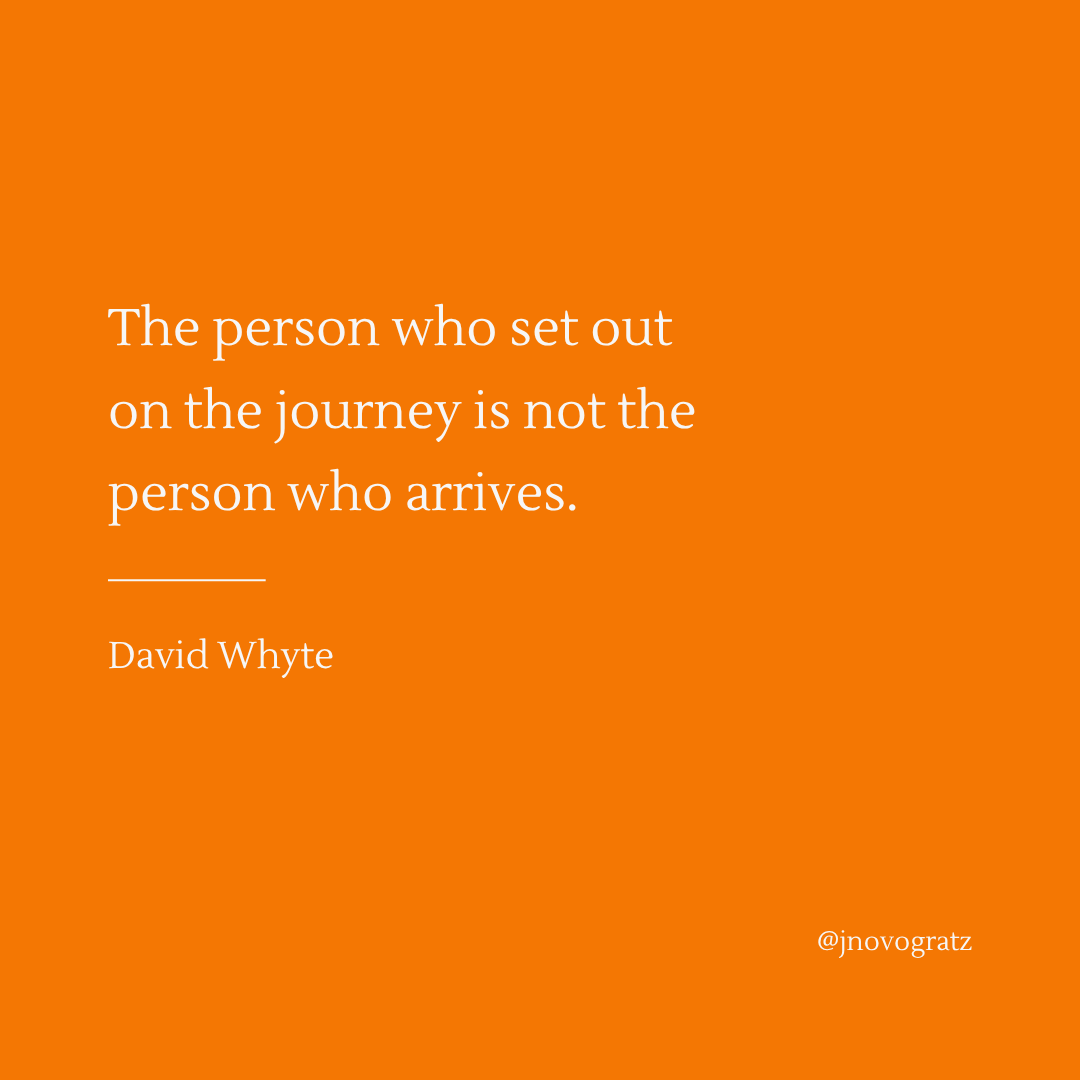
Until something shifts inside you. Not in the work — in you. Time and events change how you see, and sometimes how you are seen. You look up one day and find you are not the person who set out.
The best gift I've received from the people who make up Acumen is hearing them say this work made them more human. They came thinking the task was to help others flourish. And it was. But they were changed too.
Isn't that the better story?
Another #ClimateWeekNYC is here, at what feels like one of the most transformative and consequential moments in the 25 years since @Acumen started.
The team and I are showing up for the conversations that matter — the international community's response to this summer's climate events, the impacts of AI, and more — with our shared humanity, low-income people and the earth at the center of every one.
Let's get to work @ClimateGroup.
No one gets through life without loss, without some sort of tragedy. Yet within both are the seeds of rebirth — if we decide to look for the shards of glass reflecting light. If we remember not just what was lost but what we have. I owe so much of what I know to people who had every reason to be bitter, yet chose to teach. Maybe this is the inheritance: knowing where to look.
Twenty-five years after 9/11, I imagine people around the world remembering where they were when they heard.
I watched the first plane bank and plunge into the tower. My new CFO turned to me: "That was terrorism. That pilot meant to hit the building."
When the towers collapsed into dust and debris and death, I knew the world had changed.
@acumen was less than six months old at the time, and my team of four decided to imagine where and how we could contribute. We chose to work in Pakistan, though I had never been there. A wise friend counseled: "If you run toward a place when others are running the other way — and stay at least ten years — you will learn more than most. And you might do some good."
I made a thirty-year commitment to myself, talked it through with our board, and we went. That decision has made all the difference.
For a moment, the world stood with us in gorgeous solidarity. That goodwill is gone — we answered fear with force, and over twenty-five years traded the trust of others for suspicion of them.
Today I light a candle for the lives lost, for the families forever changed, for love and for peace.
But my message to myself is this: we citizens of every nation are more powerful than we know. In dark times, doing something positive — no matter how small, or in our case, how crazy — is the best antidote to despair. Acumen's 250 Fellows in Pakistan have become powerful human infrastructure, reshaping education, health, housing, and work. I have been reshaped by every one of them.
May we remember 9/11 with thanks to the brave ones, with mourning for all we lost. But may we also resolve to look forward — to do something, however small or big, to help heal the world's broken heart.
It is waiting for us.
—
Photo credit: Steve Liss/Getty Images
This has been a year of losing so many greats, so many people who taught us to see. Who beckoned us to be. And to be better.
Wendell Berry died this past week, and I am grateful for his poetry. And for these words that remind us that we are borrowed matter. Everything I am has been made of something else and will be again. Everything and everyone are part of each other. I love the idea that we are all artists.
So, wouldn't we do more to build care into our systems? Wouldn't we be kinder? Wouldn't we do more to make the world more just?
Thank you for your life’s work, Wendell Berry.
We lost another giant yesterday, a leader who taught us how to be strong and powerful and feminine and not apologize for any of it. A woman who reminded us that one person can change the world if she knows how to bring others with her.
Gloria Steinem knew hardship, and she turned it into resolve. Her curiosity and empathy underpinned a lifetime of unrelenting work toward equality.
She was courageous. As a teenager in the mid-70s, I found my own resolve to be called Ms. and not Miss. Thank you, Gloria.
And she was a listener. Even in her 90s, she made room to listen, gathering in her home, understanding that change starts with being heard.
"We are all one human family, and we are responsible for one another," she said. It's the same conviction I see in so many of the leaders Acumen has been privileged to back and to learn from — people who understand that dignity isn't something you're given, it's something you insist on, for yourself and for everyone else.
Gloria showed us what it looks like to spend a life that way. We're grateful for it, and we'll carry it forward.
When I heard the news that @DollyParton died, like so many of us, I shed a tear. The outpouring of tributes, of people singing and posting favorite quotes, reminded me that she was not just a superstar songwriter and performer but a businesswoman, a leader, a role model. When women my age were too often trained to play it safe and make ourselves smaller, Dolly stood apart as being bigger than life. Never political, she nonetheless lived her values, respecting everyone for who they were on the inside regardless of race or ethnicity or religion or any other kind of external marker.
And she was unafraid to state those values out loud. Dolly Parton, a woman of massive talent and wealth, always stood up for the underdog.
Mostly, she gave fully of herself, supporting young singers, investing in the overlooked hills she came from, donating proceeds from her music to buy books — 300 million and counting — for children the world forgets. She started the Imagination Library in honor of her father, who could not read or write and whom she called the smartest man she knew.
Dolly knew the meaning of dignity. She lived it. She knew who she was and where she came from, and she shared her gifts joyfully until the day she died.
I still want to be more like Dolly. When I was a child, imagining I might one day become a nun given the good they did, never did I dream that a half century later, one of the icons of true goodness to touch my heart would sing her heart out wearing rhinestones, a blonde wig, three-inch heels, and always, always, lipstick.
May all of us channel our inner Dolly. And may all of you do something nice for someone while being unafraid to wear a little glitter and a smile to open the hearts of anyone you meet.
We'll miss you, Dolly. Thank you for the inspiration, the love, for all of it.
To sing before we know how the day will go is to sing with expectation — or with the resolve to make it through whatever hits us. To sing after is to find the beauty, sometimes in the hardest places. What matters is the song, the hope, and the kindnesses that are practices, not feelings. And perhaps it is in the practice that we heal the most — perhaps it is in the doing that we — and the world — become what we say aloud.
As a young banker, I had a knack for asking the dumb questions. Sometimes it got me into trouble. Forty years later, I still think asking dumb questions can lead to breakthrough insights and innovation — and some of the best builders share this trait.
@AlterIgoe and I talked about this and much more on @devex 's Theory of Change podcast. Thanks to Michael's genuine curiosity and candor, I found our conversation to be a real exchange and a gift.
We covered a lot of ground: why impact investing needs a reckoning after years of chasing safe bets. Why entrepreneurs like @SamWGoldman and Dave Ellis are building nations, not just companies. And why, after 25 years, I still believe the biggest barrier to change is daring — having the courage to move before everyone else does.
I hope you give it a listen.
Wonderful to see Josh Whale, founder of @ampersandenergy (an @acumen investee), quoted in The New York Times on the electric motorcycle boom spreading across the developing world.
Last summer, visiting Ampersand's factory in Kigali, the place was already humming before 9 a.m. — engineers building, drivers waiting on repairs, everyone carrying the sense that they were building the future. And they are.
In the markets where we work, people aren't rushing to buy electric bikes to cut emissions. They buy them because they make economic sense: a smaller fuel bill, more take-home pay. The drivers I met were proud to ride for Ampersand — most working long shifts and saving toward the day they own their bikes and build businesses of their own. In a time of fuel shocks and high gasoline prices, the math only gets clearer.
And the bikes keep getting better. The bulky swappable battery has been made much lighter — I lifted one to my shoulder without trouble.
Africa's electric two-wheeler sales are still a tiny fraction of Asia's. That gap is one of the biggest opportunities in the energy transition, for riders, for air quality, for the climate and for intrepid builders like Josh and his team.
But the sector needs more capital. Investors can be too timid about Africa even when the fundamentals work and demand runs well ahead of supply. As I've said before: climate finance isn't scarce, it's scared.
Ampersand reminds me how much is possible with moral imagination and the right kind of capital. We need more of both.
Progress and development require a strong moral and ethical compass, one that is even stronger than our professional tools.
Looking forward to this read, kindly gifted by dear friend Ali Sadiq.
@acumenfund@jnovogratz
I am a great admirer of Howard Thurman. And I fully agree that we need people who have come fully alive. Too many of us accept that we can't do much to make a difference. But when we are on fire, people around us see it and feel it, and they become more alive as well.
And figuring out what makes us fully alive can feel like a lot of pressure. So this is where I would add to Mr. Thurman's wisdom. I would urge young people — or all of us who feel anything less than alive — to think about the world's great needs. And that can include beauty and kindness and, of course, major problems to be solved. When you look outward, it can give clues to how you feel inside. If something lights up, walk toward it. Do something. As other wise people have said, go to where the world's greatest needs meet your deepest yearning.
Every year, brilliant students ask me some version of the same thing: "Is a career in social impact worth it?"
It's the question I get most from the next generation, usually with an unspoken worry underneath it about salary, status, and whether real change is possible. Here's what I told a group of @INSEAD MBA students recently 🗣
#socialimpact #advice #careeradvice #students #college
The amazing Robin Wall Kimmerer writes about the nature of, well, nature. She points to the soil and fungi and root systems that trade sugar for minerals, each one needing what the other has. But she could be describing leadership.
No one flourishes by being indispensable. The tree that shares its water table survives the drought that kills the one standing alone. Equally, we only truly flourish as a world when the conditions for flourishing are universally felt.
We are here because of each other. The more we remember that, the more we flourish — not despite our dependence on the web around us, but because of it.
It is such a powerful truth: we cannot control what life gives us, but we can control how we respond to what happens to us. I've been talking to many people holding heavy burdens. Those who inspire me most do not hide from the pain, but also do not succumb to it. They greet each day anew, focus on what they can do, and somehow transform pain — and sometimes anger — into something good. And that good (eventually) comes back as strength, as courage.
I'm lucky to have such people around me. To remind me to be courageous. To be graceful. To keep trying.
As the world seems to spin faster and faster, our impulse too often is to react first and reflect later. In the worst cases, we skip the reflection altogether.
My work investing in leaders taught me to listen more than speak, and I found a parallel in patient capital investing. Before we fund, our aim is to ensure that what we're seeing is true and necessary. Our commitment is to ask the hard questions but never belittle. It is to ensure that our investments result in expanding dignity.
None of it is easy. And the kindness can be toughest of all, especially when the last thing you feel like doing is being kind.
In your life, where do these gates serve you best? And what kinds of practices help reinforce these ideas?
Eleanor Roosevelt's quote has become a practice in my life. My own leadership journey has taught me that we become courageous by practicing courage — not through massive leaps, but small steps. Ask the question in a group where you feel intimidated. Call that colleague to see what more you might do together at work. Sign up for the class or workshop you've been avoiding.
We grow when we push into the untried parts of ourselves.
So do one thing every day that scares you. Before you know it, you'll grow into your own kind of courage. And the world needs the best of all of us.