It's been around for the past couple of years. I've been there as a vendor and attended the talks last year. It's more about getting practitioners in one place.
Outside of big vendor announcements, the alpha isn't much more than a random Tue night in SF, but some of the curated VC tracks were useful in gauging who was actually struggling. (Also I was surprised by who did not speak well or only pitched and didn't impress practitioners.)
To the second point about geopolitics, I don't see a future where US policymakers allow Chinese open source/open weights to dominate the intelligence supply chain. I believe we'll see efforts to slow adoption and procurement by regulation, legislation, or EO.
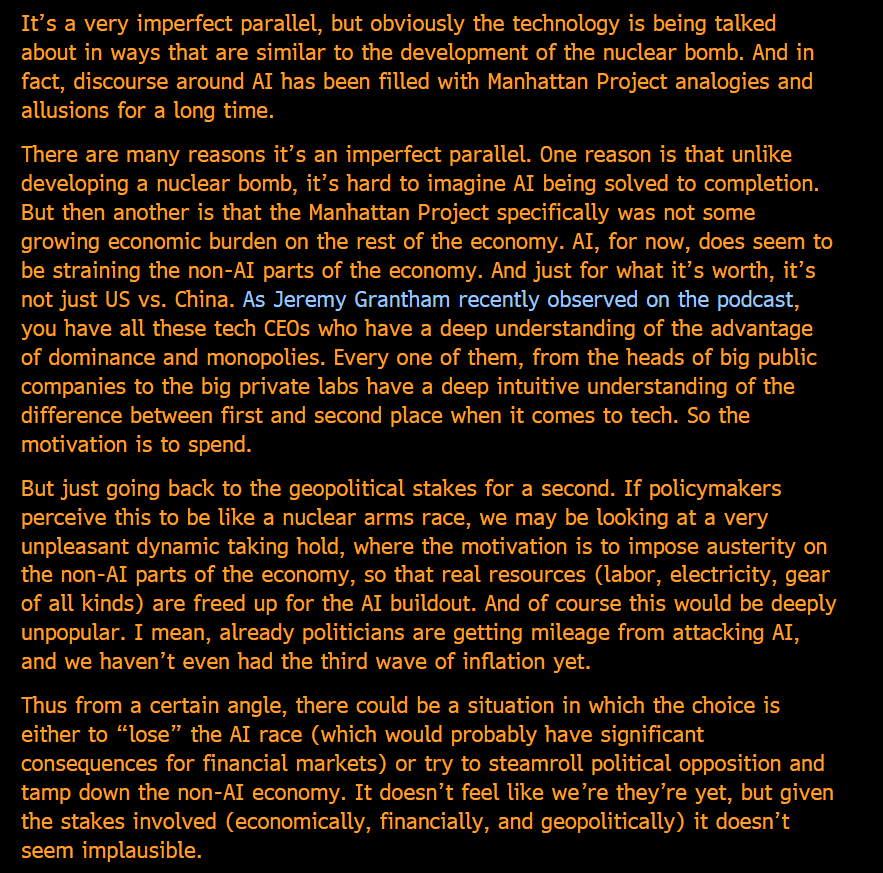
In the newsletter, I wrote about one worrying, plausible path.
One in which the AI buildout continues to be seen as a quasi- nuclear arms race against China, and policymakers feel compelled to impose austerity on the non-AI economy to free up real resources for the buildout.
@quxiaoyin Some people might need to research how open source derived technologies are procured at American companies because Twitter ain't real life.
In addition, I actually think open source AI will be regulated soon by the US gov't.
China’s AI playbook: kill OpenAI and anthropic with free great models. Make it free. Then use cheap electricity to export compute as well. Currently the blocker is chip but Hauwei would catch up soon. Imagine a world where instead of paying hundreds of billions to OpenAI and anthropic, you pay almost zero to similar level of intelligence with cheap cheap inference. What’s gonna happen?
VCs are now sharing screenshots in group chats of Claude discouraging investment in open-source AI infra startups and models.
Obviously there is an absolute EXPLOSION of pitches in inference companies, harness companies, RL-as-a-service companies, open-source tooling currently including Neolabs that plan to open source models as well.
Now the obvious takeaway is: “Claude is biased against open source.” Who cares?
The more unsettling take is: every major AI model has a worldview, and that worldview is becoming embedded in capital allocation.
If Claude’s safety priors cause it to frame open-source AI as dangerous, hard to govern, or less fundable, it’s probably doing the same thing in enterprise buying workflows.
Now investors and executives are obviously smarter, but “influence” just changes which risks get highlighted, which questions buyers should ask, and which vendors are suggested…..
I know that tpot skews younger and not always politically savvy, but that WSJ GLM article made it to the middle-America Drudge Report in case you were thinking the conversation around open source/open weights wasn't going to get more political.
As someone who has used open source for decades and who has brought OSS-derived software to market, your essay elides one big question: OSS is political and always has been.
It's fine to sing the praises of being open, but railing against regulation while failing to address the underlying political questions (while lobbying politicians) is naïveté at best.
Why shouldn't governments want to promote their values vis-à-vis the intelligence (the data, weights, and code) their countrymen and women use?
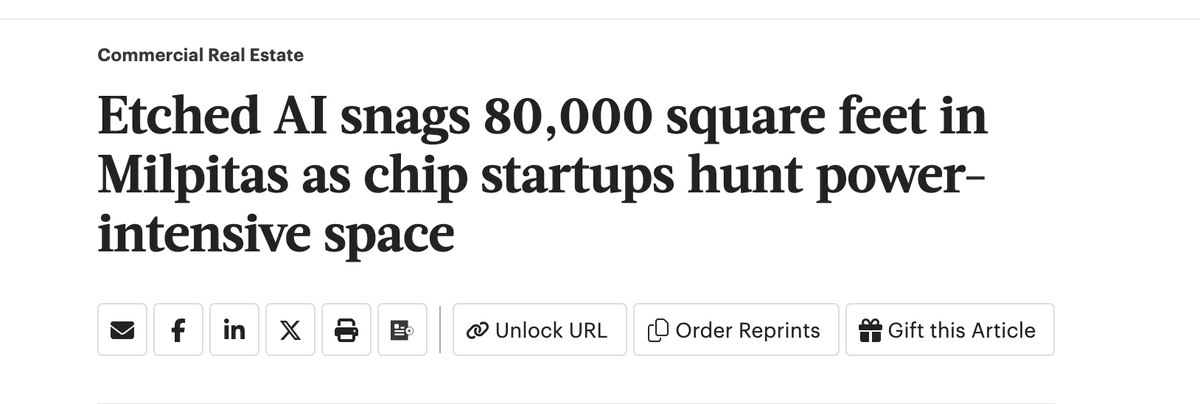
For those of you following AI, semis, and chips, just saw this news about @Etched grabbing more space in the South Bay. (Can Milpitas be defined as South Bay? idk)
@conoro One thing to note though, if (I should say when) the US puts supply chain controls on Chinese OSS, it will be difficult to sell to US entities and/or certain US industries.
I say this as someone who has done GTM for OS-derived software in a previous life, etc. etc.
@petergyang Open Source (open weights) AI will become regulated in the US. There's plenty of ways to slow business adoption through reporting and regulation without banning it outright.
After Anthropic shutdown, China's https://t.co/X02uTS545c closes frontier gap as it plans dual listing
"Our mission is to obtain AGI, so right now our focus is how to improve our model to achieve the upper bound of intelligence. So all these resources are helping us," said Qinkai Zheng, technical lead of the firm's CodeGeeX team.
https://t.co/TKd1ri387l
You don't have to ban OSS outright to make it unpalatable for business. Regulate US inference/compute providers, institute Sarbox type controls for intelligence vendors (which then affects SOC and other reporting), etc. There's plenty of ways to shape adoption but not outright ban via OFAC or export controls.
It's really about understanding the intelligence and software supply chains.