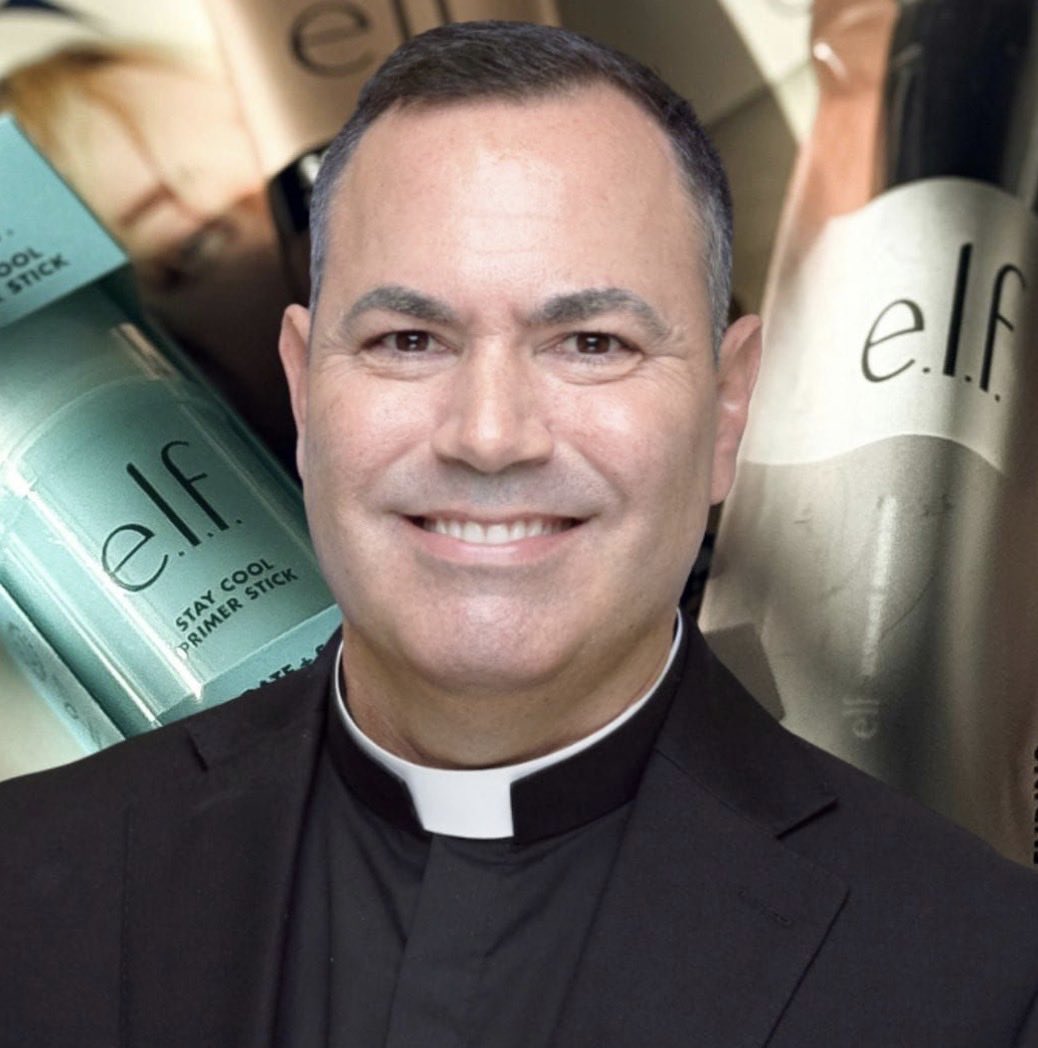
Scott-Vincent Borba, the co-founder of the multi-billion dollar cosmetics brand e.l.f., will be ordained a Catholic priest on May 23, 2026, in the Diocese of Fresno, California.
At age 40, Borba walked away from his multimillion-dollar career. He donated his entire fortune to charity and entered Saint Patrick's Seminary in Menlo Park, California at age 42.
He credits the Blessed Virgin Mary for his conversion.
Catholics confess directly to God. Protestants attack the priest as a "middleman" because sacramental confession requires what their private version avoids: contrition, accountability, and the humiliation of actually naming your sin.
The Bible says to confess your sins to one another. Christ gave His apostles authority to forgive and retain sins. It does not teach "go hide alone, say a quick prayer, and call that repentance."
A quick "God forgive me" costs nothing. Real confession humbles you, exposes your sin, and demands that you actually turn away from it. Something the majority of Protestants simply do not want.
The Eucharist is the most confrontational claim in Christianity.
Not because Catholics are trying to be dramatic.
Because if the Eucharist is only bread, then Catholicism is excessive.
But if the Eucharist is truly Jesus Christ…
Then the Mass is not optional.
Adoration is not strange.
Genuflection is not outdated.
The tabernacle is not decoration.
The altar is not a stage.
And Communion is not a symbol of community.
It is the living God giving Himself to sinners.
That is why the saints trembled before the Host.
That is why martyrs risked death for the Mass.
That is why the Church refuses to reduce the Eucharist to a metaphor.
Jesus did not say, “This represents My Body.”
He said:
👉🏽 “This is My Body.” 👈🏽
And Catholics have never redefined those words.
Truly Present.
Years ago we chose to homeschool our kids.
This choice often gets criticized, especially on social media
"They wont be socialized"
"Parents are qualified to teach"
Typical homeschool day:
- Sleep until 8/830
- Family walk outside
- Kids cook their breakfast (eggs, smoothie, yogurt etc..)
- 30-60mins of free play
- 10:30-12:30 schooling following local curriculum
- Kids make their own lunch
Rest of the day is sports, playing with friends, field trips with other home school kids etc...
Common government school day
- Wake around 7:00am
- Quick (often unhealthy) breakfast
- Rush to school
- Kids put into overcrowded classrooms, lack of outside time, too much screen use in class...
My kids test at the top of their age groups.
They socialize daily with other kids and commonly get complimented on how polite they are.
They spend time outdoor daily.
My kids also learn basic life skills like cooking, laundry, grocery shopping ect.. that arent taught in schools
Homeschool may not be for every family. But slandering it as an inferior experience for kids is an ignorant take.
The Catholic Church has consistently taught that each human life, from the moment of conception until natural death, is sacred and deserves to be protected. Indeed, the right to life is the very foundation of every other human right. For this reason, only when a society safeguards the sanctity of human life will it flourish and prosper.
9) “Catholics kept the Bible in Latin so people couldn't read it”
This is historically backwards. The Latin Vulgate was produced by St. Jerome precisely so people could read the Bible in the common language of the Roman Empire. For centuries, Latin was the universal language of educated Europe, not a tool of suppression.
Vernacular translations existed well before the Reformation – in German, Italian, French, and English. What the Church opposed at certain moments was uncontrolled private interpretation divorced from Tradition and the Magisterium – and for good reason, since the Reformation produced hundreds of contradictory interpretations almost immediately, a problem that has multiplied into tens of thousands of Protestant denominations today.
When one does not have a full historical, theological, and traditional understanding of scripture, it becomes was to misread, misunderstand, or misinterpret. For instance, the confusion that has arisen from Christ declaring “My God, my God, why have you forsaken me?” on the cross, which some have taken to mean that the Father turned away from the Son and became separated from Him. When in reality Christ was simply referencing Psalm 22 which is a prophecy of the crucifixion. If you read Psalm 22 it’s almost a word for word description of Christ’s final moments on the cross.
The Bible was written by the Church, preserved by the Church, and canonized by the Church at the Councils of Rome (382), Hippo (393) and Carthage (397). Without the Catholic Church, there is no agreed-upon Bible.
10) “Jesus is the new church. Not some building.”
This is half-right. Jesus IS the head of the Church – and the Church is His Body (Colossians 1:18, 1 Corinthians 12:27). Jesus didn't just save individuals; He founded a community. He said “I will build my Church” (Matthew 16:18) – not “my movement,” not “my feeling,” but a specific, visible, authoritative Church built on Peter.
The claim that Jesus replaces the institutional Church is itself not found in Scripture. It is a very modern idea – one that would have been completely unrecognizable to every Christian for the first 1,500 years. Even most Protestant denominations would not agree that there should be NO clear structure to the body of Christ.
6) The pedophilia within the Church
This is addressed directly, without defensiveness, because the truth demands it: the sexual abuse of children by clergy is a monstrous evil. It is a grave mortal sin. It is a betrayal of the most vulnerable. The Church has failed, catastrophically in many cases, in protecting children and holding abusers accountable. There is no defense of this.
What can be said is this: The evil of individual clergy does not invalidate the truth of Catholic teaching any more than a corrupt judge invalidates the legal system. The Church's doctrine on the dignity of every human person – especially children – condemns these crimes in the strongest possible terms. The abuse crisis is a wound that calls the Church to holiness, not a proof that the Church is false.
When the accusations first began to arise under John Paul II’s Papacy, he was resistant to investigation and attempted to back the accused clergy. However, as more accusations came in and the evidence became overwhelming, he backed off and later formally apologized. Much of the condemnation against the Catholic Church over this issue has been rightly pointed at this initial response, which the Church later walked back.
It’s important to understand that Pope John Paul II was from Poland, a country whose anti-Soviet leaders were frequently framed for sexual misconduct by Soviet KGB and other operatives. This was part of the USSR’s playbook for discrediting political opposition, and John Paul II initially assumed (incorrectly) that this playbook was being employed against the Catholic Church. Hence his inadequate, and at times obstinate, initial response.
This is not an excuse for Church failures in this arena. It is simply an acknowledgement that men are flawed, and in the “fog of war” when information is limited or can be skewed, mistakes are more prone to be made.
7) “The hoarding of wealth”
The Catholic Church operates the largest network of hospitals, schools, orphanages, and charitable organizations in human history. Much of what appears as “hoarding” is either ecclesiastical art that belongs to all humanity or is actively deployed for the poor. Caritas Internationalis, Catholic Relief Services, and thousands of religious orders serve the poorest of the poor on every continent.
Does the institutional Church have room to grow in simplicity and generosity? Absolutely – and saints like Francis of Assisi called for exactly that from within the Church. Internal critique is part of Catholic tradition.
8) “Pagan ritualistic worship”
This objection confuses influence with corruption. The Incarnation itself is God entering into human culture – light, fire, water, bread, wine, oil. These are not “pagan” elements; they are creation itself being sanctified. If physical elements in worship make something pagan, then baptism with water and the Last Supper with bread and wine would be equally “pagan.”
I would also add that the Israelites were hardly pagan, as they worshiped God alone – and their Temple rites and procedures were far more ritualistic than that of the Catholic Church, which is the fulfillment of the Jewish faith. And we know from Acts that the earliest Christians worshiped in the Temple, which likely involved some elements of the Jewish Temple rituals.
4) “Mary had other sons”
This is one of the most commonly misunderstood arguments. In the case of Mary's perpetual virginity, the key to explaining Matthew 13:55 is understanding the Greek word for “brethren” (adelphoi). The reason relatives were called brothers or sisters was because in Hebrew, there was no word for cousin, nephew, or uncle. So the person was referred to as simply a “brother.” Since the New Testament was written in a dialect of Greek heavily influenced by Semitic culture, many of the Hebrew idioms intrude into the Greek text. So, the fact that Jesus had “adelphoi” does not mean that Mary had other children.
The perpetual virginity of Mary has always been reconciled with the biblical references to Christ's brethren through a proper understanding of the meaning of “brethren.” The understanding that the brethren of the Lord were Jesus' stepbrothers (children of Joseph) rather than half-brothers (children of Mary) was the most common one until the time of Jerome (fourth century). It was Jerome who introduced the possibility that Christ's brethren were actually his cousins, since in Jewish idiom cousins were also referred to as “brethren.”
A powerful scriptural argument: If Jesus did have brothers, why would he have entrusted Mary to the beloved disciple, John, at the foot of the cross (John 19:26–27)? He would have had surviving siblings who would have taken care of her.
Research into the early reformers on this question disclosed that Martin Luther believed Mary did not have other children and did not have any marital relations with Joseph. He used the term "Ever Virgin" to refer to Mary. Huldrych Zwingli, the Swiss Radical Reformer, directly supported perpetual virginity. Even the Protestant Reformers held this belief.
5) The Spanish Inquisition
The Spanish Inquisition is real history, and whitewashing it would be dishonest. The Church has formally apologized for the abuses committed in its name during that period. Pope John Paul II issued a sweeping act of repentance for historical sins of the Church's members.
That said, the popular understanding is wildly distorted. Modern historical scholarship has shown that the Inquisition was far less murderous than the cultural myth suggests – far fewer people were executed than popular imagination holds, and many who were tried were given lighter sentences than secular courts of the same era would have given.
It’s crucial to understand the historical context of the Spanish Inquisition. It didn’t happen in a vacuum. For 700 years there was a powerful Islamic presence in Spain, at times ruling over 90% of Iberia. The Christian kingdoms of the north fought for seven centuries to reclaim their lands, and finally in 1492 they succeeded in driving out the last Muslims. It’s not a coincidence this is the same year Columbus sailed west and discovered the new world – the Spanish exploration and colonization was an extension of the Reconquista.
When the Emirate of Granada was conquered in 1492, the remaining Muslim civilian population was given the option to convert to Christianity or leave. Many chose to outwardly convert, but remained secret Muslim practitioners.
I am not endorsing compulsory conversion, but the problem that arose shortly after this was that the crypto-Muslim population began revolting agains their Christian overlords. The Catholic king and queen of Spain appealed to the Vatican for aid, thus launching to inquisition to root out the revolutionaries.
The Church did not, on a whim, decide to start persecuting folks. There was a pressing concern, and people were dying in battles against these rebels. It called for a legitimate response. Sometimes that response went too far, but it is in some ways understandable how it got to that point.
I shouldn’t have promised to respond within 12 hours. It’s been a busy day. Mass and wife’s birthday today.
Let’s go down the line.
1) “Everything the Bible says tells me to stay away from Catholicism”
The Bible never mentions the words “Protestant,” “Sola Scriptura,” or the Reformation. What the Bible does describe is a visible Church with authority (Matthew 16:18-19 and 18:18), sacraments (John 6, Matthew 28:19), bishops and elders in apostolic succession (1 Timothy 3, Titus 1), a living oral Tradition (1 Corinthians 11:2, 2 Thessalonians 2:15 and 3:16), and a Eucharist that is the real Body and Blood of Christ (1 Corinthians 11:23-31).
Every one of those things is Catholic. The honest question is not “does the Bible condemn Catholicism?”
Rather it's “does the Bible actually describe a Church that looks more Catholic or more Protestant?”
When I studied the writings of the earliest church fathers such as Ignatius of Antioch and Justin Martyr, I encountered a description of a church that sounded alien to the one I was attending. It sounded very Catholic. Read Ignatius’s letter to the Smyrnaeans and the First Apology of Justin Martyr.
2) “Praying to a pile of bones”
This one’s a little silly. Surely you recognize the straw man nature of this. But in case you don’t, here’s a basic breakdown.
Any time a Catholic petitions a saint, it is taken for granted that it is a request for that saint to pray to God for them. This is no different in principle from asking a friend to pray for you.
What needs to be stressed here is that none of our prayers terminate in the saints, as if they had the power in and of themselves to answer prayers.
The scriptural basis for this is solid. Revelation 5:8 describes saints offering prayers before God's throne. The Church teaches that Christ is the sole mediator, but the saints intercede as members of the Body of Christ (1 Corinthians 12:12–26).
The early Church Fathers not only clearly recognized the biblical teaching that those in heaven can and do intercede for us, but they also applied this teaching in their own daily prayer life.
As for bones specifically – relics are honored because the bodies of the saints were temples of the Holy Spirit (1 Corinthians 6:19). Even the Old Testament records a dead man coming back to life simply by touching the bones of Elisha (2 Kings 13:21). God works through physical things – that's the entire logic of the Incarnation.
3) “Taking money to lessen time in purgatory”
The selling of indulgences was a real historical abuse – and the Church agrees. Unfortunately, at times in history, many of the faithful were led (by corrupt clergy) to believe that money could purchase spiritual benefits, or less time in purgatory. However, this was a distortion. The Catholic Church has never taught that salvation can be merited by money or purchased through indulgences.
The Council of Trent forbade the selling of indulgences, thus partially agreeing with Luther and the Protestants, while retaining the doctrine itself.
In Catholic theology, an indulgence is a remission of the temporal punishment due to sin, the guilt of which has already been forgiven through the sacrament of Confession. The concept hinges on the distinction between the eternal and temporal consequences of sin. Eternal punishment – separation from God – is forgiven through Christ's sacrifice and the absolution of sin in Confession (CCC 1471). However, temporal punishment remains, which is the lingering effect of sin that requires purification, either in this life through penance or in the afterlife through Purgatory.
Modern indulgences involve no financial exchange – a plenary indulgence for the Holy Year 2025 requires Confession, Communion, and prayer.
I was an anti-Catholic non-denominational “born again” Christian and got into a debate with a Catholic.
I used the same tired lines – you guys don’t read the Bible, you’re basically pagans for worshipping Mary and the saints, etc.
He challenged me on the topics of apostolic succession, sola scriptura, and Marian prayer.
So I began researching. I needed to understand Catholicism better so I could more effectively debate these fools!
But the more I researched, the more I struggled to find valid arguments against the Catholic faith. I set out to disprove Catholicism, and found myself unable to do so – so much so, that Catholicism became impossible for me to disprove.
I didn’t become Catholic because I wanted to. I became Catholic because the Holy Spirit called me home to the Church Christ founded. It wasn’t up to me. Catholicism is much harder than being a Protestant; I am called to a much higher standard.
It is at times unpleasant. But God calls us to worship Him in the manner in which HE chooses. Worship isn’t about us. Church isn’t about us.
It’s all about Him.
A lot of parents think that you reap the rewards of parenting by kicking them out of the house and reclaiming your “independence” or whatever. So the reward is just going back to your pre-parenting state? No, the reward should be a family that you love and get to enjoy until you die. The reward should be raising children who one day also become companions, and eventually caretakers. The reward is not, or shouldn’t be, 30 years in a silent empty house and then dying under florescent lights in a nursing home.
I used to be entirely in the camp that said you should kick your kids out at 18 and force them to live independently and make their own way in the world. I don’t feel that way at all anymore. I want all my kids to live with us until they get married. Even after they’re married, if they want to live on our property, or close by, my wife and I would love that.
The important thing is to teach your kids responsibility, which we’re doing. They need to contribute and help around the house, which all of our kids do from a very young age. Provided you aren’t raising ungrateful useless moochers, why kick them out? Why drive them away from your family home? I don’t see the point in it anymore. I actually like my kids and like being around them.
Maybe they’ll all end up scattered to the wind. But I’d prefer to keep the family together. Why wouldn’t I?