In Los Angeles, individual letters about student growth barely changed families’ decisions. But when enough parents got them, choices shifted — and students benefited. https://t.co/UH7MBnIAh8
Let's figure out this phone thing — what it's doing to us, and our kids.
But let's do it by focusing on research rather than intuitions. I just reviewed the latest evidence, and it leads to some pretty interesting (and unexpected) places.
https://t.co/q3KNdVBgNs
National study finds lockable pouches reduce in-school phone use but have little effect on test scores. Discipline and student well-being worsen on adoption, improving thereafter, from @huntallcott, @JasonBaron4, @ProfTDee, Angela L. Duckworth, Matthew Gentzkow, and Brian Jacob https://t.co/WwKt8bvUMb
📣📚💵Doing research on school finance?
@EdFundNews - a nonprofit supporting policy-relevant, actionable research - is accepting proposals. Topics include career pathways, English learners, and at-risk students. LOIs due April 24. Please apply!
🔗 https://t.co/bT13rLGHTY
1/ I have an outstanding student on the job market!
@Barron_Tsai is among the select group of top students I’ve had the pleasure to advise at Duke.
https://t.co/BcYqvi1c4B
Did you know that 1/5 of the prison population in the U.S. is comprised of former foster children?
But (!) it appears that relationship is not causal.
This new ReStat leverages quasi-random assignment of kids to foster care in Michigan to show that placement actually substantially reduces the chances of adult arrests.
Leveraging the quasi-random assignment of investigators, the authors show that foster care reduces later-in-life crime. Just Accepted new paper by E. Jason Baron @jasonbaron4 and Max Gross https://t.co/sNkRoHQhSc
I'm excited to help organize @OppInsights' 2025 Conference on Economic Mobility (Oct 9-10)! Submit your papers by August 1st here: https://t.co/d0wIAiN4w6. Looking forward to reading your submissions! #EconTwitter
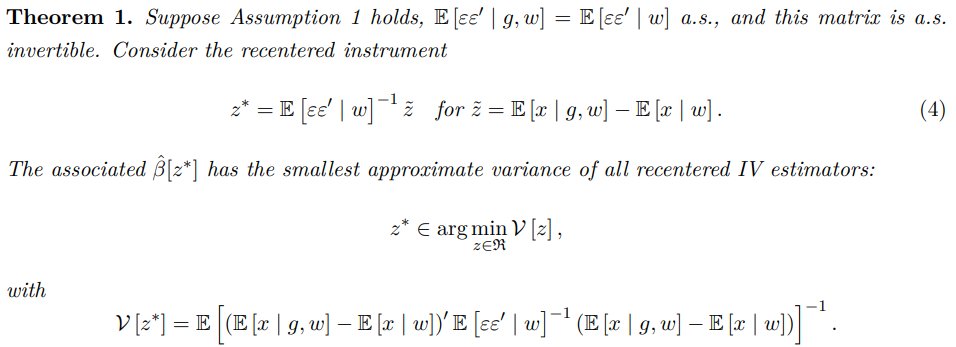
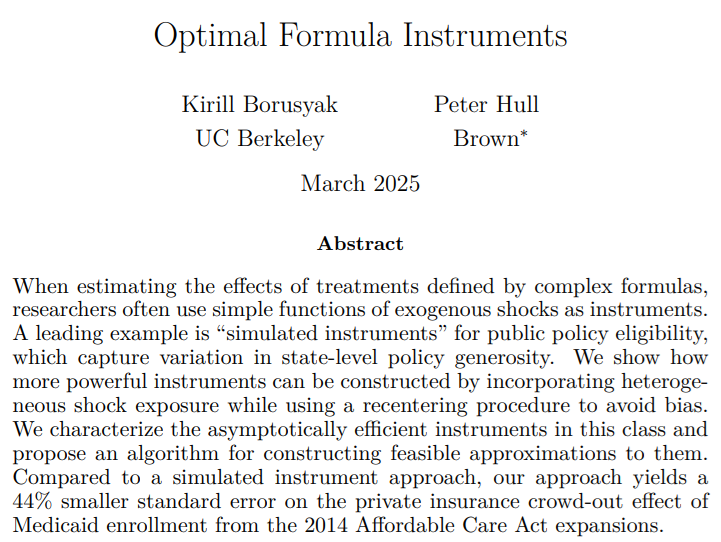
📢New working paper with @borusyak: "Optimal Formula Instruments"!
We derive the most powerful recentered IVs for treatments given by complex formulas, and propose an algorithm for approximating them in practice
This approach yields *huge* power gains, relative to a conventional simulated IV approach, when estimating Medicaid crowdout effects from ACA expansions
Check it out!
https://t.co/UPg2XQBefN
🚨📢 3rd Workshop on Economics of Education, Valle Nevado, 🇨🇱 (Aug 19-22)
Confirmed speakers
🎓 JOHN FRIEDMAN (Brown)
🎓 STEVE PISCHKE (LSE)
✅ Submissions by March 2nd, 2025. https://t.co/IjcTPzQVvl
2024 edition ⛷️
https://t.co/rER6PAWfXO
#econtwitter@hdl_uandes@uandes
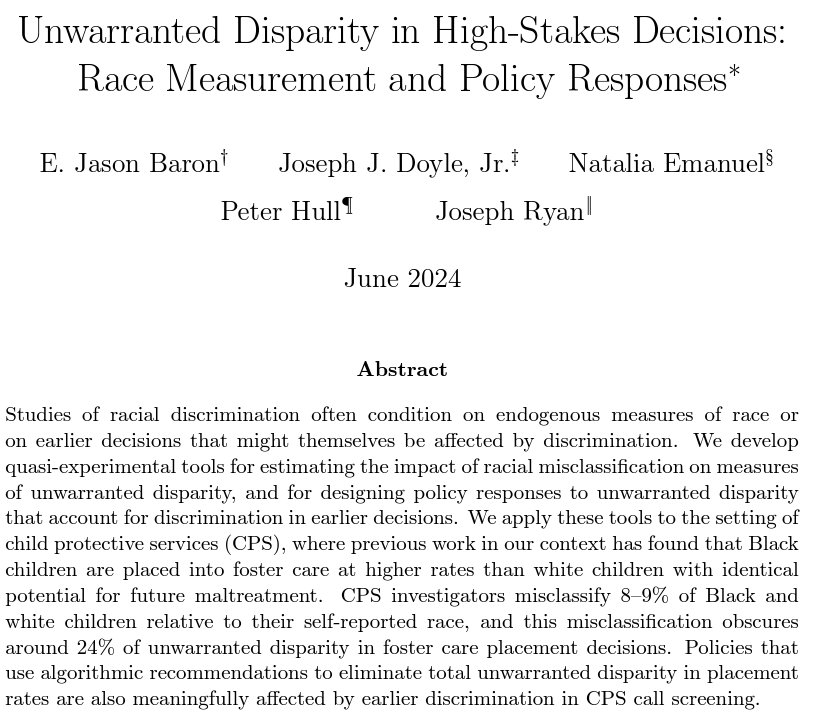
I have a new NBER WP out with @JasonBaron4, Joe Doyle, @nataliahemanuel, and Joseph Ryan on racial discrimination in foster care decisions. Check it out!
https://t.co/vEz8F2NxXl
(short summary thread👇)
Introducing our 2024-2025 job market candidates, all seeking employment starting Summer 2025. For more information, visit: https://t.co/8PH87TOAWs… or see 🧵 below.
Our new field experiment (w/ @AnujitCh, @hmmlowe, @GarethNellis) shows how brief interactions with multiple outgroup members (broad contact) and longer interactions with a single one (deep contact) shape intergroup relations.
Paper: https://t.co/Q8n3S7VTR5
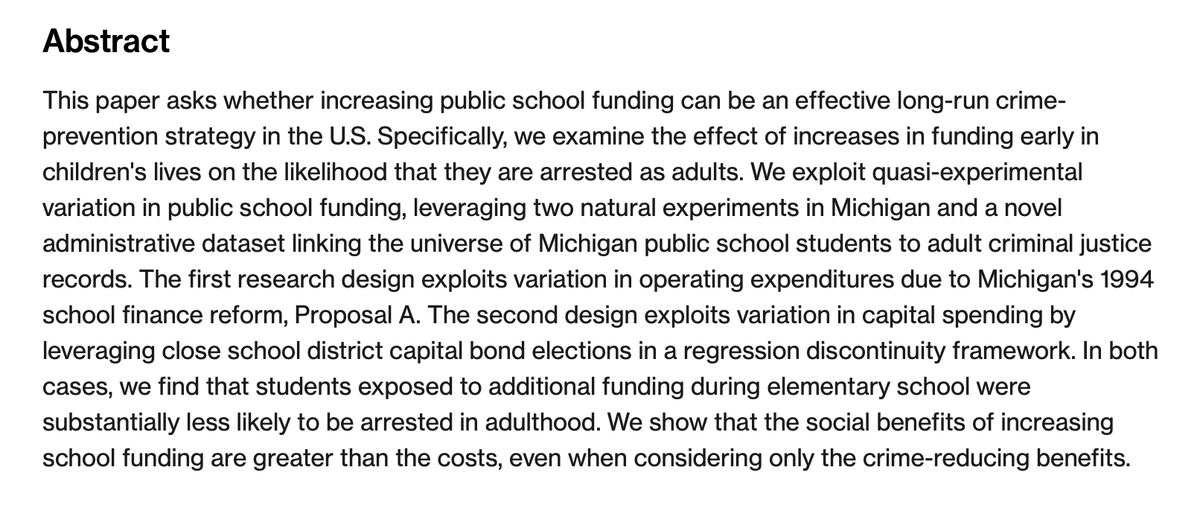
Invest in public education, reduce crime.
New research published in the Review of Economics and Statistics finds that increases in school funding levels are outweighed by reduced criminal justice spending down the road.
We can build strong kids or house broken adults.