Mark your calendars—tickets for JavaOne 2027 go on sale on November 3! 🗓️
Need help justifying to your manager why you should attend #JavaOne? Customize this email with your project priorities, estimated costs, and how you'll share what you'll learn. Send your request in now to allow time for budget and travel approval: https://t.co/hwKsY8uBgi
The latest Inside Java Newscast tells the story of the structure and community that fixes OpenJDK bugs and how they operate. 🐜
You'll also get look at #JavaOne, the Inside Java Podcast, and JDK 28. https://t.co/Ii5LadWQaz
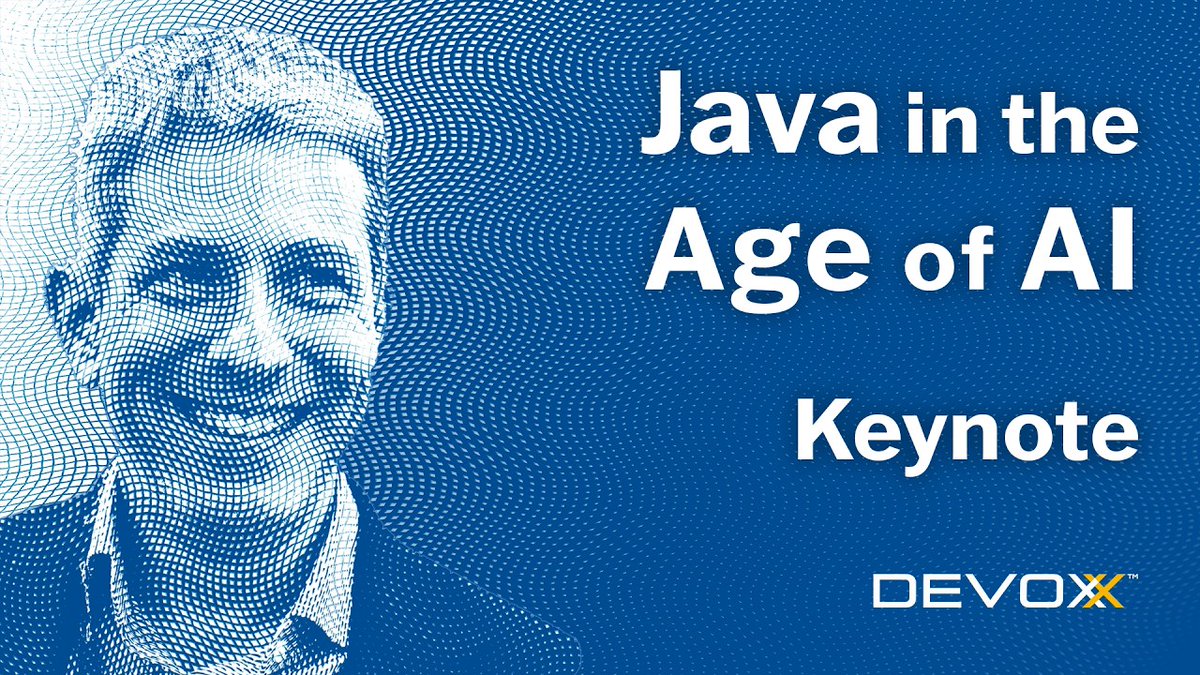
As AI coding agents make language syntax less central, runtime performance and operability become increasingly important.
Ron Pressler's keynote at Devoxx Belgium explores why Java’s JVM and standard library are well-suited to this shift. https://t.co/tnwTL2Z80t
Discover what's next for Java and Helidon at #AIWorld! 🤓
Check out these sessions, where Java leaders will be speaking about the latest innovations in AI, security, post-quantum cryptography, and Java's roadmap. https://t.co/rvtHSbAwaW
📢 Just a few days before JavaOne 2027 CFP closes!
Build an interesting Java product? Solved a tricky problem?
Learned something the hard way?
Then share it with the JDK experts and the wider #Java community
💁♀️https://t.co/68zcfTEjC8
We’d love to learn from you ❣️
🚨 The Call for Papers to JavaOne 2027 is closing soon! Got a Java story, a hard-earned lesson, or a cool demo to share? Don't wait, submit your proposal now! 📬
👉 https://t.co/UQ2NDnRkRB
Oracle Java Platform Extension for Visual Studio Code version 27.0.0 is now live on Visual Studio Code Marketplace and Open VSX Registry!
Java Visual Studio Plugin 27.0.0 is based on Apache NetBeans 31 and includes the following enhancements:
✅ Adds support for JDK 27 features/enhancements
✅ Adds the ability to set breakpoints in individual lambda expressions during debugging
Check it out! https://t.co/eVjCGrFEeE
We rely heavily on polymorphism when programming with the object-oriented paradigm. However, like any tool and technique, there are times when that may not be the right choice.
Java now provides an alternative that is useful in those select situations—the data-oriented programming.
In this #JavaOne presentation, Venkat Subramaniam discusses OOP, DOP, when to use each one of these, and how to intermix them in your applications. https://t.co/eS8gvsoM2n
Learning Java for the first time? You may already know enough to build a virtual pet. 🐶
Our latest lab covers how to name your pet, start it at 100 energy, and track how sleep, exercise and meals change it.
The trick? Only full blocks count, and Java’s int division handles that for you.
Check out our AP CSA lecture series to learn more: https://t.co/FXu2ZiOh8l
In this "Ask the Architects" episode of the Inside Java Podcast, Nicolai Parlog talks to Sean Mullan about the critical importance of security in Java. 🛡️ https://t.co/MT6gEbUqlY
In this "Input/Output" episode of the Inside Java Podcast, Nicolai Parlog talks to Martin Chalupa and John Rose about Java's ahead-of-time capabilities and how Netflix's training run approach is the ideal one. https://t.co/llgeGwHOMo
The deadline for the call for papers for JavaOne is coming soon! Submit your proposal ASAP and tell us about the ideas, experiences, and insights you want to bring to #JavaOne 2027. https://t.co/fzf4fDoNJw