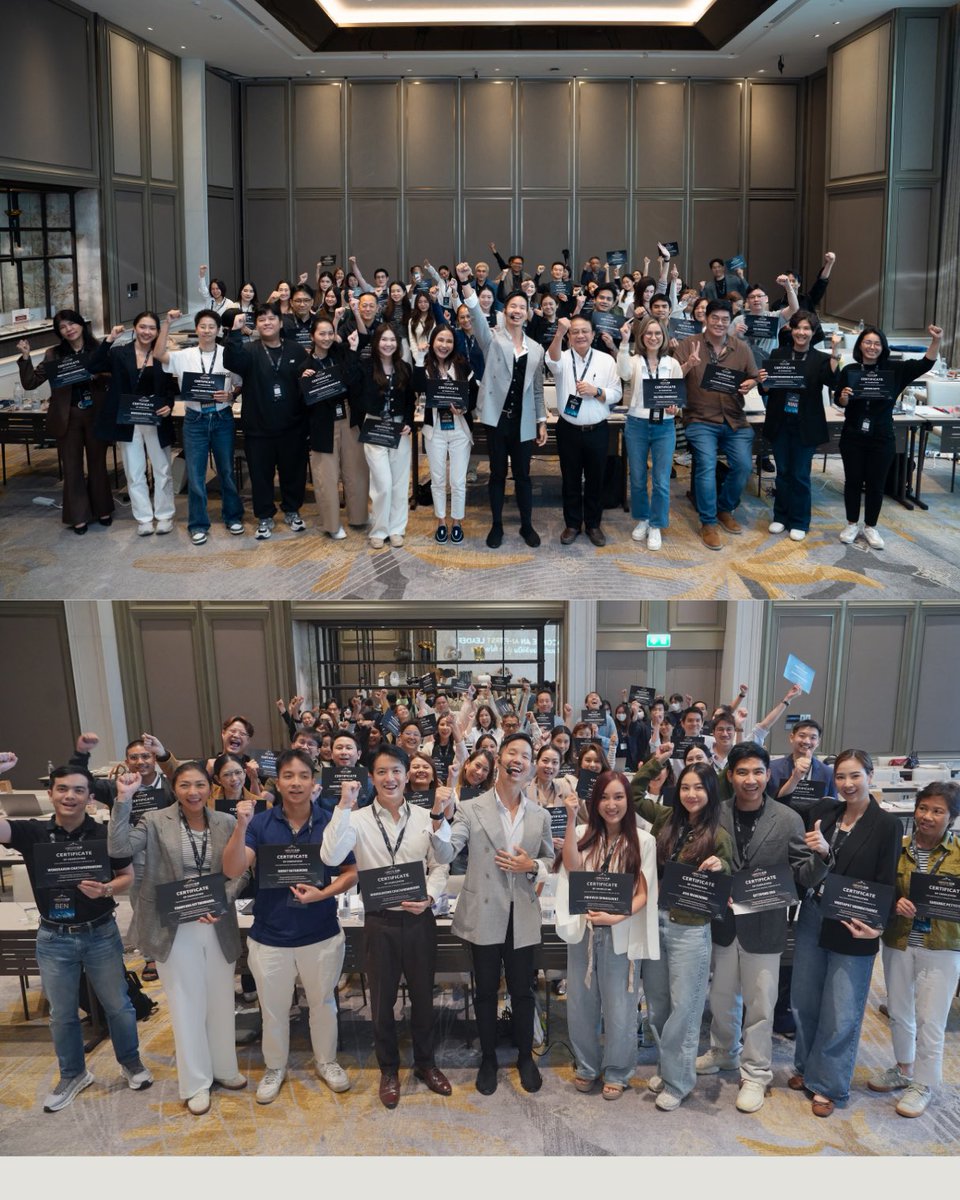
So proud of all the leaders I’ve trained 😍
We are opening our doors to the world and ready to bring this to your local city.
Hit me up if you want to join as partners or want to find out more 😉
One of my favorite features about ChatGPT Codex is its ability to use my computer without distracting me.
Claude is great but when you ask it to work on your computer, it literally takes over the whole screen.
Most teams think the AI bottleneck is prompts.
It is not.
It is context.
If your SOPs, pricing, customer history, and decisions are scattered, AI will sound smart and still be useless.
1. I used to have a 160-person team.
From the outside, it looked impressive.
Inside, I was drowning. 50 decisions a day. Thin margins. Fire drills every morning.
I was the most expensive operator in the building.
Now I run a 7-figure business with 8 AI agents.
Heres my exact system 🧵
An AI employee should first be reliable. It should work 90% of the time. That's why my go to for open-source agents is still Hermes. Spent 3 months with it and it's changed how I work completely. Mine runs on my Mac Studio that never turns off.
I paid $200 for Perplexity's max subscription to replace $6,000 worth of consulting work done in one afternoon. This is how you leverage these tools. If you use it like a toy, it will always be "expensive".
13. Now let's get practical.
I recommend starting with one simple agent.
One that first handles all of your emails, calendars, and the boring admin work.
From there, start mapping your:
- Inputs
- Processes
- Outputs
Build one workflow at a time now all 100.
14. Aim for one process. One agent per week.
As you become faster at building these, you will start to experience another level productivity that 95% of the population never reach.
It's the benefit of burnout vs peace of mind knowing that you got a team that backs you up.
12. This post isn't about telling you to go fire everybody in your team.
It's about scaling without having to add headcount.
Every dollar you don't spend on unnecessary payroll goes back to your business, your team, or your family.
10. Yes people glorify the fact that we can literally do more with less which becomes a cost advantage for businesses.
However, what is barely spoken is the peace and calm that comes when you don't have the stress of $150k payroll you have to find every month.
11. Right now, my AI education business pulls in $60-$80k per month with a team of 3. The rest are agents or freelancers that we hire.
Before: 160 people, $150K/mo, thin margins, no sleep.
After: 8 agents + 3 humans, $1,500/mo, thick margins, I sleep through the night.
50,000 baht vs 5,000,000 baht.
9. Level 3: Specialist Agents. On-demand.
"Research 10 viral hooks on AI for business owners."
"Write a full script from this brief."
"Turn this 20-min video into shorts and carousels."
I view these as head departments who do not have routine jobs in place but I can call on with specialized tasks.
1. I used to have a 160-person team.
From the outside, it looked impressive.
Inside, I was drowning. 50 decisions a day. Thin margins. Fire drills every morning.
I was the most expensive operator in the building.
Now I run a 7-figure business with 8 AI agents.
Heres my exact system 🧵
8. Level 2: Director Agents. They run on timers.
Every 7AM my Ads Agent pulls Meta data, analyzes performance, drafts a report:
"Campaign A: ROAS 3.2.
Campaign B: ROAS 1.1. Recommend pausing."
Something I used to do myself or have my marketing manager do for me.
7. Level 1: The Orchestrator. I call her Kelly.
She triages everything before I wake up.
Instead of 50 messages, I open one report:
"Here's what happened. Here are 3 decisions you need to make. Everything else is handled."
5 minutes. Yes or no. Then my real day starts.
6. Every agent runs on the Golden Triangle:
Knowledge (your expertise)
Instructions (clear prompts)
= Output (finished work, not suggestions)
Miss one leg. Nothing happens.
This is the foundation the whole system sits on.
5. The secret isn't one AI doing everything.
It's an org chart. Three levels:
• Level 1: Orchestrator (your COO)
• Level 2: Director Agents (department heads)
• Level 3: Specialist Agents (the doers)
The magic is in the handoffs between them.