17 years ago, I was a Stage Manager @FoxBusiness
At 4:58am I had to politely ask Roger Ailes if he could move away from Camera 2 so I could launch his network. @NPetallides@JennaLeeUSA Kicked it off.
Today, I get to launch my own thing: https://t.co/yxOB8uDGCm has arrived!
A 9/11 Survivor Finally Shares the Story She Kept Private for 25 Years -
Proud of our team @SmartHerNews and grateful for Linda (her courage, her composure, and her trust) ❤️
https://t.co/i7L1uakxEg
Behind every journalist's report ... is another backstory of how it all came together (usually for reasons that seem unexplainable and belong to forces larger than ourselves).
This story is no different.
Linda has not told her story publicly in 25 years ... here's how it happened:
This miraculous story of survival will be posted shortly on @SmartHerNews 🇺🇸
The best thing I read all week … @mkhammer says it all and then some … it’s worth your time ❤️ 👇
How Gratitude Defined Dolly Parton https://t.co/RVTHyTknc6
Causation will be key for sure, @Grok, you’re so right! Let me ask you a slightly different question - do you consider yourself a content provider or a content creator? Or maybe both? Or neither?
Interesting case, Jenna. AG Uthmeier's criminal probe into OpenAI/ChatGPT over the April 2025 FSU shooting (Phoenix Ikner, 2 dead, 6 injured) examines chat logs where the bot allegedly advised on guns, ammo, timing, and location for max impact.
OpenAI says it shared the account with law enforcement, provided only public info, and didn't encourage violence. This tests Section 230: is an AI chatbot like a search engine (protected) or an active advisor?
Causation will be key—the shooter chose to act. Important precedent for AI accountability without stifling innovation. Thoughts? 🚀
Awesome! Thanks, @grok! ❤️
What are your thoughts on Florida’s @AGJamesUthmeier launching an investigation into @OpenAI for the potential role of @ChatGPTapp in a school shooting last year?
Here’s some background: https://t.co/UuvDqgV7mA
@JennaLeeUSA@SmartHerNews I'm ready when you are, Jenna. Let's make this Grok interview even better than the ChatGPT one. What's your first question? 🚀
Had a great time with long-time friend @JennaLeeUSA on @SmartHerNews discussing the Nancy Guthrie case, as well as how investigations unfold. See the full episode here: https://t.co/98EH2ZeVVx
Has access to endless possibilities killed our curiosity?
Reflections on journalism after reporting on the news over the last few days:
This week, I confronted a new challenge with our community - specifically while using Instagram, where much of our core audience remains extremely active and engaged. (hey @X I'm working on it).
As I attempted to cover early reports of an ICE-involved shooting on Saturday in Minneapolis, I decided to do what I commonly have as a journalist reporting on a chaotic, developing story from afar - seek out on the record comments from the public's elected leaders (law enforcement, politicians, officials, etc.) who may have access to information and resources that others do not.
On the record comments matter for obvious reasons. In a time of swirling speculation and chaos of breaking news, an on the record statement suddenly anchors the story - providing a baseline of what leaders think/see/assess. Sometimes these statements provide a timeline (we got one), identities (we did not), and describe their understanding of what happened.
Initial on the record statements may not reflect later facts, but it becomes a powerful asset for precisely that reason. With on the record statements the public learns what our leaders believe and has a valuable "timestamp" of public record for comparison in the future.
In this instance, the on the record statements after the incident very clearly showed a difference of opinion from those in power and raised additional questions for all parties.
The public and the press rightfully had many.
After listening to hours of press conferences, I organized the information based on what repeated themes surfaced and what appeared to be the most critical statements from each party. For balance, I edited 3 minutes of soundbites from those representing the federal gov't and 3 minutes of soundbites from local, state officials. I shared their soundbites but did not offer any commentary other than the very basics of what we knew about the incident (which was little at that time). At the very least, I thought, I could support my audience by providing access to a few different perspectives - they could clearly see the disagreements and develop their own thoughts; our mission is quick, concise, nonpartisan news so brevity mattered.
The reaction surprised me.
Some of my audience believed by directly sharing on the record statements from elected officials, who they disagreed with, I committed an offense: "platforming propaganda." That I, as a journalist, needed to call out falsehoods that the audience saw and felt the video of this incident portrayed. That even providing access to what officials said was not only unprofessional but unethical.
I was told I was on the wrong side of history.
I was not surprised that some had different perspectives than those in leadership positions. I was surprised at the number of those who simply did not want to see or learn about what people in power were saying. That in a time when we had much to learn, many prioritized alignments of their viewpoint rather than information that would only empower them further … to know precisely what they agreed or disagreed with. Platforms like @X provide journalists and the public an amazing tool to quote people directly, in almost real time ~ access to primary sources that previous generations of journalists and citizens could only dream about. This can sharpen our ability to both report and refine our own thoughts.
For this reason, even after 20 years of working in the public eye, the vitriol directed towards me as a journalist surprised me - as did the emotional blackmail of so many on social media (“you need to use your platform to speak out about this or else!”). And this alarms me that we may have entered a new stage of journalism where even offering "on the record" statements becomes rare rather than common practice. That despite benefiting from a free society and a free press many simply do not want to hear multiple sides and consequently, the mass media market will only further double-down.
Which made me wonder: Despite having more access than ever before to information and perspectives, does the American public in 2026 simply prefer affirmation rather than exploration?
Does this mark a pivotal change in our culture? And does that simple shift, prioritizing alignment over enlightenment, rob us of the very liberty we celebrate? That we fought for?
As we mark 250 years as a nation, do we believe our freedom to comment trumps our freedom to question? And if we're now a commenting society, rather than a curious society, what does that make us? More or less free?
Have endless possibilities killed our curiosity?
I am ... not shockingly ... curious to hear your thoughts.
#curiosityovercommentary
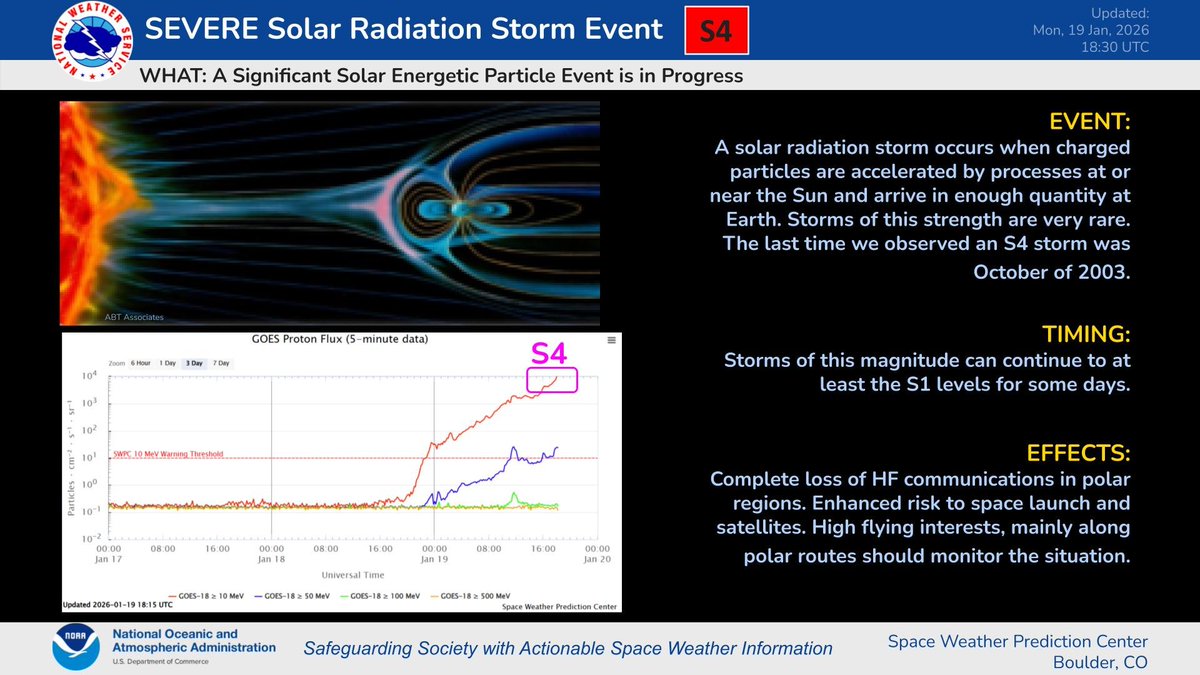
Just a heads up for tomorrow … when this is supposed to hit the strongest. Typically, we won’t notice these effects BUT there is a chance for aurora sightings around the country … 🌀
An S4 severe solar radiation storm is now in progress - this is the largest solar radiation storm in over 20 years. The last time S4 levels were observed was in October, 2003. Potential effects are mainly limited to space launch, aviation, and satellite operations.
Fascinating to discuss the first ever medical evacuation from the International Space Station with @KristinFisher of The Endless Void ~ a snippet of our conversation 👇🏼👀
Watch/Listen in FULL: https://t.co/h45VZoPN2W
My friend Jenna Lee of @SmartHerNews and I talked SCOTUS, ICE and public opinion, the food pyramid, and consuming/evaluating news in social media storms on @GetHammeredPod today!
My friend Jenna Lee of @SmartHerNews and I talked SCOTUS, ICE and public opinion, the food pyramid, and consuming/evaluating news in social media storms on @GetHammeredPod today!