Patrick Mahomes is EMPLOYED by the Kansas City Chiefs to play Quarterback, but when you see him in a State Farm Commercial, thats an NIL deal.
The problem with college is that athletes DON’T sign contracts to play football, they sign NIL agreements with their schools to avoid triggering employment law.
That distinction is why revenue sharing exists, buyouts are murky, and enforcement power is almost nonexistent. 🤷♂️
As schools continue prove athlete value by spending $60M+ of “NIL Deals” on 2026-27 rosters — Congress wants to cap that through legislation, with no athlete seat at the table.
Collective bargaining isn't radical. It's the only fair fix. 👇
The Protect College Sports Act is being marketed as a solution to stabilize college sports, but in reality protects schools and NCAA leadership over athletes.
Read the full statement on https://t.co/TkAGdt2gdX.
The Protect College Sports Act is being marketed as a solution to stabilize college sports, but in reality protects schools and NCAA leadership over athletes.
Read the full statement on https://t.co/TkAGdt2gdX.
This from the CBC release: The CBC has transmitted formal letters to Greg Sankey, Jim Phillips, and Charlie Baker “demanding immediate engagement and a public response regarding the ongoing assault on Black political representation throughout the South and across the nation.”
As @JayBilas correctly points out, there’s a lot of hypocrisy in college athletics right now.
It’s only when athletes begin to get paid that it’s necessary to have a federal law to “save college sports.”
❌ THE “STUDENT-ATHLETE” ERA IS OVER.
College athletes are living in a system where the rules can change overnight… and they’re the only ones with no protection.
A coach can quietly tell a kid: “You’ll never play another down here,” so the athlete hits the portal.
What’s really happening is thousands of athletes are getting pushed into a marketplace with no guarantees, no standards, and no safety net.
Agents are also taking advantage of young athletes who don’t have lawyers, guidance, or leverage.
👉 Promises that aren’t in writing and deals that don’t come through.
👉 Pressure to make decisions fast because “someone else will take your spot.”
This is exactly why collective bargaining matters.
We need:
👉 Standards for health + safety
👉 Real enforcement and accountability
👉 Guardrails for representation
👉 A system where athletes actually have a voice
👉 In a survey of college athletes conducted by @AthletesOrg it was discovered that 38% of Power 4 athletes were promised money… and never got paid. 🤯
If your boss skipped your paycheck, how long are you showing up to work? 🤷♂️
That’s the most direct case for collective bargaining:
Real contracts. Real protections. A minimum standard for compensation, benefits, health insurance, and workplace safety.
Because in today’s system there’s no structure, and the athletes keep paying the price….
The White House is hosting a summit about college athletes—without college athletes.
They fill stadiums, put their bodies on the line, and generate billions of dollars in revenue for others.
College athletes are at the very center of college sports. Their voices need to be at the center of any policy discussions about its future.
The NCAA is bracing for “blind transfers,” where a player transfers without ever entering the portal. 🤯
👉 With the spring portal window gone, the NCAA expects more of these moves and is discussing major penalties for schools that take them, including a 6-game head coach suspension, fines tied to the football budget, and loss of roster spots.
But how can these penalties be enforced when the current contracts do not employ players to be athletes? They are just NIL deals… 🤷♂️
Thats’s why at @AthletesOrg we’re building the first players association for college athletes, because the only way to fix this is to give the athletes the seat at the table that they deserve. 🤝
What does 𝙘𝙤𝙡𝙡𝙚𝙘𝙩𝙞𝙫𝙚 𝙗𝙖𝙧𝙜𝙖𝙞𝙣𝙞𝙣𝙜 look like in college sports?
Listen to the full show featuring @MattBrownEP, @jimcavale, @samcehrlich and @JeramiahDickey now on Bronco Studios Live.
📺 https://t.co/0wjiqrXVyB
As the co-founder of @AthletesOrg, we have built the first operating Players Association for college sports, ensuring that the athletes who drive this multibillion-dollar industry finally have a seat at the bargaining table - as they deserve!! 💪
Don't be fooled by the marketing behind recent Congressional bills.
The SCORE Act isn't about saving sports, it's about securing an antitrust exemption to cap athlete pay, amongst other things, without their consent.
👉 The "amateur" model is a relic of the past, and the only way to stop the endless litigation is through real collective bargaining.
It’s time to move past the disguises and build a system based on fairness and professional structure. 🤝
Indeed. Today’s environment is one that the top 1% can take advantage of. But they’re missing key protections (standardized contracts, guaranteed money, health & safety protections, agent protections, etc) that they would have with a CBA. Not to mention all the protections that the other 99% are missing in this environment.
Amid continued chaos in college sports, TCU Athletic Director Mike Buddie joins a growing number of campus leaders endorsing something the industry has always opposed: Collective bargaining with athletes. https://t.co/mycEp33SBB
Yes. We provide our ~5,000 active college athlete AO members with technology to vett agents (background checks), we have a registry for agents on our AO member app where athletes can rate and review them. But the ultimate way to regulate agents is through certification and fee regs that are negotiated and standardized in a cba, where all agents have to abide by same standards.
As the co-founder of @AthletesOrg, we have built out the first-ever College Athlete Players Association, providing college athletes with a seat at the table to solve the structural failures of the current system.
🤝 We all agree the system is broken, but here’s why collective bargaining is the solution: College athletics is currently trapped in an unsustainable cycle. Schools are operating like for-profit entities on the revenue side while letting expenses spiral out of control on the other.
Without a collectively bargained path forward, the lawsuits won’t end, and the model won't survive. 📉
College Athletics began commercializing its revenues decades ago.
It’s time to commercialize the expenses. It’s time to move past the "student-athlete" myth and build a college athlete framework that actually works for everyone. 🙌
🗓️ In July 2022, only one year into NIL, the data was already screaming the truth. My company, INFLCR, had processed over $100 million of the first-ever NIL payments to athletes.
College Athletics leaders (who were my INFLCR software clients at the time) asked me what the data was saying, because nobody knew what was real. ie. “Did this HS QB Nico from California really get $8M of NIL money to go to Tennessee?”
I spent the entire year of 2022 pleading with college athletic leaders to understand that pay-for-play was inevitable.
I delivered the "rant" in this video clip to anyone who would listen, because I knew the only way for this to be a sustainable model was to build it correctly from the start.
The reality?
🤷♂️ The current chaos isn't a surprise, it's the result of a system that wasn't built to scale.
👉 We moved from marketing to compensation faster than the infrastructure could keep up.
🗣️ As someone who starting building INFLCR 5 years before NIL began and ultimately build the systems that processed that first $100M and has processed hundreds of millions to this day, I’m not speculating, I’m explaining.
This is why we founded @AthletesOrg.
We aren't just reacting to the shift, we’re actively building the first operating college athlete Players Association to give athletes the seat at the table I was pleading for two years ago.
The term “student-athlete” wasn’t created to celebrate education.
It was created to save the NCAA from paying workers' comp to the family of a player who died on the field.
Walter Byers, the man who built the NCAA, admitted it was a legal shield.
I don't use the term. I call them COLLEGE ATHLETES.
Because when you strip away the "hyphen," you finally see the truth: We are operating on a 70-year-old legal loophole that was never meant to protect the player. It was meant to protect the money.
That’s why at @AthletesOrg, we’re moving past the myths.
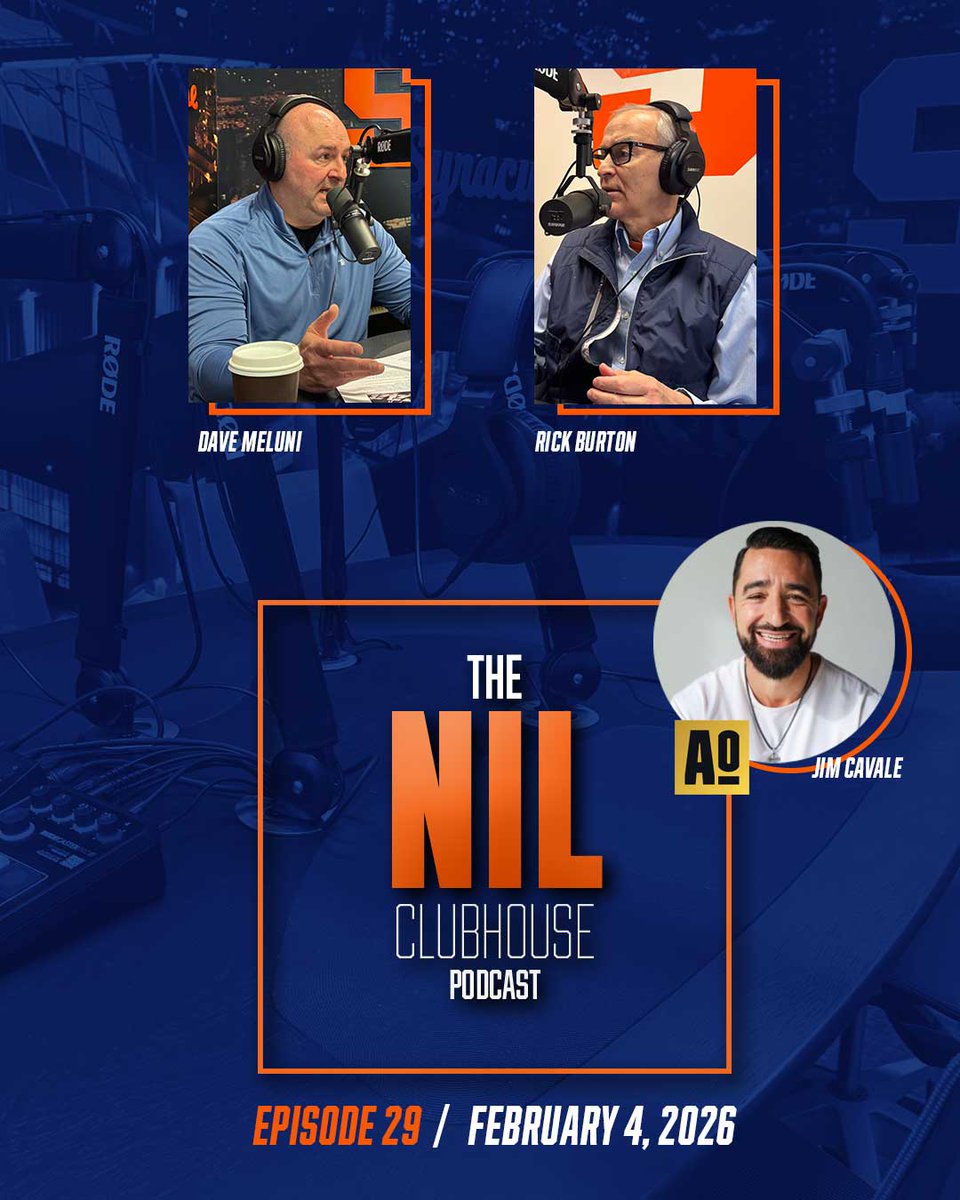
Happy February from the podcast studios at @SUFalkCollege. Rick and I are back for our newest episode of the NIL Clubhouse. Excited to share our incredible chat with @jimcavale of https://t.co/W32LO14Do7. This is a must listen.
@AthletesOrg@SUSportMgmt
🔗 https://t.co/wHZRaUPQou
I’ve thought about what life might’ve looked like if I went to Harvard instead of pursuing my dream to play Baseball at a small school in Alabama.
Maybe more resources. Maybe better connections. But also way more competition to even get a seat at the table.
The truth is, where you go matters a lot less than what you do while you’re there.
Community college. Small school. Big-name school. It doesn’t matter.
The advantage goes to the people who squeeze every ounce of opportunity outside the classroom, wether you’re an athlete or not…
That’s where careers start.