Who would buy Pi from the US for $314,159 when it goes on sale?
Some pioneers wonder why anyone would pay $314,159 to a pioneer when they can mine Pi themselves.
They claim that this is why Pi is not worth $314,159.
Pi is supposed to be used as a payment currency,
not to replace fiat currency.
If Pi is successfully adopted at the price some pioneers are asking for, such as $31.4
or $314,
based on Pi’s current core mining speed of 6.48,
and assuming more pioneers and active miners join,
the mining speed will slow down.
Let’s assume it takes a month to mine one Pi,
that’s 12 Pi in a year.
If the price is $31.4,
You will only earn $376.80 per year,
Or maybe even less than that to $37.68,
which is equivalent to one hour of work.
Do you think Pi can still attract more miners to become a distributed currency character?
It is important to understand that companies and institutions will buy Pi from us when we reach the OM stage because they need our blockchain.
To become a user on our blockchain,
You must pledge at least 10,000 or 100,000 Pi
if the price is $31.4 or only $314.
However,
Based on the current mining rate of 12 Pi per year,
Companies would need to mine for 83 to 833 years to earn 10,000 to 100,000 Pi. This is not practical,
so they are more likely to buy Pi from us.
If Pi reaches a stable GCV price of $314,159 in OM,
companies will not find it expensive to buy Pi because one Pi will have a purchasing power of $314,159.
At this point, they are just moving money from their left pocket to their right pocket.
When Pi is at $314,159, companies only need to pledge 10 Pi or 100 Pi, not 10,000 or 100,000 Pi.
But up to 10 Pi, companies will buy,
not me, for a year. Because timing is very important for business.
Now let's look at the international trade numbers.
I quote my speech at last year's Twitter conference in June as follows:
According to data from the Bank for International Settlements from the Bank for International Settlements two days ago,
The average daily transaction volume of the international foreign exchange market was $6-11 trillion. yS)
If the price of one B is $1,000, it will take 6-11 billion B. yS)
If the price of one B is $10,000, it will take 0.6-1.1 billion B. yS)If the price is $100,000, it will take 60-110 million B. yS)
If the price is $314,159, it will take 19,098,609 to 35,014,117 B.
Currently, we only have 850 million B available for use.
Therefore, the initial swap price of B should be increased to at least $314,159 per B.
This is the most reasonable price for international settlement.
Now let's take a look at the figures from China's trade:
According to customs statistics in 2023, the total value of China's import and export trade in goods in the first quarter of 2023 was 9.89 trillion yuan,
an increase of 4.8% year-on-year. Among them,
Exports were 5.65 trillion yuan,
an increase of 8.4% year-on-year;
Imports were 4.24 trillion yuan,
an increase of 0.2% year-on-year.
So the total US dollar is 1.3846 trillion US dollars. S)y
If Pi is $100, we need 13.846 billion Pi.
So we have migrated 2.45 billion Pi keys and 1.6 billion,
and only 0.85 billion are available.
Even if the next migration is carried out in large numbers,
this number will not be reached within 3 years,
and this is only the first quarter of China's data. S)y
P must have the function of an international settlement currency,
which obviously cannot be achieved with $100.
So, can GCV meet that?
We can see that 44,073 Pi are needed.
If calculated based on China's annual needs,
it is estimated that about 200,000 Pi are needed.
233 countries need 40 million Pi for trade alone.
If calculated according to several small countries divided by 4 times,
10 million Pi are still needed. y)SIThis
does not include individual peer-to-peer transactions.
Because Pi wants to be a stable currency,
the starting point must be high to lay a solid foundation for stability over hundreds of years.
Global trade and financial transactions involve huge amounts of m
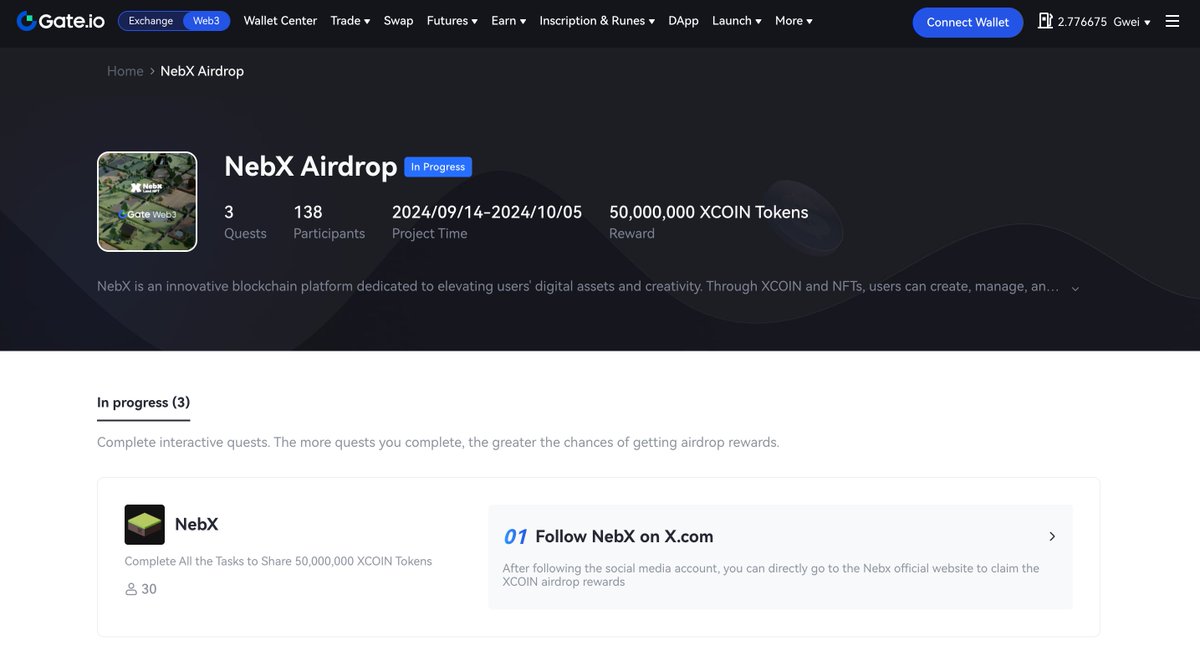
🚀 NebX Exciting Giveaway with Gate Wallet 🚀
We’re thrilled to team up with Gate Wallet @GateWeb3Wallet for a special giveaway event! 🎉
Don’t miss your chance to win incredible prizes and dive into the excitement with Gate Wallet! 🔥
🗓 Event Period: Sep 14th ~ Oct 5th
🎁 Rewards: 2000 XCOIN per person
📰 Learn more:https://t.co/fguaEQRYIR
The end of exploration is just the beginning of new discoveries—Join NebX! 🪐
#gatewallet #Giveaway #web3 #airdorp
☆ Happy New Month, Pioneers ☆
Welcome to the last month of kyc grace.
Kindly do your kyc once eligible. Time is ticking.
Come next month, migration started.
#PiCoreTeam#Pimainnetupdates
🚀 Major update: Unlock 15% of your CTM balance! Daily mining unlocks 1% of your balance every day.
First withdraw batch August '24: Bridge mined CTM to Ethereum (fee applies). Reserve your spot now! Stay tuned for more! https://t.co/xgfnTdYOMd 🌌💰
In their daily roles and routine performance of their duties, private security personnel (security guards) form the initial barrier and frontline defence against criminal threats, including acts of terrorism, robbery and armed aggression. However, the absence of defensive capabilities and security equipment significantly compromises their ability to protect themselves and the public effectively. This limitation not only endangers the safety of these security guards but also impedes their capacity to execute their responsibility of protecting lives and property. In the recent past a number of security guards have been killed while on duty by armed criminals.
As part of the ongoing private security sector reform agenda, the Authority has proposed ammendments to the Private Security Regulation Act No.13 of 2016 with a view of empowering and sufficiently equiping the private security guards to posses and use firearms - The primary intent of these ammendment is to equip the private security officers with knowledge, skills, tools, equipment and capacity to detect, deter and effectively respond to security threats within their area of jurisdiction.
The Proposed Private Security Regulation (Amendment) Bill 2024 is a strategic initiative aimed at amending Section 53 of the Private Security Regulation Act No. 13 of 2016. Once this legislative proposal is approved, the law will authorize the controlled issuance, ownership, and operational use of firearms by private security officers (security guards) assigned to high-risk tasks and critical infrastructure.
Such high risk assignments include public spaces characterized by high human traffic, Shopping Malls, Cash in Transit, Maritime Security, Critical Infrastructure, Government Institutions and Institutions identified with elevated vulnerabilities and security risks.
This measure will be implemented under stringent regulatory supervision, ensuring adherence to established safety protocols for handling firearms and related operational use of firearms.