1/Chris Sims is easily one of the most influential macroeconomists (& perhaps most influential empirical macroeconomist) of the last 50 years; he fundamentally changed thinking about monetary policy, metrics,& causality (VARs, time series models). Thread on his greatest hits🧵👇
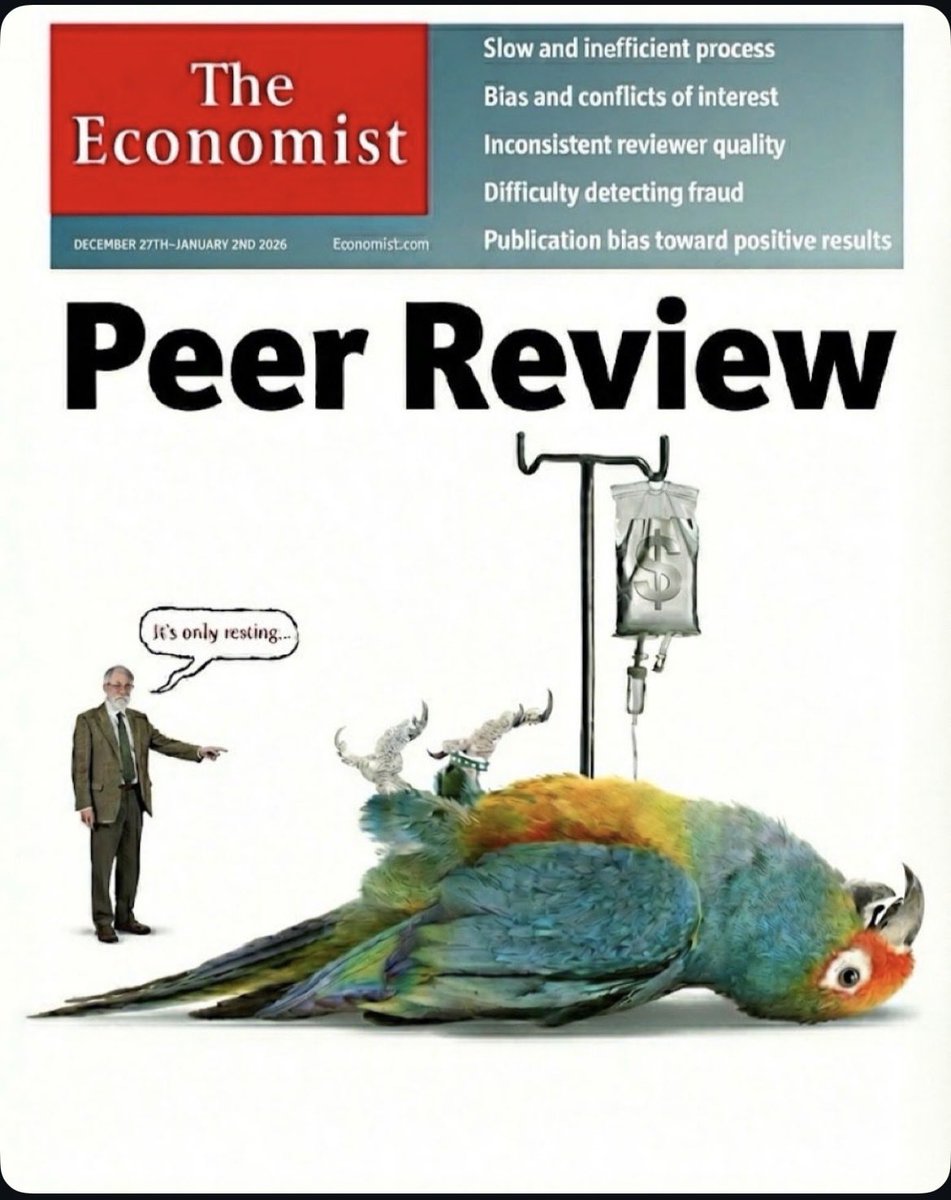
For decades, peer review has been treated as the gold standard of scientific validation.
Yet many scientists know the reality: the system is far from perfect. Peer review is broken and sometimes even corrupted.
The process can be slow, inconsistent, and vulnerable to bias. Reviewers are sometimes asked to judge work outside their true expertise. In other cases, they may be evaluating ideas that challenge the very paradigm in which they were trained. And occasionally, reviewers are simply competitors.
Ironically, the most prestigious journals can also be the most conservative. Truly new ideas are often met with skepticism, while safer work that fits the current narrative moves more easily through the system.
Increasingly, papers are judged less by the originality of the idea and more by the volume of data, the sophistication of statistics, and the beauty of the figures. Science risks becoming data-rich but idea-poor.
But there is an important reality to remember: journals do not ultimately decide the impact of scientific work. Impact is decided later, by the community. By the scientists who read it, test it, debate it, and cite it.
In the end, citations and ideas determine the legacy of a paper, not the impact factor of the journal that first published it.
Science has always advanced by questioning assumptions. Perhaps it is time we also question the system that filters scientific ideas.
Short-term rentals and housing prices: the role of tourism development typologies* https://t.co/TtXeei5Tz1 recién publicado con Agustina Romero, Teresa Torregrosa y Luis Moreno.
The relationship among short-term rentals, house prices and rental prices in consolidated tourism destinations https://t.co/CEfgP1DqmQ with @Anaramon43@TTorregrosa@JosepIvars
Recent published with @luismoreno_tw and me Perles-Ribes, J. F. ., & Moreno-Izquierdo, L. . (2024). Testing the tourism led growth hypothesis: A nonsensical exercise?. European Journal of Tourism Research, 38, 3817. https://t.co/byyWMtGd4l
Also with @luismoreno_tw @AnitaRucci, Adrian Más and me Perles Ribes, J. F., Moreno Izquierdo, L. ., Rucci, A., & Más Ferrando, A. (2024). Is the tourism-led growth hypothesis valid after the COVID-19 pandemic? The case of Spain. European Journal of Tourism Research, 38, 3815.
La comisión saliente del Grupo 10 os da la gracias por estos 4 años de confianza💜Agradecid@s a @JosepIvars y muy ilusionados con la nueva etapa, incorporando a @mcapdepon, que se suma a @ATorres_Delgado @carmen_hidalgo y @PacoFemenia en la comisión permanente que arranca (24-28)
@luismoreno_tw @Anaramon43 Ana Rucci y un servidor Competitiveness, sustainability, and development in tourism: a relationship analysis for the case of Spanish regions https://t.co/xdNwosDTjt
Con @luismoreno_tw Adrian Más, María Núñez y Antonio Rubia Methodological proposal to determine explosive tourism growth: a warning for unsustainable development? https://t.co/hKXtlmy4a2
𝗖𝗮𝗹𝗹 𝗳𝗼𝗿 𝗽𝗮𝗽𝗲𝗿𝘀
XVI Workshop "Tourism: Economics & Management"
Alicante, 6-8 de noviembre de 2024
Fecha límite envío de abstracts: 30 de junio
Más información: https://t.co/Mo536qxVfi
#workshop#turismo#economía#gestión#Alicante