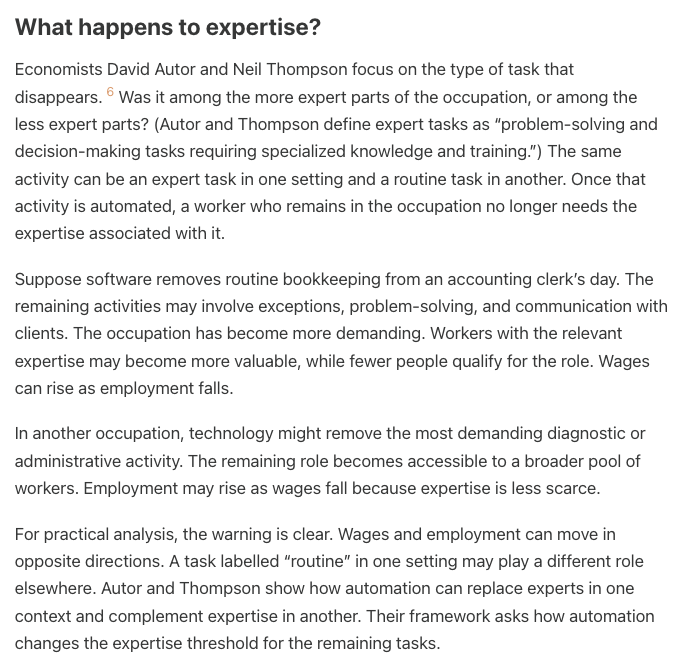
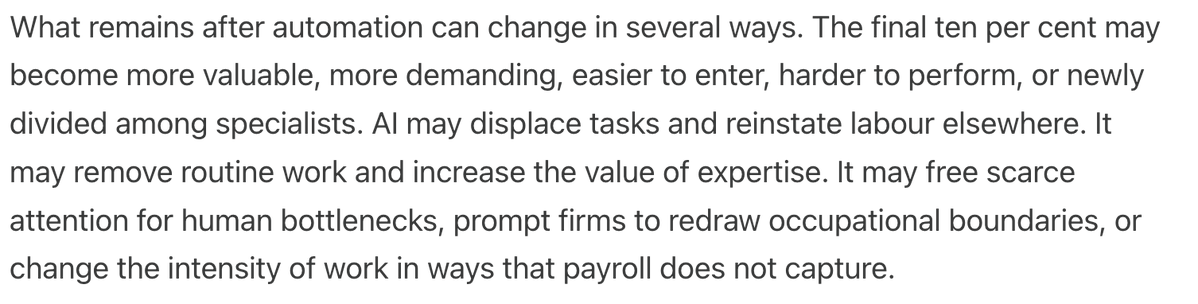
In the American Worker Project’s latest guest essay, @joshgans explains why, instead of asking whether an entire occupation is “safe” or “at risk” of automation, we should identify which tasks within an occupation can be automated to increase productivity.
Read more: https://t.co/l2oGDCmRxx
There is lots of criticism of the https://t.co/Y8htZKiDJ4 letter on AI to which I am a signatory to because of lack of specifics. You know why? As far as I know there has not been a single paper in regulatory economics on the details of regulating AI to counter potential risks.
This specification from @joshgans is going to dominate everything. The task of orchestrating human inputs and evaluation, alongside embodying it in an orchestration of agents, is enormous. There are surely, surely, very few pre-AI organisations that are up to it.
Lots of papers on whether we should stop AI or not. Lots on broad governance ideas. But literally none on who should get access to frontier models and why. This is why this letter is important. I just wish it had pointed this out more clearly.
Fundamental Theorem of Welfare Economics: Every competitive equilibrium is Pareto optimal.
How did Arrow and Debreu prove it?
My new article about it:
https://t.co/IugMbqIzvu
This is actually the founding principle of All Day TA. When professors provide content, it is used to train their TA and nothing else. We don't even store it (even when some profs want us to), and we can't use it to train our own backend.