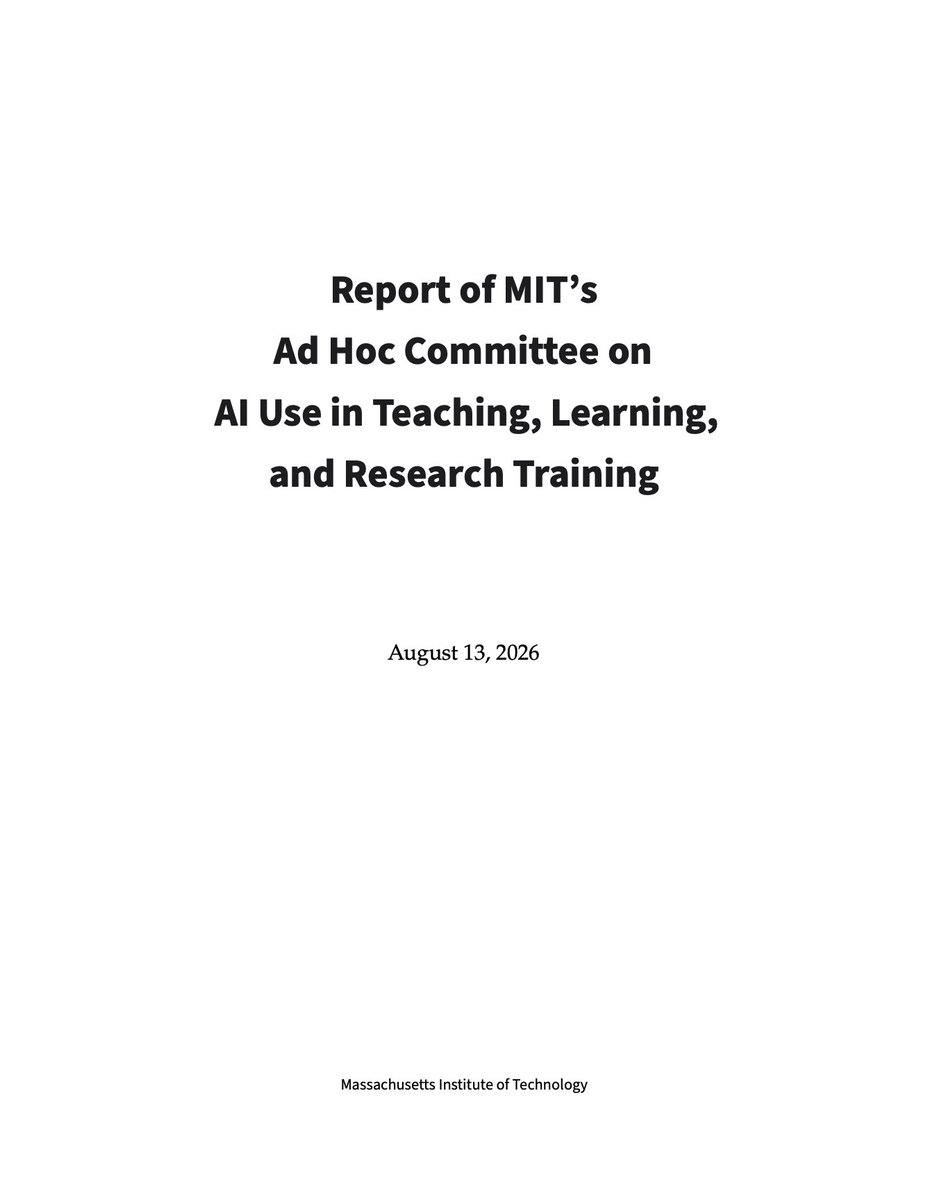
MIT published a brutally honest report on what AI is doing to students.
A committee of professors and students spent five months studying how AI changed learning on campus, and the findings read like a warning to every university on the planet.
Study groups are disappearing. Office hours are emptying out. Problem sets and take-home exams no longer prove anything, because AI can produce credible solutions to almost any written assignment in the undergraduate curriculum. Students who lean on chatbots lose mastery and confidence, and some slip into what the report calls cognitive surrender, reaching for AI at the first hint of struggle.
The numbers are rough. 46 percent of surveyed MIT undergrads use LLMs daily. 90 percent worry about their own overreliance. Undergrads who feel AI makes them replaceable now outnumber those who feel it makes them capable.
The committee's answer surprised me. They refused to fight AI with surveillance. The report calls AI detectors unreliable, says lockdown browsers feel like spying, and warns that policing students builds a classroom atmosphere of mutual distrust.
Instead, MIT wants to rebuild education around the things AI can't replace. That means oral exams, semester portfolios, in-person project work, and a required social component in every subject. The report even floats the idea of rethinking grades entirely, since without a GPA to optimize, much of the incentive to cheat with AI evaporates.
The committee warns professors against replacing undergrad research assistants with AI agents just because they're cheaper, because a university exists to grow people, not output.
The most famous tech school on earth admitted the machines broke its way of teaching. Its answer is more humans, not more software.
Satya Nadella just warned every company using AI: you are paying twice. Once with money. Again with something far more valuable.
He published an article introducing something called the Reverse Information Paradox.
And it changes how you think about every AI tool your company uses.
Nobel laureate Kenneth Arrow described the original paradox: a seller risks giving away knowledge just to sell it. Nadella says AI flips this completely.
In the AI age, the buyer gives away knowledge just to use what they bought.
Every time your team uses Claude or GPT at work, every prompt reveals what you are building. Every correction teaches the model what good looks like inside your company. Every eval shows what you value. Every trace exposes your workflow.
The model provider learns more about you with every interaction. You learn almost nothing about what they are learning in return. Your corrections are distilled institutional know-how. The kind a competitor could never buy.
And it leaks trace by trace, correction by correction, without you noticing.
His line: "You can offload a task. You can offload a job. But you can never offload your learning."
If the model provider disappears tomorrow, do you still own the intelligence your team built on top of it? Your evals. Your memory. Your traces. Your workflows. Or did all of that compound inside someone else's infrastructure?
In the cloud era, companies accumulated data. In the AI era, they accumulate learning. Right now, most of that learning is compounding inside the model provider. Not inside the company paying for it.
The CEO pushing AI harder than anyone just told you to protect your knowledge from the very tools he is selling you. That should tell you everything.
There is a process that I have used, and still use, to reignite life...
Create two timelines—6 months and 12 months—and list up to five things you dream of having (including, but not limited to, material wants: house, car, clothing, etc.), being (be a great cook, be fluent in Chinese, etc.), and doing (visiting Thailand, tracing your roots overseas, racing ostriches, etc.) in that order.
If you have difficulty identifying what you want in some categories, as most will, consider what you hate or fear in each and write down the opposite.
Do not limit yourself, and do not concern yourself with how these things will be accomplished. For now, it’s unimportant. This is an exercise in reversing repression.
Be sure not to judge or fool yourself. If you really want a Ferrari, don’t put down solving world hunger out of guilt. For some, the dream will be fame, for others fortune or prestige. All people have their vices and insecurities. If something will improve your feeling of self-worth, put it down.
Drawing a blank? In that case, consider these questions:
1) What would you do, day to day, if you had $100 million in the bank?
2) What would make you most excited to wake up in the morning to another day?
Don’t rush—think about it for a few minutes.
If still blocked, fill in the five “doing” spots with the following:
— one place to visit
— one thing to do before you die (a memory of a lifetime)
— one thing to do daily
— one thing to do weekly
— one thing you’ve always wanted to learn
What does “being” entail doing?
Convert each “being” into a “doing” to make it actionable. Identify an action that would characterize this state of being or a task that would mean you had achieved it. People find it easier to brainstorm “being” first, but this column is just a temporary holding spot for “doing” actions.
Here are a few examples:
1) Great cook —> make Christmas dinner without help
2) Fluent in Chinese —> have a five-minute conversation with a Chinese co-worker
Determine three steps for each of the dreams in just the 6-month timeline and take the first step now.
Define three steps for each dream that will get you closer to its actualization.
Set actions—simple, well-defined actions—for now, tomorrow (complete before 11 A.M.) and the day after (again completed before 11 A.M.). Once you have three steps for each of the four goals, complete the three actions in the “now” column.
Do it now. Each should be simple enough to do in five minutes or less. If not, rachet it down. If it’s the middle of the night and you can’t call someone, do something else now, such as send an e-mail, and set the call for first thing tomorrow.
If the next stage is some form of research, get in touch with someone who knows the answer instead of spending too much time in books or online, which can turn into paralysis by analysis.
The best first step, the one I recommend, is finding someone who’s done it and ask for advice on how to do the same.
As engineering, product, design, DS, etc. melt into a new kind of role, I was reflecting on what roles might look like in the future. For example, when I look at the Claude Code team I see what I think is five archetypes:
1. Prototyper: comes up with brand new ideas; churns out many ideas, most of which don't ship
2. Builder: quickly turns a prototype/idea into production-grade product/infra
3. Sweeper: cleans up the UI, simplifies the code and system, unships, optimizes performance
4. Grower: takes a product that has been built and iterates on it to improve Product-Market Fit
5. Maintainer: owns a mature system to make it secure, reliable, fast, and efficient as it scales
Many people span across 2 roles, and sometimes 3 roles. I also notice that these roles are not really tied to job function -- eg. across Anthropic, some designers match category 1, some 2, some 3; same for engineers, PM, DS.
A healthy team needs a mix of these, depending on the product:
- A product that is new and pre-PMF needs people that are strong at 1+2+3
- A product that is growing and has found PMF needs 2+3+4 and some 5
- A product that has strong PMF needs 3+4+5 and some 2
Maybe product roles of the future will look more like this, and less like the domain-specific roles of today?
I'm a cardiologist. For months I've been telling you that inflammation is the fire behind heart disease ��� not just cholesterol. That we've been treating the smoke while the fire kept burning.
Penn Medicine just built the fire extinguisher.
They took the most powerful immune technology in cancer medicine — CAR T-cell therapy — and flipped it. Instead of engineering killer cells to destroy tumors, they engineered regulatory T cells to suppress the chronic arterial inflammation that causes heart attacks.
Published in Circulation. The results stopped me cold.
In CAR T cancer therapy, doctors extract your T cells, genetically engineer them to recognize a specific target, and infuse them back into your body as precision-guided missiles. It has cured previously terminal blood cancers. The technology won its developers a Nobel Prize.
The Penn team asked a question no one had asked before: what if we aimed this at the arteries?
They engineered regulatory T cells — Tregs, the immune cells whose job is to calm inflammation rather than cause it — to specifically target oxidized LDL. OxLDL is the molecule that starts the entire atherosclerotic cascade. It infiltrates your artery wall, triggers macrophages to gorge on it and become foam cells, releases inflammatory cytokines, recruits more immune cells, and builds the plaque that eventually ruptures and causes a heart attack.
OxLDL is the match that lights the fire. These engineered CAR Tregs are designed to find that match and snuff it out — at the arterial wall itself.
The results in mouse models of atherosclerosis:
Blocked macrophage foam cell formation — the cellular process that builds plaque. Dramatically reduced arterial wall inflammation. Prevented over 70% of plaque buildup compared to untreated controls. And critically — preserved normal immune function everywhere else.
That last point is essential. Previous anti-inflammatory approaches to atherosclerosis failed because they suppressed the entire immune system — leaving patients vulnerable to infections and other complications. Colchicine works modestly. Canakinumab in the CANTOS trial reduced events but increased fatal infections. The immune system is a sledgehammer. You can't just turn it down globally.
CAR Tregs solve this by being targeted. They don't suppress your whole immune system. They patrol your arteries specifically, calming the inflammation at the exact site where it's causing damage — and leaving the rest of your immunity intact.
One infusion. Targeted. Precise. The cells do the work.
Lead author Robert Schwab of Penn Medicine put it directly: "If we can get the immune system to see OxLDL and provoke an anti-inflammatory response, it would reduce inflammation and essentially stop the pathogenesis in its tracks."
Senior author Avery Posey: "Our study shows for the first time how CAR T cell technology could be used to treat the underlying cause of the most common form of heart disease — the leading cause of death worldwide."
As a cardiologist who has spent twenty years treating the downstream consequences of arterial inflammation — the stents, the bypasses, the cardiac rehab, the second heart attacks — I need you to understand what this represents.
Every treatment I currently have manages the damage after the fire has burned. Statins lower the fuel supply. Blood pressure meds reduce the mechanical stress. Stents prop open arteries that have already narrowed. These save lives. I use them daily.
But none of them put out the fire itself.
CAR Tregs are engineered to extinguish the inflammation at its source — inside the artery wall — before the plaque builds, before the vessel narrows, before the rupture, before the heart attack.
This is the shift from managing disease to correcting the biological process that causes it. At the cellular level. With living medicine.
This was demonstrated in mice, not humans. The leap from mouse models to human cardiovascular trials is enormous and filled with failures. Manufacturing CAR T cells is currently expensive — roughly $400,000 per treatment in cancer. Scaling this for a disease that affects billions would require a manufacturing revolution. Long-term safety of engineered immune cells patrolling human arteries for years or decades is completely unknown. Human trials are likely years away.
But 70% plaque reduction. With preserved immune function. Targeting the exact inflammatory mechanism I've been writing about for months. Published in Circulation — the flagship journal of the American Heart Association.
The trajectory is unmistakable.
Gene editing to permanently lower cholesterol. Personalized mRNA vaccines to hunt cancer. GLP-1 drugs rewiring metabolism. Cellular reprogramming to reverse aging. And now — living immune cells engineered to extinguish the inflammation that causes the number one killer on earth.
Every one of these treats the root cause instead of managing the downstream damage. Every one of them was impossible a decade ago. Every one of them is in trials or approaching trials right now.
I've held dying hearts in my hands in the cath lab at 3 AM. Hearts that were destroyed by inflammation I could see but couldn't stop.
The day I can infuse a patient with cells engineered to stop that inflammation before it ever builds the plaque — that's the day cardiology changes forever.
We're not there yet. But the fire extinguisher just passed its first test.
Story from NYT on saving life by AI
As a cardiologist, I appreciate the human story here but let’s be precise about what’s actually happening.
A well-trained physician would have caught this ECG finding and ordered the echo. What we’re often calling ‘AI breakthroughs’ in cardiology are really gap-fillers for under-resourced or under-trained systems, valuable in that context, but not paradigm-shifting for centers with strong clinical care.
The hype cycle around AI in medicine risks overpromising to patients and undervaluing the clinicians already doing this work every day. 🩺 🫀
@nytimes@DKThomp