We're excited to announce the creation of a new Short Paper submission option at the Journal of Public Economics!
AERI rules apply, submissions are now open!
See details here:
https://t.co/DHv8oFI0Ju
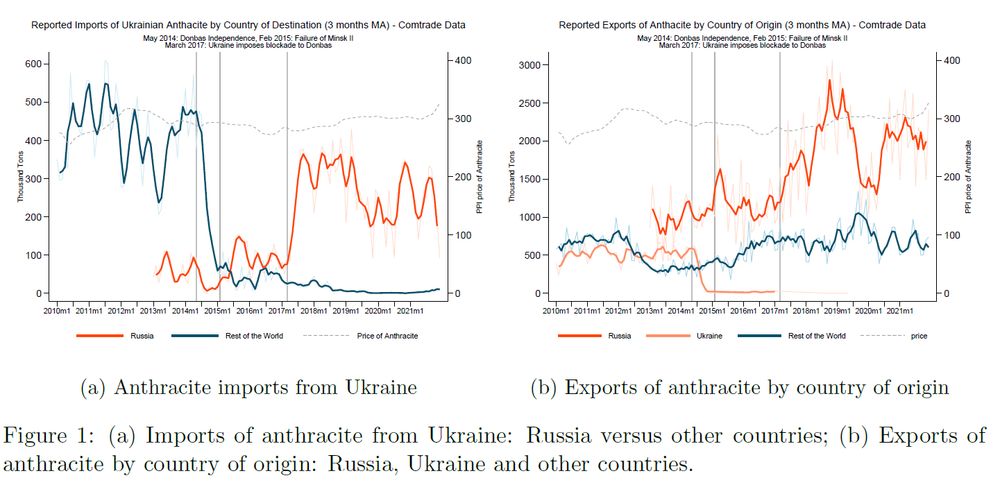
Authors show that sanctions imposed by Ukraine on Donbas in 2014 were undone by entrepot trade through Russia, while Ukraine was forced to import coal from Russia to keep its factories running, highlighting the challenges to embargoes created by market power and non-participants.
Just published in @JPubEcon:
"The undoing of economic sanctions: Evidence from the Russia–Ukraine conflict"
By @RFisman, Giovanna Marcolongo, & Meng Wu
https://t.co/StPKntZj0d
#econtwitter#publiceconomics
Gola shows that in a model in which workers differ in skill and preferences for status, high-skill workers with strong status concerns match with status-indifferent low-skill workers.
If these are rare, they can earn above average wages & benefit from skill-biased tech change.
Just published in @JPubEcon:
"The pond dilemma with heterogeneous relative concerns"
By Pawel Gola
https://t.co/TCg9mgxj2g
#econtwitter#publiceconomics
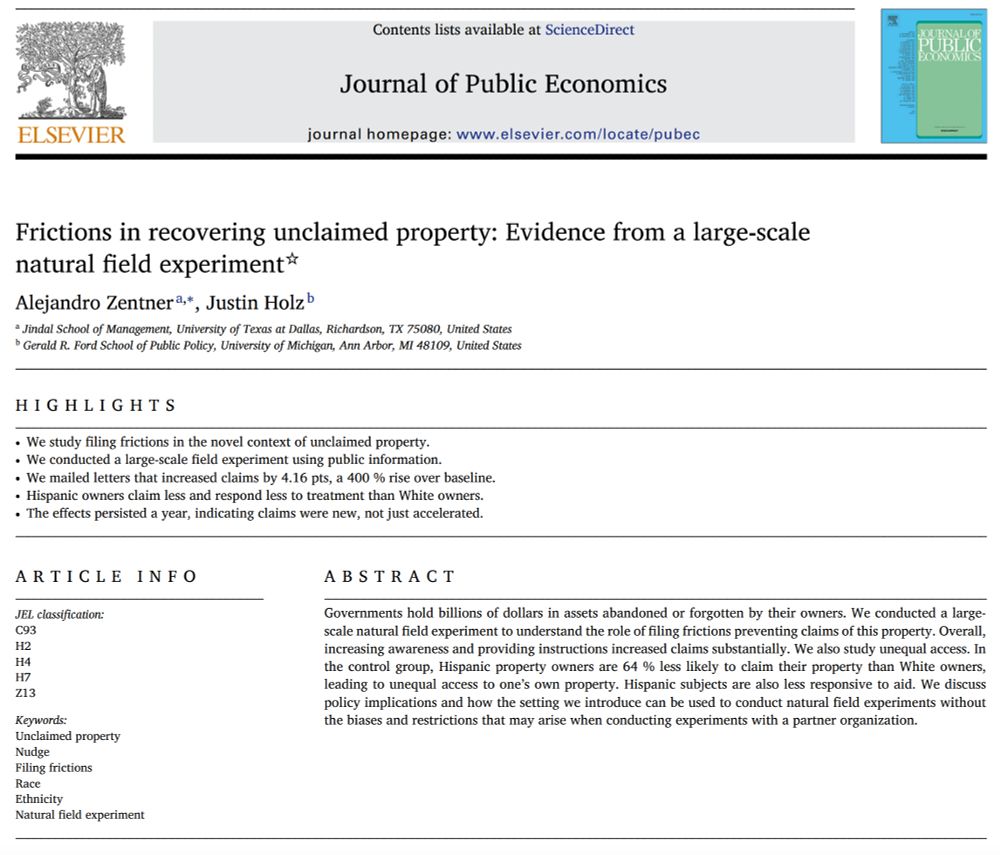
The authors ran a large-scale field experiment on unclaimed property.
Simple mailed letters boosted claims by 4.2 pts—a 400% increase. Hispanic owners claimed less & responded less than White owners.
The effects lasted a year, showing new (not just faster) claims.
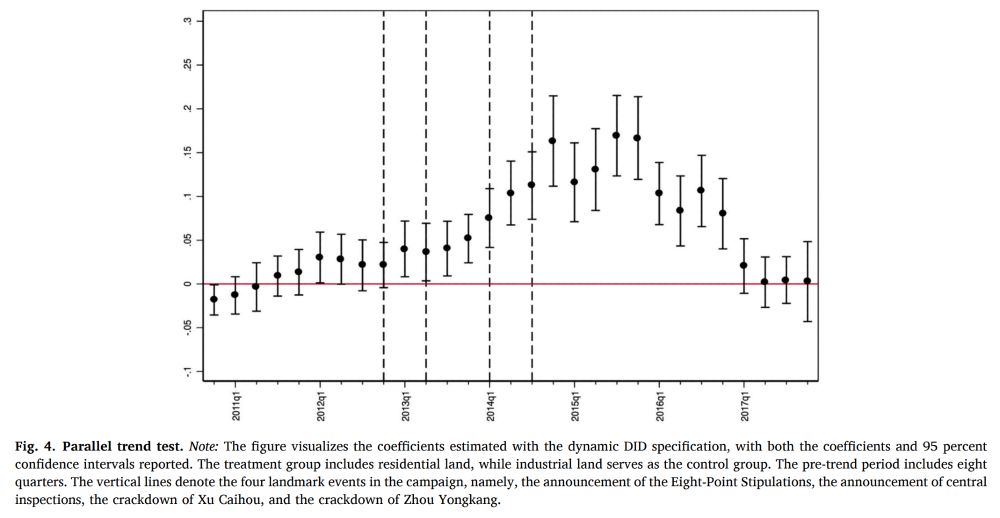
Authors find that China’s anti-corruption drive reshaped land sales: officials, fearing scrutiny, sold less to private developers and more to State-Owned-Enterprises (SOEs).
The campaign—meant to curb corruption—may have unintentionally fueled a resurgence of SOEs.
Just published in @JPubEcon:
"Corruption stereotype and the unintended consequences of an anti-corruption campaign: evidence from the real estate sector in China"
By Hanming Fang & Rongjie Zhang
https://t.co/fB9QpVnfFm
#econtwitter#publiceconomics
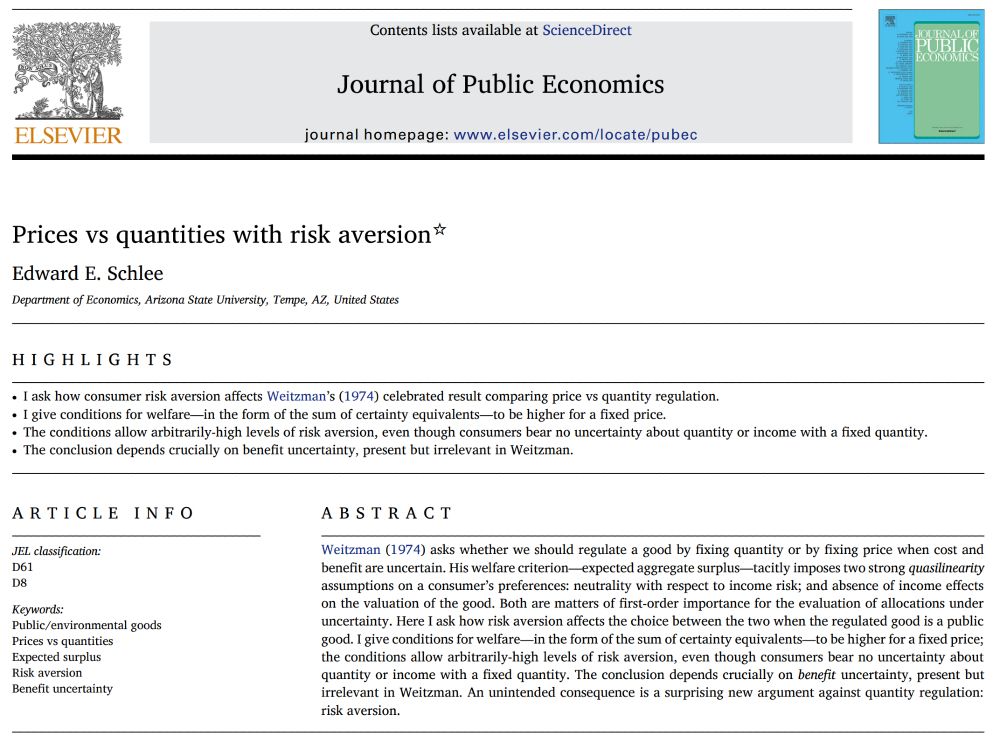
How does risk aversion change Weitzman’s (1974) price vs quantity result?
Schlee shows that welfare (via certainty equivalents) can be higher under fixed prices—even with arbitrarily high risk aversion. The key: benefit uncertainty, not in Weitzman.
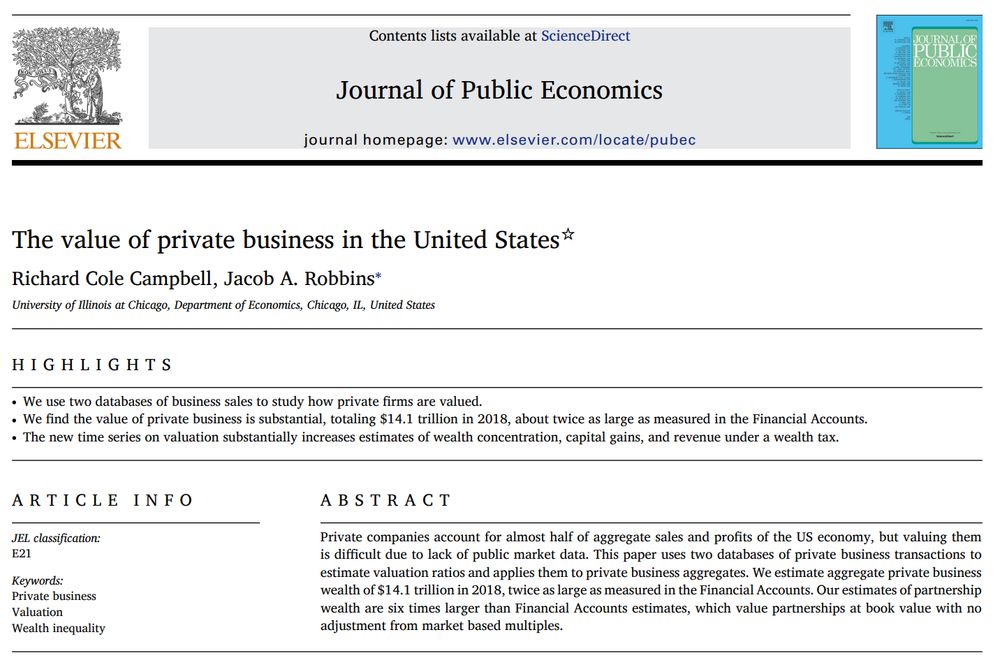
Private firms account for nearly half of US sales & profits, yet difficult to value.
Using transaction data, the authors estimate private business wealth at $14.1T in 2018—2× official stats.
Partnership wealth alone is ~6× larger than reported.
Just published in @JPubEcon:
"The value of private business in the United States"
By Richard Cole Campbell & Jacob A. Robbins
https://t.co/8OsOjgHP9R
#econtwitter#publiceconomics
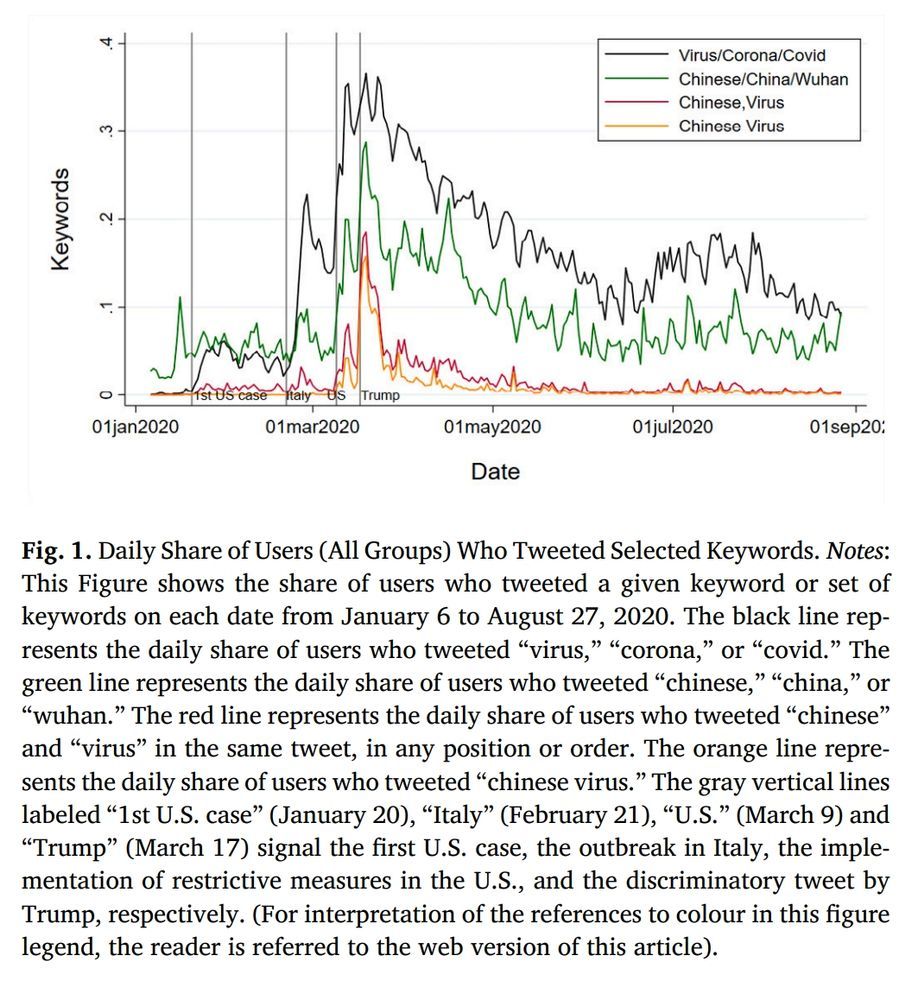
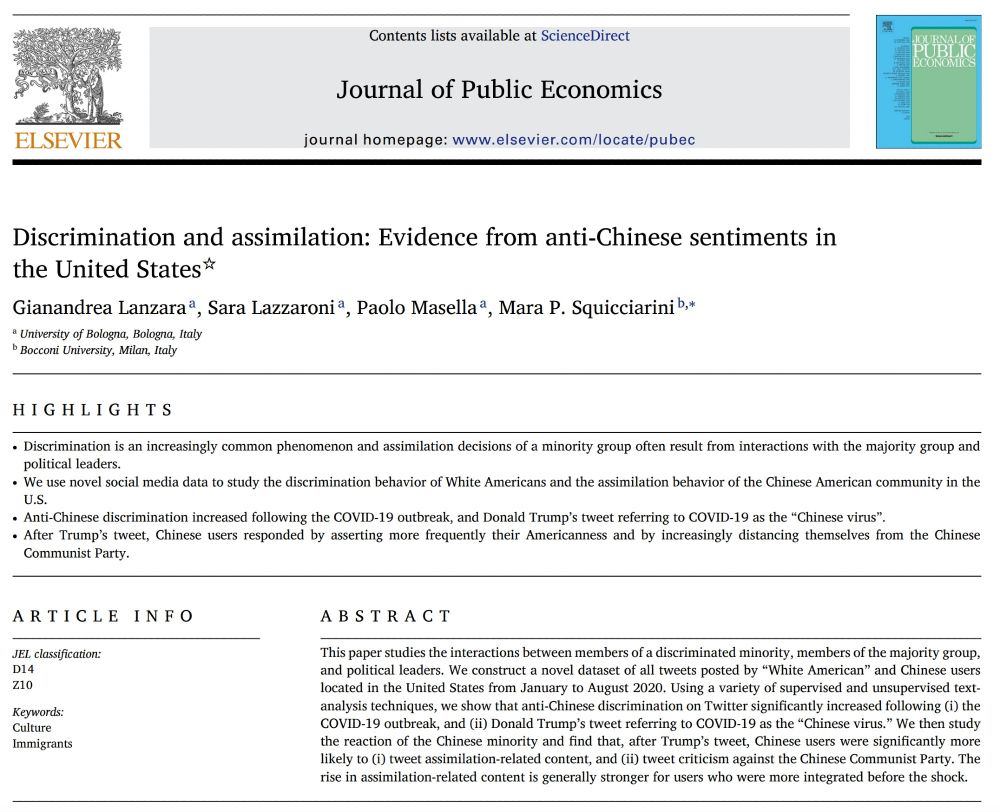
Using social media data, the authors found that anti-Chinese discrimination in the U.S. spiked after COVID-19 and Trump’s “Chinese virus” tweet.
In response, Chinese Americans asserted their Americanness more and distanced themselves from the CCP.
Just published in @JPubEcon:
"Discrimination and assimilation: Evidence from anti-Chinese sentiments in the United States"
By Gianandrea Lanzara, @sara_lazz , Paolo Masella, & @mara_squi
https://t.co/4H9aMnM05A
#econtwitter#publiceconomics
In a driving experiment, the authors show that Black participants predicted a higher chance of receiving a speeding ticket than White participants.
Black participants always drove the same speed but White participants drove slower when there was racially representative police.
Just published in @JPubEcon:
"Does black and blue matter? An experimental investigation of race, perceptions of police, and legal compliance"
By @MackenzieAlsto4 & Emily Owens
https://t.co/1ZYfbrKyM8
#econtwitter#publiceconomics
Authors show that extortion ⬇️ entrepreneurial entry and ⬆️ both exit & economic concentration.
Causal evidence from a franchise in Guatemala shows that security devices like cameras help firms survive by reducing extortion risk and safety concerns, increasing competition.
Just published in @JPubEcon:
"The effects of extortion and security device adoption on entrepreneurial entry and exit: Evidence from Guatemala"
By Alejandro Estefan & Romina Ordoñez (@KeoughGlobalND, @BIDInvest)
https://t.co/n4y3ea8QOd
#econtwitter#publiceconomics
Authors show that charity auctions face a revenue vs. risk trade-off. Lab & field tests show a “revenue frontier” across formats: all-pay auctions raise average revenue but also risk.
A new framework helps nonprofits choose fundraising methods based on risk tolerance.
Just published in @JPubEcon:
"Auctions for risk-averse non-profits"
By Jeffrey Carpenter, Joshua Foster, & Peter Hans Matthews
https://t.co/XxEciyZIAL
#econtwitter#publiceconomics