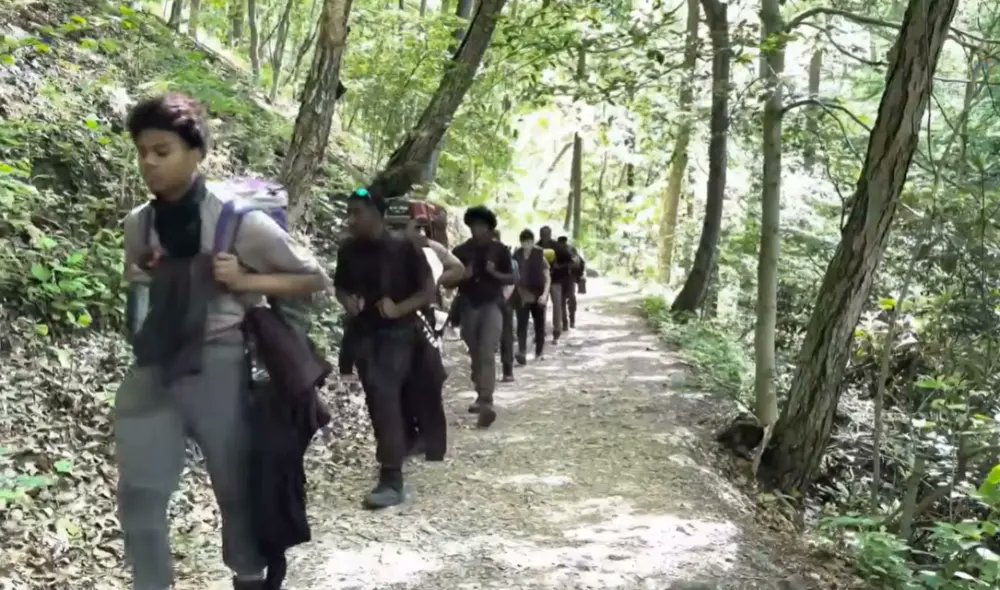
New Jersey school has required every freshman to hike 55 miles on the Appalachian Trail for 53 years straight.
At St. Benedict’s Prep in Newark, this isn’t optional — it’s a mandatory 5-day rite of passage before becoming a sophomore.
Many students have never hiked or camped before. They train together in the spring, then get split into small teams where each kid gets a critical role: navigator, medic, cook, captain, etc. No one knows everything — they must rely on each other.
With minimal adult supervision, they hike rain or shine, facing blisters, sore muscles, and real challenges head-on. As one administrator put it: “The only way we can get through this is if we work together.”
The result? Teens who return more confident, resilient, and bonded — proving that real growth happens when you step away from screens and into the wilderness.
What an incredible tradition! Parents, educators, and anyone raising tough kids — this is gold.
Who else believes we need more experiences like this?
One of the most devastating indictments of socialism sits buried in Soviet agricultural statistics: private plots representing just 3% of farmland consistently produced 25-30% of the USSR's total food output. Private ownership generated output that collective ownership could not match, even at vastly smaller scale.
Picture this absurdity. A collective farm worker tends 1,000 acres of state wheat with the enthusiasm of someone filling out tax forms. The same worker then rushes home to lavish attention on his quarter-acre private vegetable patch, working until sunset to coax maximum yield from every square foot. The difference in productivity per acre often reached 10:1 ratios. Sometimes higher.
On collective farms, additional effort generated zero additional reward for the individual worker. Your extra sweat benefited the collective (meaning nobody in particular) while you bore the full cost of that effort. Workers rationally allocated their energy toward their private plots where they captured 100% of marginal returns.
Soviet planners grasped the embarrassing implications and repeatedly restricted private plot sizes and banned certain crops, fearing that obvious productivity comparisons would undermine ideological credibility. The restrictions backfired spectacularly. Every limitation on private plots worsened food shortages and strengthened black market prices.
You can dress up collective ownership in whatever intellectual framework you prefer. You can invoke solidarity, social justice, or the greater good. But you cannot escape the fundamental reality that human beings respond to incentives, and collective ownership systematically destroys the connection between individual effort and individual reward.
My waiter had dementia and forgot my order.
I visited a cafe in Japan that ONLY hires people with Dementia. It's called the Cafe Of Mistaken Orders.
Sometimes the servers bring you the wrong food, never bring your order, or sit down and join you instead.
But the point of this cafe is to be a place for dementia patients to feel needed and have purpose.
And this cafe is working. Japan has discovered that being socially connected actually slows down the progression of dementia.
So now there are 8,000 dementia cafes all over Japan!
The U.S. should be more like Japan. We should keep elders out of nursing homes, find ways to give them purpose, and part of society until their last days.
I want to tell you the story of a young woman who you have probably never heard of. Her name is Mary Anne. She was born on a remote island in Scotland, where life was harsh and unforgiving.
On May 2, 1930, when she was 18 years old, she got on a boat headed for Ellis Island to start a new life. She arrived here 11 days later.
She wasn't chasing fame, riches, or power. She came for the unique opportunity that America offered. Her sister was already here and had found a job as a maid. So, Mary Anne MacLeod joined her, listing her occupation as “domestic” on her Ellis Island immigration papers.
She came to America knowing that she would clean the houses and toilets of the wealthy families in New York. She and her sister lived and worked hard through the worst days of the Depression. And she persevered.
Six years later, she married a man named Fred. He was the son of German immigrants. Then In 1942, she became a citizen.
Mary and Fred would end up having five children: two daughters and three sons.
One of those sons, they named Donald.
A woman who came here as a maid, the lowest of jobs, would raise a son who would change the very skyline that greeted his mother when she arrived at Ellis Island.
After that, he would become the 45th and 47th President of the United States.
There is no other country in the world where a woman can arrive with nothing, and in ONE generation, her son would lead the entire world.
For America’s 250th anniversary, I wanted to present President Trump with this painting I did, and then I ran out of time and talent. So, I asked a good friend of mine, Mike Malm, to help me finish it. This is how I envisioned her coming into the United States.
Mary Anne MacLeod Trump should be a household name. Her story is everything that is great about America.
The Plymouth Pilgrims accidentally ran the first documented socialist experiment in America three centuries before Marx scribbled his manifesto. Governor William Bradford's "common storehouse" system from 1620-1623 delivered textbook collectivist results: mass shirking, crop failures, and near-starvation.
Bradford recorded the disaster in detail. Young men "complained that they were oppressed" when forced to work for others without reward. Productive colonists watched lazy neighbors receive equal rations despite contributing nothing. The system "was found to breed much confusion and discontent" because it violated basic human incentives. People starved while fertile Massachusetts soil lay underworked.
The turnaround came swiftly in 1623 when Bradford abandoned the collective model and assigned private family plots. Production exploded overnight. Women and children voluntarily joined field work when their families directly benefited from extra effort. The same colonists who nearly died under socialism suddenly produced abundant harvests under private property.
Bradford explicitly credited private ownership for saving Plymouth Colony. He documented how individual responsibility transformed human behavior within a single growing season. Individual effort cannot be separated from individual reward without destroying both.
Every socialist experiment since Plymouth has repeated this identical pattern. Different century, different continent, same predictable collapse when planners ignore the reality of human nature.
No matter what they call it, whenever and wherever collectivist ideas are put into practice, disaster soon follows.
🚨PRESIDENT TRUMP: "THE ISLAMIC REGIME KILLED 42,000 UNARMED IRANIANS."
Reporter: Do you plan to arm the people?
Trump: "I don't want to say that but YES."
People asking why aren’t they protesting?
"Because they don't have any guns."
"You can have 200,000 people protesting and have 5 or 6 sick people with guns... they start shooting right between the eyes... when you see a guy fall and another one fall... very few people would stand."
"They killed 42,000 UNARMED civilians. They shot them with SNIPERS on the rooftops — RIGHT IN THE FOREHEAD."
Time to arm the Iranian people and end this barbaric regime.
@carreraB6@jmkettle Stars:
1-horrible
2-bad
3-okay/fine
4-very good
5-excellent
Do you really need the government to hold your hand because anything less than excellent is an insult? Germans are so weak these days. 3 stars.