If you think the war in Ukraine doesn't affect you look at this crater in Poland.
A Russian missile crashed here today. This will keep happening until Europe wakes up and takes the russian threat seriously.
Negotiations on the 21st sanctions package have revealed the limits of the current model of EU political integration.
The European Commission proposed new restrictions targeting Russia's energy, financial, and military-industrial sectors. However, after several days of negotiations, EU member states' ambassadors failed to reach an agreement. As of July 21, the package has not yet been adopted, with another attempt scheduled for July 22-23. Meanwhile, some of the original proposals have already been softened or removed under pressure from individual member states.
The clearest example is Greece. Athens blocked a ban on transporting Russian liquefied natural gas to third countries. A Greek diplomat openly explained that such a restriction could destroy the business of Dynagas, a company owned by shipping magnate George Prokopiou. The company operates 27 LNG carriers, including about one-third of the specialized Arc7 fleet built for Russia's Yamal LNG project. Since the start of the full-scale war, its vessels have transported more than 30 million tonnes of Russian gas worth over $24 billion, according to the Financial Times. Another of Prokopiou's companies, Dynacom, has earned more than $900 million over the past three years from transporting Russian oil.
In this case, it is not a matter of losses that the business could not have avoided, nor of the need to protect a vulnerable segment of the population. It is about a specific company that has continued to earn substantial profits from servicing Russian energy exports after 2022. We all understand that this is business built on war, and that this company and its owner have, in effect, helped finance the Russian army through Russia's state budget. Yet the Greek government effectively turned the interests of this business into its national negotiating position and used its veto power to weaken the EU's common decision.
A similar logic was evident in the issue of Russian fish. The European Commission's original proposal included restrictions on imports of certain products and a complete ban on Russian cod. Countries whose food industries depend on Russian raw materials, including Germany, Poland, and Portugal, opposed the tougher measures. The main products concerned were cod, haddock, and pollock, which are used to produce processed foods, including fish fingers. During the negotiations, this part of the proposal was weakened to such an extent that the ban on Russian fish imports was ultimately removed from the draft package.
France and Italy secured a softening of the proposed restrictions on the entry of Russian servicemen who took part in the war. They argued that banning Russian military personnel from traveling to Europe could hurt the tourism industry. This is very strange logic, considering how many resources are later spent identifying and catching Russian spies and saboteurs.
Austria, for its part, once again demanded the unfreezing of around €2 billion in Russian assets to compensate Raiffeisen Bank International for losses resulting from a decision by the Russian authorities.
‼️ The current situation cannot be explained simply as "sanctions fatigue." It is, above all, a manifestation of the European Union's institutional model. Sanctions require unanimous approval by all member states. The right of veto formally belongs to governments, but through them, large national companies and industry groups can influence common policy. The more sensitive sanctions become for these interests, the greater the pressure on governments to seek exemptions.
This is not merely a question of the morality of individual governments, although that also matters. It is a structural limitation of a system in which blocking a common decision carries almost no cost for a member state, while allowing it to protect a specific domestic interest. Under such rules, every new sanctions package will inevitably become the subject of increasingly difficult bargaining.
The key question is therefore not only whether the EU will be able to adopt the 21st sanctions package. It is whether the Union is capable of acting as an independent political actor when common security comes into conflict with the short-term interests of individual states, companies, and industries.
Laura Loomer has arrived in Ukraine.
She previously supported Russia and criticized US aid to Kyiv.
Ms Loomer visited Bucha, where she saw evidence of Russian war crimes and mass graves of civilians killed during the occupation.
She commented:
"I'm not in Russia because I'm not a propagandist.
I was living in a media echo chamber and I was propagandized by Russian media on social media to believe those things.
So I came to Ukraine to see the country for myself. I am going to try to find evidence for the propaganda I’ve been fed, and if I don't find it, I will let everyone know so they too can come to see the light."
President Aliyev suggests that Azerbaijan could replace gas exports from Russia.
Putin has cost Russia so much and has closed off European markets from Russia.
"Given that Russia is unable to export as much refined oil products to its traditional customers as it would like due to the disruption of its oil refineries, and as these ongoing events with an uncertain outcome persist... Azerbaijan could significantly increase its gas exports to Europe, including Germany."
@Gerashchenko_en This is painful to read although I already knew most of it. Each reader of this post should reach out to their government and question why Ukrainian life’s can be wasted for egoistic reasons.
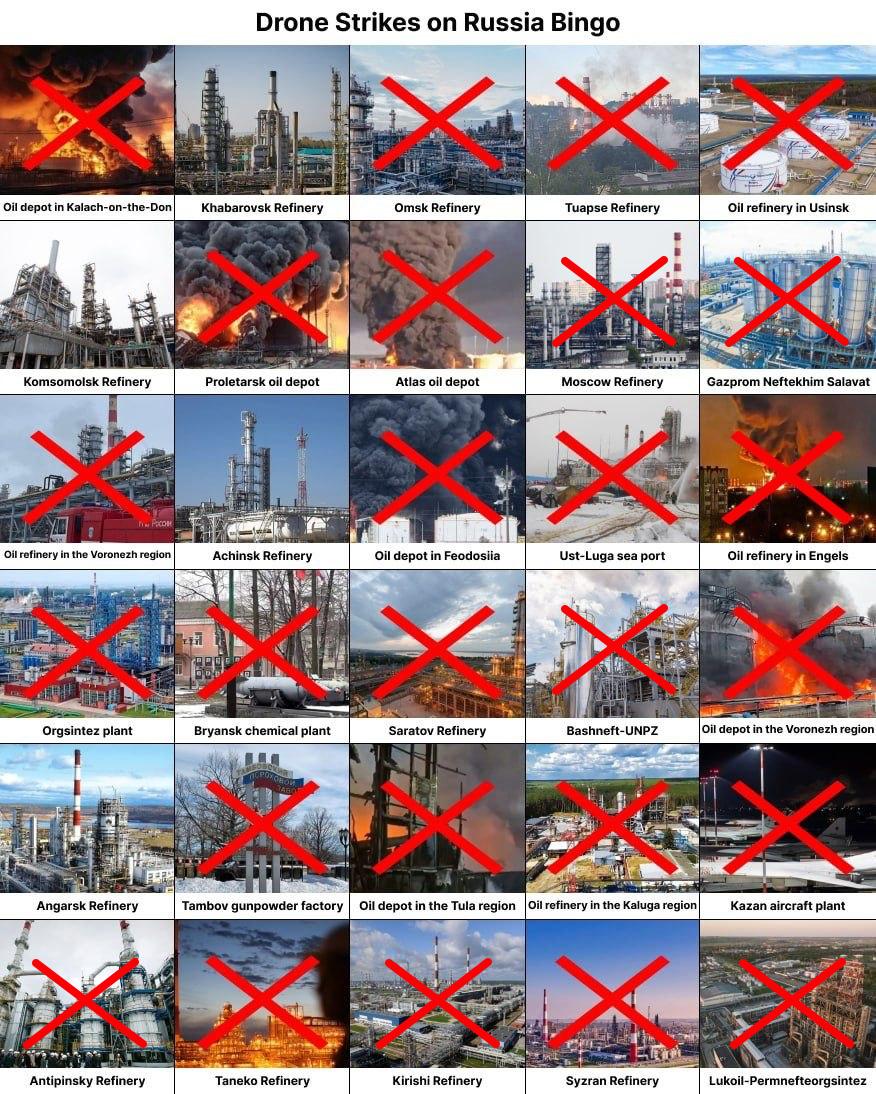
The fuel crisis in Russia has long ceased to be a problem solely for drivers and farmers. It is gradually becoming a problem for the state budget. Russian authorities had projected that the deficit for all of 2026 would amount to 3.786 trillion rubles ($48,9 billion) (1.6% of GDP). However, in the first half of the year alone, it reached 5.731 trillion rubles (~ $74 billion) (2.5% of GDP). Even a small surplus in June did not reverse the trend: in six months, the budget hole had already exceeded the full-year target by about 1.5 times. Ukrainian strikes on Russian oil refineries played a significant role in this.
🔷 First, Russia has less oil money. The Russian budget relies heavily on oil and gas revenues. But for oil to translate into tax revenue, it must be processed and sold. Today, Russia is facing increasing problems in this regard. In the first five months of 2026 alone, oil and gas revenues for the federal budget were nearly 30% lower than during the same period the previous year.
🔷 Second, the so-called "damper." It's more profitable for oil companies to sell fuel abroad than domestically. To prevent gasoline from disappearing from Russian gas stations and prices from rising to unacceptable levels, the government pays oil companies compensation for sales on the domestic market. This results in a strange arrangement: the government takes money from oil companies through taxes, and then immediately returns a significant portion of it.
In 2025, these compensation payments accounted for about 10% of all oil and gas revenues in the budget. By the spring of 2026, this share had risen to nearly 30%: in April–June alone, the damper payments totaled about 622 billion rubles ($8 billion) against 2.2 trillion rubles ($28,4 billion) in oil and gas revenues. In other words, an ever-increasing portion of oil money is no longer remaining in the budget.
🔷 Third, new expenses. After the attacks on the refineries, the government had to restrict fuel exports (which means lost revenue), grant tax breaks to refiners, fund additional protection for refineries against drones, and support the domestic market. The budget is simultaneously receiving less revenue and spending more - the worst possible combination.
The Russian government is desperately looking for money. As of January 1, 2026, Russia raised the excise tax on gasoline from 17,088 to 17,959 rubles ($232) per metric ton of Euro-5 gasoline. According to government estimates, the excise tax increase will bring the budget only about 10.5 billion rubles ($135,5 million) in additional revenue in 2026-2027. By comparison, the federal budget deficit exceeded 5.7 trillion rubles in the first half of 2026 alone.
That is why discussions in the State Duma about further excise tax hikes or higher gasoline prices are more a demonstration of activity than a genuine solution. That leaves four remaining sources:
◾️ Taxes on everyone - the primary source.
VAT - the tax built into the price of nearly every item in stores - has been increased from 20% to 22%, the number of taxpayers has been expanded, and excise duties on alcohol, tobacco, and sugary drinks have also been raised. The increase in indirect taxes alone is expected to generate more than 1.2 trillion rubles ($15,5 billion) in additional revenue, while higher excise taxes on "harmful products" are projected to bring in another 138 billion rubles ($1,78 billion) during 2026-2027. Simply put, ordinary Russians will increasingly foot the bill for the deficit every time they make a purchase.
◾️ Debts.
The government is borrowing money domestically at a record pace by issuing federal bonds, which are purchased primarily by banks. The placement plan for 2026 totals up to 6.47 trillion rubles ($83,5 billion), including 1.5 trillion ($19,3 billion) during the third quarter alone. The catch is that about 1.34 trillion rubles ($17,3 billion) of the new borrowings will go toward repaying old debts. This means that the government is increasingly relying on refinancing its own debt.
◾️ Savings.
Russia has a reserve "piggy bank" - the National Welfare Fund. The government had promised to leave it largely untouched in 2026, but as early as February, it had to sell 13.2 billion yuan and 7.9 tons of gold, raising 244 billion rubles ($3,15 billion) to finance the deficit. The fund's liquid portion has shrunk to 3.62 trillion rubles ($46,7 billion) - less than the current accumulated federal budget deficit.
◾️ Property of another.
The state is squeezing more dividends out of state-owned companies and is increasingly confiscating business assets through the courts. In 2025 alone, Rosimushchestvo generated a record 638 billion rubles ($8,24 billion) in revenue for the budget from state property, dividends, and privatization transactions.
So, the fuel crisis has come full circle: less fuel means less oil revenue → more compensation and expenses → a deeper budget deficit → new taxes, debts, the use of reserves, and the mobilization of state assets.
And since it is this very budget that finances Russia's war against Ukraine, every ruble the Kremlin is forced to divert to plug budget holes is a ruble that can no longer be spent on waging war.
Greed and immorality have won.
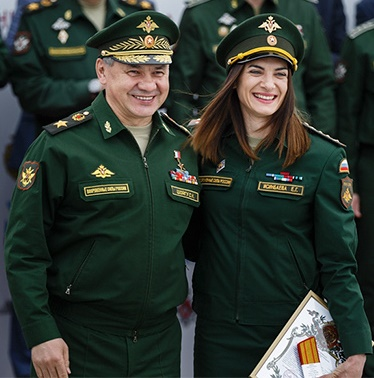
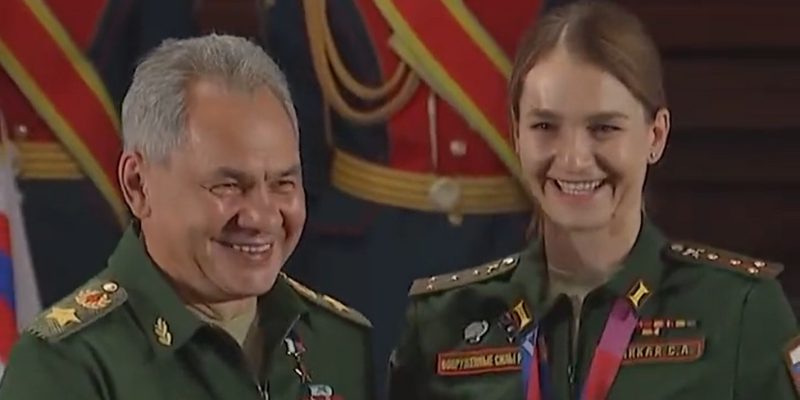
Yesterday, July 7, the IOC provisionally reinstated the membership of the Russian Olympic Committee and rescinded its recommendations to international federations to ban Russian athletes from competitions. Formal restrictions remain in place: Russian officials are not invited, no events will be held in Russia, and the issue of the flag and anthem has been postponed "until the appropriate time." But the main step has already been taken: for the first time since 2022, the Olympic system has opened its doors to a state that is waging war.
IOC officials found a convenient legal basis. The ROC’s membership was suspended in 2023 due to the inclusion of sports structures from the occupied territories of Donetsk, Luhansk, Zaporizhzhia, and Kherson regions. The Russians amended their statutes, removing references to these structures - and the IOC decided the problem had been resolved.
We are used to associating the Olympics, the international Olympic movement, and elite sports with peace. The mission of sport is to serve a peaceful society. This is enshrined in the Olympic Charter itself.
However, the IOC has chosen a convenient interpretation of the principle of non-discrimination and every athlete’s right to sport. In this case, it is not simply about the right to participate in competitions, but about the right to propaganda and the normalization of violence as a state policy of the Russian regime. Some Russian athletes themselves take part in the war against Ukraine. Many of them support the Russian regime, accept awards from Putin, and whitewash crimes. Therefore, they cannot pretend to be "neutral" representatives of sport. Yet the IOC believes they cannot be discriminated against.
The most cynical part of this story is that the IOC has retained the requirement that athletes must be "role models for a peaceful society." Checking this has been entrusted to the Russian Olympic Committee itself. In other words, a structure tied to the aggressor state will determine its own integrity.
The IOC’s argumentation does not withstand criticism. IOC officials insist that athletes already need "equal access" to qualification for Los Angeles 2028. But qualification for Paris 2024 also took place during the war that argument did not work then. IOC officials insist that "sport is beyond politics." Yet the same IOC quite politically stripped Putin of the Olympic Order in 2022.
The Olympic system did not adopt this decision unanimously. World Athletics confirmed a full ban for Russians and Belarusians just days earlier. FIFA and UEFA are also not lifting restrictions - in particular because teams from other countries simply refuse to play against Russia. Conversely, swimming and gymnastics surrendered back in the spring. This split is a map of institutional resilience: it shows where it still holds and where it no longer does.
Money plays the main role here. Russian financial influence on world sport is well documented. The purest example is fencing. Alisher Usmanov, designated by the EU as an oligarch with particularly close ties to Putin, transferred about 80 million Swiss francs to the International Fencing Federation over three Olympic cycles; in 2020, his money accounted for 93% of its income.
For decades, he financed federations in Africa and South America, for which these contributions were a matter of survival. The result: in 2024, despite sanctions from forty countries, Usmanov was re-elected president - 120 votes to 26.
Russian money has become a structural part of the financing of the Olympic periphery - small federations whose votes elect the leadership of world sport. It is not the decision itself that is being bought. It is the environment in which such a decision looks natural. The IOC has long been vulnerable to this mechanism - it is enough to recall the Salt Lake City 2002 scandal. There is also a personal dimension: Bach exchanged awards with Usmanov, Putin was the first to congratulate both Bach in 2013 and Coventry in 2025.
Coventry, while still a member of the executive board under Bach, advocated for the return of Russians.
History knows cases of excluding aggressors - and knows no such return. Germany was not allowed to participate in the Games after both world wars: readmission came only after peace. South Africa was kept out of the Games for twenty-eight years and was only returned after the dismantling of apartheid. Yugoslavia was excluded in 1992 while the war in the Balkans was still ongoing. Russia is the first case where an aggressor is being brought back in the middle of a war that it itself started.
However, there is one analogy: Berlin 1936, when the IOC similarly chose "neutrality" and gave the Nazi regime an international platform.
The IOC’s decision is a pathetic example of immorality and greed. The tactic is clearly set by the Russians themselves: this is their style of small steps, each of which shifts the boundary of what is normal. Neutral athletes in 2023. Paris in 2024. Milan in winter. Belarus in May. The ROC in July. The next step is the return of the flag and anthem.
Markers to watch: the decision on Russian symbols before the Youth Games in Dakar in October; whether World Athletics holds its position; and whether the IOC proceeds to full rehabilitation of Russia before Los Angeles without any ceasefire. If it does - the IOC will finally confirm that its principles have a price, and that price is not high.
Russia spent last week murdering civilians sleeping in their homes with ballistic missiles and now the Olympics invites them back. That means the russian anthem will play at the next games. This is absolutely disgusting.
Russia has spent $1 billion in the last few days attacking Kyiv. Not building roads, hospitals or fixing the failing economy - on murdering civilians. This is the priority of a nation totally obsessed with terrorism and nothing else.
"She’s such a good person... She’s only 19..."
Aliona is waiting for news about her friend Vika, who may be under the rubble of a residential building destroyed by Russia’s attack on Kyiv last night.
Near the same building, a mom is waiting for her daughter, who is still being searched for under the debris.
📹: Radio Liberty
President Zelenskyy:
"Our Warriors showed good results today in shooting down drones and cruise missiles, but unfortunately not Russian ballistic missiles. The reason is the insufficient supply of interceptor missiles.
It is crucial that the world - above all the United States and our European partners - leave the NATO Summit in Ankara with strong decisions to strengthen our air defense and, therefore, protect the lives of ordinary people.
As long as missiles for Patriot systems remain in our allies’ warehouses, they only encourage Russia to keep 'defeating' residential buildings.
The United States and Europe have the capabilities to stop this terror."
📹: Reuters
Russia attacked Ukraine with 68 missiles and 351 drones last night.
A horrible, scary night with devastating aftermath.
❗️ 14 people were killed by the Russian strike on Kyiv and Kyiv region. Nearly 60 more were injured, including five children.
About 30 residential buildings in Kyiv were significantly damaged.
Russia also attacked other regions of Ukraine:
▪️ In Zaporizhzhia, a gas station was struck. Five people were injured, including an 11-year-old boy.
▪️ In the morning, a Russian drone hit a civilian car in Kherson. Two men killed. Two women injured.
▪️ Russia attacked a postal sorting terminal in Dnipro.
▪️ Russian drones also struck gas stations in Kharkiv and Izium, Kharkiv region. Homes near the strike site in Izium were damaged.
▪️ In Odesa region, a 23-year-old man was injured. Apartment buildings were damaged.
📹: natashanaffy / Instagram / mariankushnir / Threads