Another bad law, the 2008 Climate Change Act in the UK. It resulted in industrial work outsourced to China and imported back to the UK, with much higher global carbon pollution + UK lost hundreds of thousands of jobs + more expensive energy.
So many laws with good intentions but horrendous outcomes. Example: Massachusetts 2024 Climate Act includes a grant program for lawyers for disaffected communities. Result: Multiple lawsuits preventing solar and wind power installations in Massachusetts.
One of the often slept-upon benefits of attending the University of Chicago is that they make you read Marx as part of the core curriculum, which is why this article gave me flashbacks of taking SOSC 114 as a freshman.
Marx, writing during the Industrial Revolution, predicted capitalism would periodically devour itself: firms replace labor with machinery to boost profits, but competition diffuses the technology, drives prices to marginal cost, and the gains get competed away. Meanwhile, displaced workers lose purchasing power, hollowing out the demand the whole system depends on. Production rises but no one can afford to buy what's produced - the contradiction between production and realization.
Citrini's piece describes this exact dynamic, then declares there's "no natural brake." It's the most Marxist piece of financial analysis written in years, and makes the same errors Marx did.
Schumpeter offered the obvious rebuttal 80 years ago: creative destruction doesn't just destroy, it creates industries we can't yet conceive of. Everyone in the replies is already making this point, and I think they're right.
But the sharper rebuttal is Hayek's: prices are the brake Citrini says doesn't exist. Who funds $200bn / qtr in AI capex when equities are down 38%, private credit marks are in the 50s, and consumer demand has collapsed? Cost of capital rises. Incremental build-out becomes uneconomical. Capital gets destroyed and reallocated.
Citrini also unknowingly describes Marx's proletarianization of the petite bourgeoisie: the $180k PM driving Uber is textbook. But the article claims this collapses consumer demand, and that's where it breaks.
The top decile drives 50%+ of spending and their wealth is in equities, not W-2 income; they're long the hyperscalers posting records in Citrini's own model. Blue collar is insulated because AI replaces cognitive labor, not physical.
The professional middle class gets crushed, but aggregate demand doesn't.
The spending class IS the capital-owning class. The K-shaped recovery they fear actually stabilizes the demand base they say is collapsing. In the stable aggregate demand, the petit bourgeoisie finds ways to reinvent itself.
I think the Citrini piece is excellent and worth reading. But history has repeatedly shown that periods of transformative productivity gains ultimately accrue to the consumer through lower prices, more leisure, and higher quality of life. Marx's error wasn't diagnosing the disruption, it was underestimating the system's ability to adapt.
@ericedwardthor In 2020 and 2021 literally hundreds of thousands of people fled NY for the suburbs and FL. This is a basic supply and demand story. NY makes land/building incredibly expensive and impossible for landlords to make upgrades to empty rent stabilized apartments (HSTPA is a killer)
What amazing fortune
To be 1 of the 100 billion homo sapiens sapiens that have ever lived
And to be alive at this the moment of the great inflection
Not to be 1 of 50 billion that died of mosquito borne disease
Nor to be 1 of 30 billion that died before age 5
Nor 1 of 10 billion killed in an act of violence
Instead to witness this ahistorical moment, to contribute in whatever small way in our outward expansion and proliferation,
To stand on the cusp of history:
What amazing great good fortune
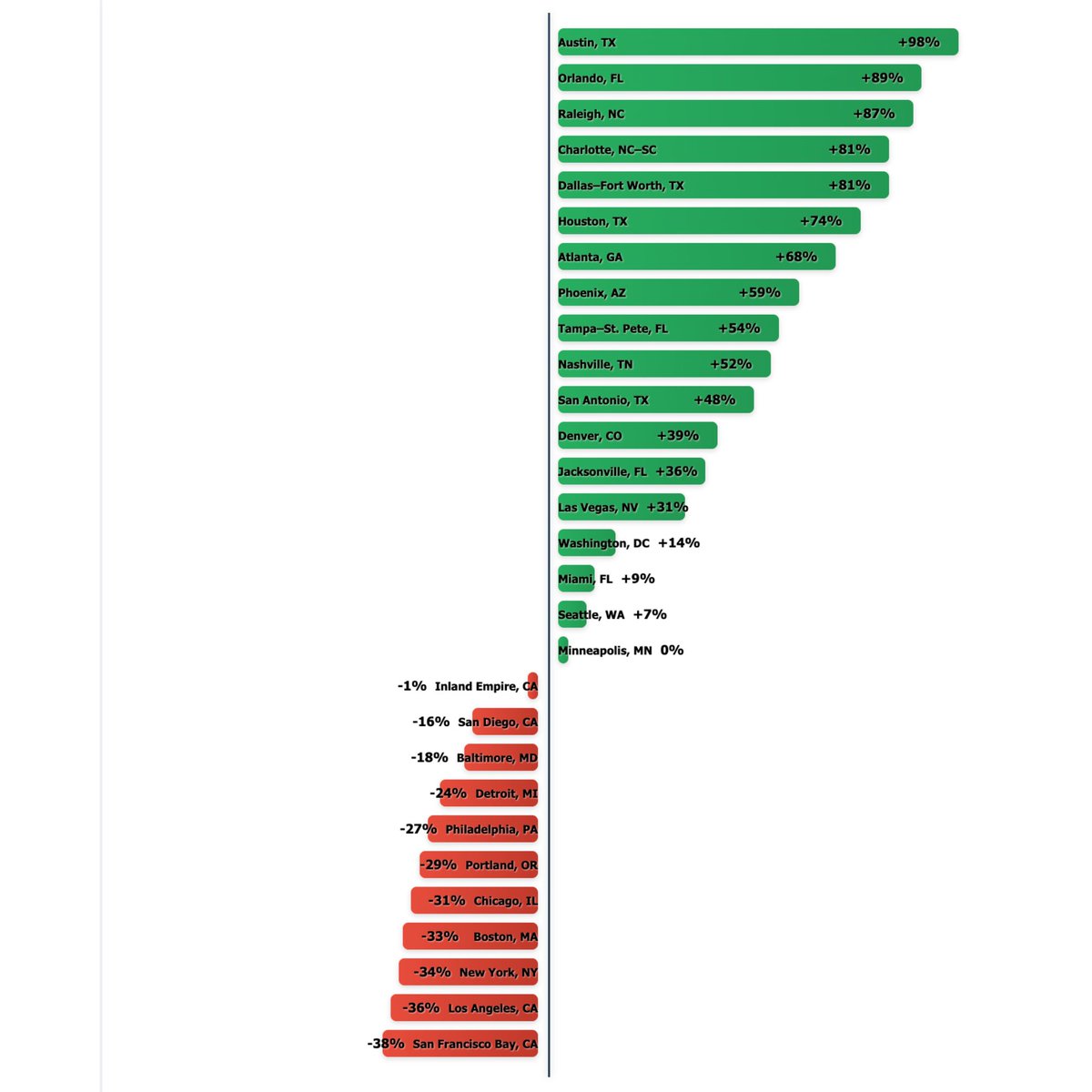
Look at the decline in population for young children (under age 5) in major cities from 2005 to 2024
This is catastrophic
Austin +98%
Orlando +89%
Raleigh +87%
Charlotte +81%
Dallas +81%
Chicago -31%
Boston -33%
New York - 34%
LA -36%
San Francisco -38%
@PabloTorre Except that socialism makes all those problems far, far worse. Example A: San Francisco under Dean Preston and London Breed tens of thousands of middle class fled because of policies that only the super rich could afford. Socialism has a zero percent success rate.
@nic_carter Check out rents in Austin, the obvious answer is deregulation and more supply. This isn't even a right wing solution, it's just a middle of the road solution that Econ 101 students understand.
“I don’t care how much you love working people. They can’t afford a house because all the rules in your state make it prohibitive to build. And zoning prevents multifamily structures because of NIMBY."
@thestustustudio@UChicago@UChicago Why do I donate money to you, my alma mater, to improve the school when the person receiving the funds wants to destroy the school?
One of these campaigns looks like New York.
The other… doesn’t.
We’re the campaign of working people, real neighborhoods, and real progress.
Receipts below:
An actual path to an affordable NYC for everyone:
1. Remove all zoning, now. I want a 100-floor skyscraper apartment building on every block of the city. Make NYC Tokyo. Build over every parking lot.
2. Fully fun transit. We need to double the subway coverage, connect the outer boroughs to each other, and push the NYC subway further into Jersey, Outer Queens, etc.
3. Remove anti-market measures like rent control (why are WASPs paying $350 to rent apartments on the UES?)
This will create a state of housing abundance, which tackles the primary cost of living and quality of life problem faced by the city.
Zohran is a NIMBY (look at his record) so he doesn't want to do this. He doesn't want NYC to be Tokyo.
He prefers third-world gibs that will make NYC a third-world city, like back home.