A warning system only works if people trust it enough to act on it. That line, from the parliamentarian who stepped in for Joanes Atela in Session 11 today, cuts through most of what gets discussed under "adaptation" at climate conferences — infrastructure, budgets, targets — to name something rarely measured: whether communities believe the institutions warning them.
The speaker, representing Zimbabwe's Parliament, reframed adaptation and resilience as governance questions before they're technical ones. Parliaments carry four mandates that determine whether adaptation commitments become real: legislating the laws that institutionalise resilience and disaster risk reduction; controlling budgets, since no resilient programme survives without resourcing aligned to actual risk; providing oversight to confirm resources reach intended beneficiaries; and representing the lived realities of constituents in policy itself. Put together, parliament functions as an accountability engine — the mechanism that catches commitments before they quietly lapse.
His point on trust extended further than warning systems. Adaptation policies succeed when communities trust the institutions implementing them; recovery after disasters depends on the same trust; and building it requires transparency on budgets, honest correction of past mistakes, and genuine citizen participation. He was equally candid about parliamentary capacity gaps — most parliamentarians aren't climate scientists and shouldn't be expected to become them. What they need is the institutional capacity to interrogate evidence and ask the right questions, built through sustained support rather than one-off workshops.
That accountability thread ran through the rest of Session 11's six panels. Obed Koringo of Care Denmark pressed the same question on finance — that adaptation resources stay too concentrated in large institutions and complex mechanisms, and locally led adaptation only means something if communities decide how the money is used, not just receive it. Beatrice Makwanda's panel asked how Africa builds climate-resilient food systems for smallholder farmers and pastoralist communities. Halfrey Agevi's addressed what investment in water, sanitation and health systems needs to look like for services to keep functioning through floods and heatwaves. Robert Sangori's panel turned to cities and nature-based solutions, and a final panel addressed climate-driven displacement and how governments help people remain safely where they are.
The moderator closed with one unifying question for all six panelists: what single accountability measure would show Africa is actually moving from adaptation commitments to adaptation outcomes, and who should be responsible for reporting it publicly. That question is the one CCDA-XIV as a whole has been circling since Dr. Mithika Mwenda opened it on Day 1.
#PACJA #ClimateJustice #Africa #CCDAXIV #Adaptation #ClimateFinance #Accountability #LocallyLed #COP32 #GlobalSouth
Accountability at CCDA-XIV took a turn today that most finance conversations avoid: it has to run in both directions.
Obed Koringo, Climate Policy Advisor at Care Denmark, opened his intervention on familiar ground — Africa's adaptation finance needs remain acute given the continent's exposure to climate risk against its minimal role in causing it, and the scale of finance reaching the most vulnerable countries and communities has to grow accordingly. But his sharper point concerned where scrutiny gets applied. Developing countries face constant questions about their progress toward adaptation targets. Koringo argued the same scrutiny belongs on the other side of the ledger: whether the finance, technology and capacity-building required to hit those targets actually arrived.
He set a specific test for COP31 — developed countries need to show a credible roadmap for tripling adaptation finance by 2035, built primarily on public, grant-based finance rather than instruments that shift risk back onto the countries least able to absorb it. Beyond the headline commitment, he called for the ability to trace money through its full path: from pledge, to provision, to access, to disbursement, to the resilience it's supposed to produce on the ground. That means asking not just how much finance moves, but on what terms, how predictable it is, and whether it reaches the people it was named for rather than stalling in large institutions and layered funding mechanisms.
Locally led adaptation, in his framing, isn't a design preference. It's what accountability looks like once finance actually reaches the community deciding how to use it. Koringo's closing point tied the two threads together: accountability for adaptation outcomes only means something if it's matched by equal accountability for the means used to deliver them.
#PACJA #ClimateJustice #Africa #CCDAXIV #ClimateFinance #Adaptation #Accountability #COP31 #LocallyLed #GlobalSouth
Climate information has no value if it does not change a decision.
As Session 8 at #CCDA14 concluded, one message became increasingly clear: Africa does not only need more climate data. It needs stronger systems that connect information to action.
Speakers highlighted a persistent disconnect between those who produce climate data, those who shape policy, and the people and institutions expected to use that information. Closing this gap requires more than technical capacity. It requires trusted messengers, stronger institutions, meaningful collaboration, and climate information designed around real decisions.
The “last mile” remains one of the most important tests of climate services. An early warning only becomes meaningful when people understand what it means for them and know what action they can take.
The frameworks already exist. From the Global Framework for Climate Services and National Frameworks for Climate Services to Regional Climate Centres and user-interface platforms, important foundations have been established. Yet a critical question remains: why does operationalizing climate services continue to be such a challenge?
Part of the answer lies in investment.
National Meteorological and Hydrological Services need sustained funding to maintain and modernize observation networks. Climate projects must also recognize climate services as an essential investment, not an optional technical component. A dedicated share of climate finance should strengthen the systems that generate, communicate, and sustain the information needed for anticipatory action.
Capacity matters too—not only the capacity to produce high-quality climate information, but also the capacity to communicate it clearly and ensure that different users can act upon it.
For civil society and climate advocates, this raises an important question:
Who benefits from climate information if communities at the frontline cannot access it, understand it, or use it to influence decisions?
Climate information is not an end in itself. Its value is realized when it supports better decisions, reduces risk, protects livelihoods, and creates the confidence needed to mobilize investment.
The call from this session was clear: African governments, development partners, technical institutions, and civil society must turn frameworks and commitments into functioning systems that serve people.
The future of climate resilience will depend not only on what we know about the climate, but on whether that knowledge reaches the people who need to act before it is too late.
#CCDA14 #ClimateAction #ClimateServices #ClimateAdaptation #EarlyWarning #AnticipatoryAction #ClimateFinance #CivilSociety #ClimateAdvocacy #AfricaClimateAction #AddisAbaba
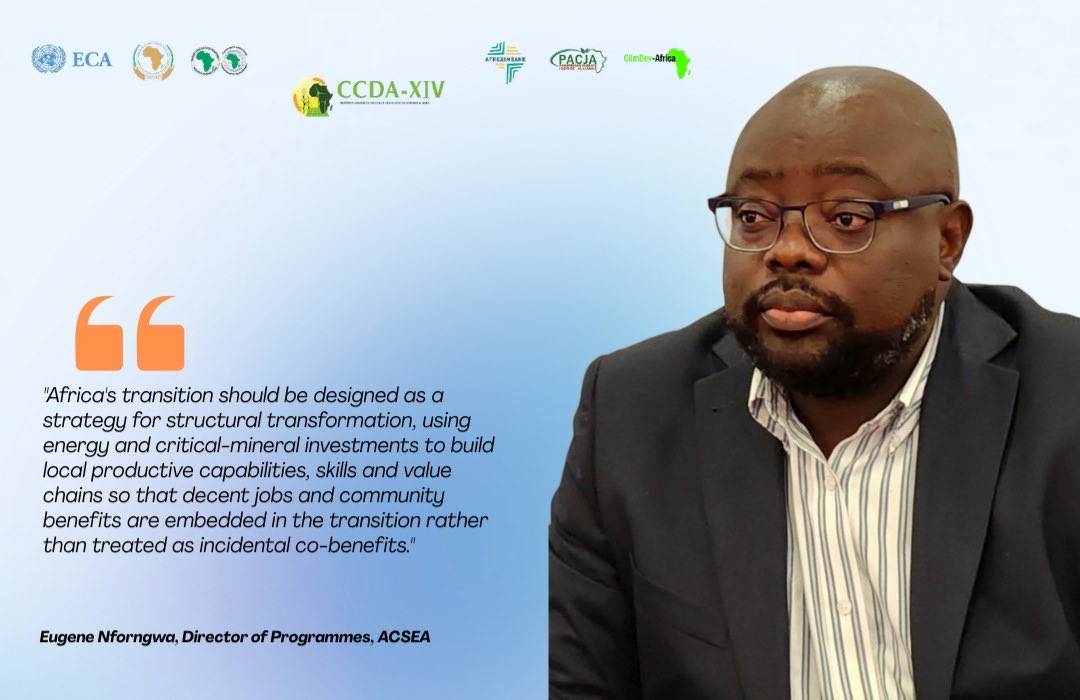
Two powerful voices from CCDA-XIV reminding us that a just transition must be built on shared responsibility and economic transformation.
From producer responsibility across global value chains to investing in local industries, skills, decent jobs and community benefits, Africa's transition must be deliberately designed to deliver justice and lasting prosperity.
Climate action must not shift burdens to communities or leave Africa outside the value it helps create.
#CCDA14 #JustTransition #ClimateJustice #AfricaClimateAction #EnergyTransition #EconomicTransformation #AddisAbaba
Today’s message is: Climate resilience is strongest when finance, planning, ecosystems and communities are connected before climate shocks occur.
Warm regards,
Kenya Platform for Climate Governance (KPCG)
The KPCG Climate Action Media Watch for Friday, 21 August 2026, highlighting key developments on El Niño and anticipatory action, landscape resilience, Kenya’s clean-energy transition, sustainable finance, adaptation planning and COP17 land governance.
KPCG concluded the two-day Technical Inception and Second Writeshop that was held on 18–19 August 2026 in Machakos County, bringing together the County Government, Technical Committee and partners to advance the development of the Machakos County Agroecology Policy.
Fastenaktion around the next phase of the policy process, with a shared commitment to broad stakeholder participation and sustained support towards finalisation and implementation.
KPCG reaffirmed its commitment to continue supporting the County and partners towards a resilient,
Machakos Agroecology Policy Writeshop
Technical Inception and Second Writeshop for the Review, Consolidation and Strengthening of the Draft Machakos County Agroecology Policy
https://t.co/YV7eaB9etv
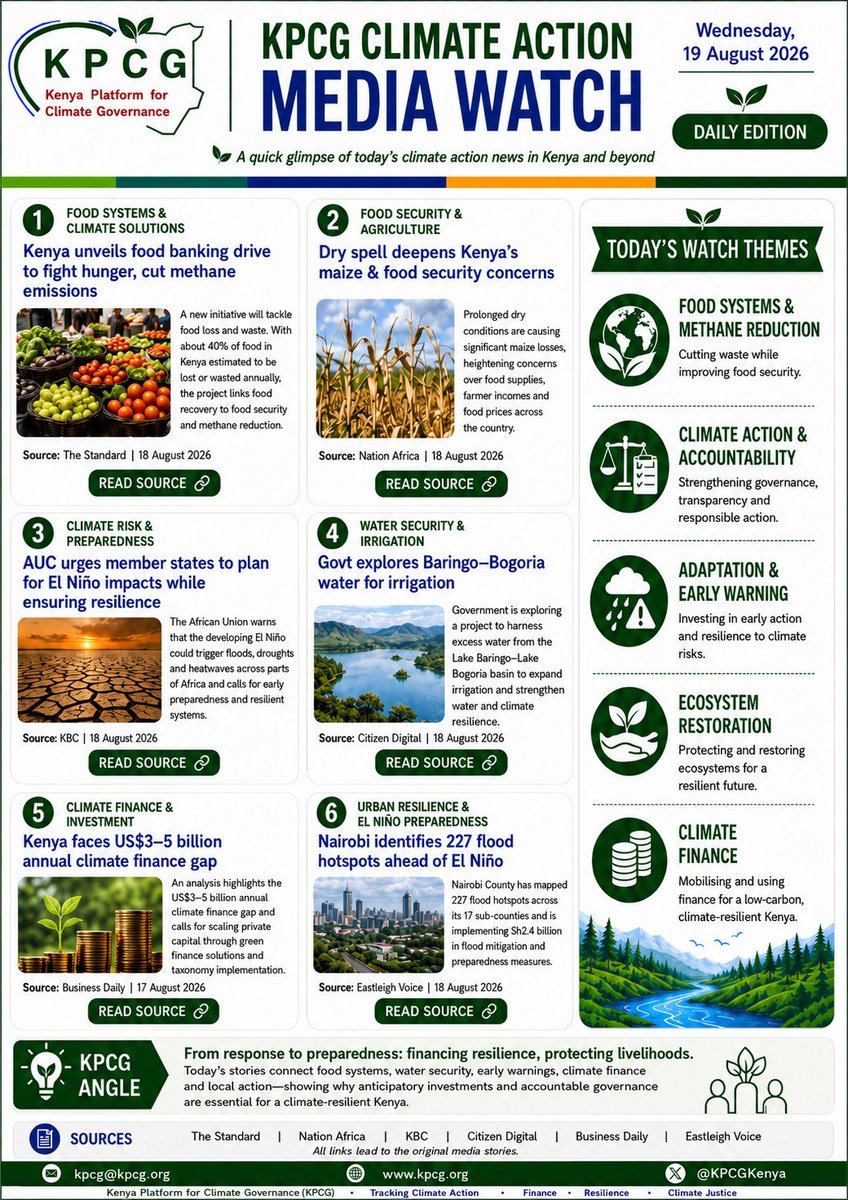
Today’s key message is the need for response and preparedness, with stronger early action, financing and accountable local delivery.
Warm regards,
KPCG
Dear colleagues, members & partners,
Please find attached the KPCG Climate Action Media Watch for 19 August 2026, highlighting key climate action developments on food systems, drought and food security, El Niño preparedness, water security, climate finance and urban resilience.