In 1999, I worked with Abdul Qadir, Pakistan's great leg break and googly bowler, on his autobiography. It was never published
Qadir died in 2019
I'm serialising King of Spin: The Untold Story of Abdul Qadir on Substack
https://t.co/Hy43KNKWty
Something to cling on to after a disastrous tour of England. My occasional column in Dawn #EngvPak
COMMENT: Razaullah and Pakistan cricket’s lost soul https://t.co/EpbtCasoLp
Ikigai is the Japanese concept of “what makes life worth living.”
Ikigai might also allow us to make better sense of a number of problems in healthcare, writes @KamranAbbasi in Editor's Choice
https://t.co/XdgTsKUznJ
All the other failings aside, there’s a big leadership problem in this Pakistan Test
Team. Cricket intelligence, responsibility, and application all lacking among senior players. What are the team management doing allowing such a laissez faire attitude in a major series? #EngvPak
Sheer nonsense. BMJ has diverse revenue streams. Editorial decisions are independent of our owners, business board, and the commercial side of our business. You might not agree with our editorial decisions, that’s anybody’s right, but we are not “bought and paid for” by anybody.
Chuffed that the BMJ has 9 nominations in the Medical Journalism Awards shortlist! Including both @jennifer Richardson and myself in the Editor category!
Congrats to my colleagues and so many friends who are also nominated https://t.co/501DDTtSln
Pakistan’s Supreme Court has ordered that former prime minister Imran Khan be moved from jail to a hospital in Islamabad within 48 hours, following his worsening health.
The 73-year-old has been in prison since 2023, with his family and lawyers raising concerns including significant vision loss.
The court ordered a specialist medical panel to oversee his treatment, while Khan’s PTI party welcomed the decision and urged that it be implemented immediately.
How are we “corrupt” @stkirsch? That’s
a serious (and untrue) allegation. We also aren’t in “violation” of COPE guidelines. And, trusting the retracted literature is a bad and unsafe idea. I guess you got nothing right in this sensational post.
BMJ is corrupt. Retracts the Mostert paper in violation of COPE guidelines. So you should put your trust what has been REMOVED from the journals, not what is in the journals.
Let’s put it another way for you: it is a lie to say that we retracted the paper for political reasons or bowed to external pressure. You are, of course, perfectly entitled to disagree with our decision. However, the paper will stay retracted.
Like any brave publisher the editor in chief of @bmj_latest accused me of spreading misinformation in a post I can't reply to. But I do have something to say: @KamranAbbasi you seem awfully comfortable throwing around the word "misinformation" and that's terribly damaging to the debate.
Our letter predates the retraction, but I feel my concerns were justified after reading your retraction notice (link below), which led to my decision to publish it. Our letter is not "misinformation", it's criticism. Criticism from a scientist with personal experience in the issues we're discussing who is deeply concerned about your decision. Criticism you could have taken the time to seriously consider and respond to.
You throw the same accusation at the paper. But just because you (or even I) might have chosen different words for the discussion does not immediately make it "misinformation". True science progresses by those who dare to ask new questions, and the authors asked a very important one. Whether Covid-vaccines may contribute to the persistent excess mortality we have seen since 2021, remains unanswered as studies claiming to prove no link exists suffer from serious flaws (see other link below). It is in fact a question that many are working on. Diligent, hard working scientists who put key questions and the search for truth before their own career advancement. Scientists whose work you just made even more difficult, and even more dangerous.
Because a great deal of damage has been done to individual scientists and to the field of (Covid)vaccine research in general by those who throw the word "misinformation" at anything they don't like. I consider this trend to be one of the greatest threats to scientific research in our time. I would be happy to tell you about my research and what I have experienced as a result of it that led me to this conclusion, if you would be open to that?
As a side note for the audience: the BMJ never replied to our e-mail. This post on X is the first I have heard from them.
Don’t be silly. The measure of scientific integrity isn’t the opinion of people who agree with your anti-vaccination stance. The retraction wasn’t “political.” We weren’t “pressurised” — wouldn’t influence us if people tried. Retracting a flawed paper is scientific integrity.
The BMJ has retracted a peer-reviewed paper linking Covid vaccines to excess deaths – despite finding no evidence it was inaccurate. Experts say the real reason is political, casting doubt on the BMJ's scientific integrity
https://t.co/thM2qsjUzJ
Utter garbage and predictable misinformation about the retraction. It was not political. We were not pressurised — by anyone. We completed the investigation, gave the authors a fair hearing, and we appropriately retracted. We did make a mistake, yes, it was publishing the paper.
Interesting article in the Daily Telegraph by @sarahknapton about the @bmj_latest choice to retract a paper on Covid-19 and excess mortality, and our criticism of this decision. Rare example of balanced reporting on this topic.
https://t.co/bPYawWZQ8q
- https://t.co/FGI3MLZaix
Government thinking is often that public services—and health and social care is a perfect example—are unaffordable without private and commercial enterprise.
Yet this thinking may have been stretched too far, says @KamranAbbasi in Editor's Choice
https://t.co/3jKKpPxYza
Who owns our health service? Who owns our data?
These questions are hitting us hard because of a combustible mix of market forces and artificial intelligence, says @KamranAbbasi in Editor's Choice
https://t.co/aaXiolAwuj
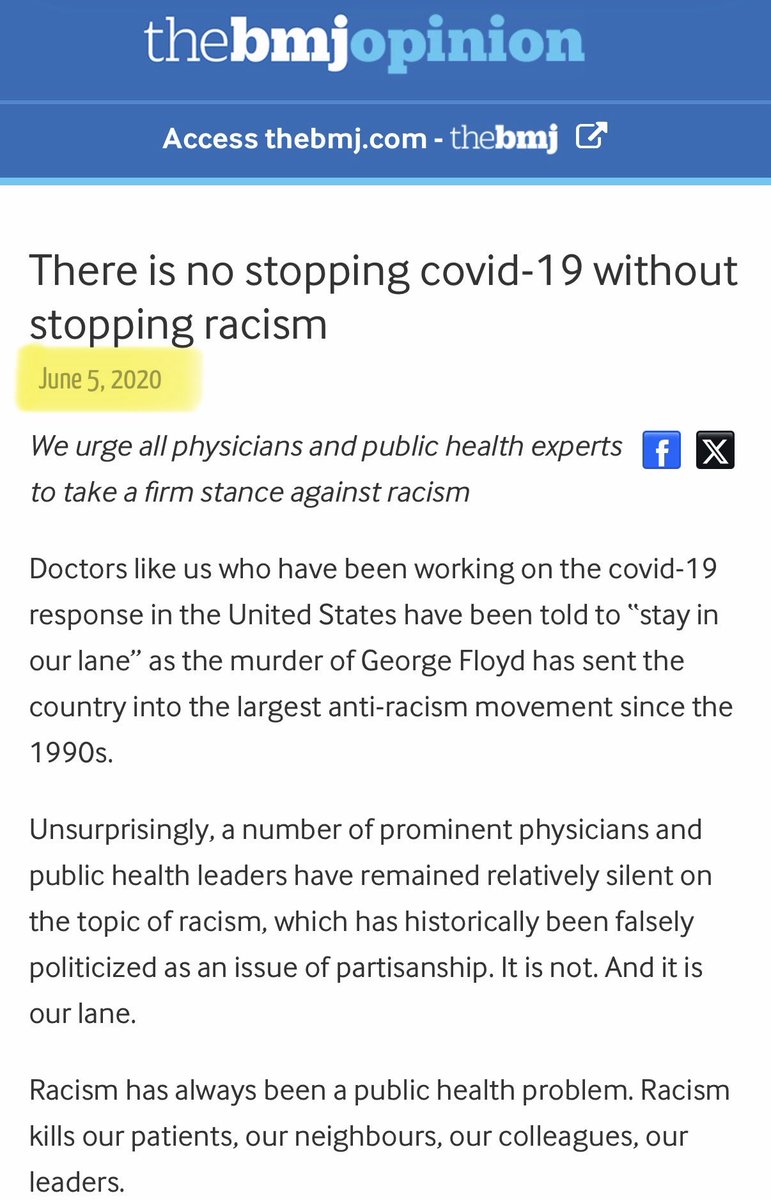
We are being accountable: we acknowledge racism as a public health issue. Don’t take my word for it, read the work of Michael Marmot. Tackling racism is evidence based and improves the health and wellbeing of the general population. But I guess that doesn’t fit your narrative
Never allow them to invert reality and cast YOU as the enemy of science given that they peddled this nonsense.
This was printed in the BMJ - the British Medical Journal - under the same banner that actual peer-reviewed scientific research is published under.
Countless other medical institutions and professionals likewise joined in this reputational seppuku.
The only way the scientific establishment can even begin to regain its credibility again, is to start with accountability.
"Burnham is rightly focused on the cost of living crisis, but the evidence for a “health first, health in all policies” approach continues to mount."
In this Editor's Choice, @KamranAbbasi explains why Andy Burnham must take “health first” mainstream
https://t.co/YtTp1qVDYo
In this Editor's Choice @KamranAbbasi offers a seven point health plan for Prime Minister Andy Burnham to restore public and professional trust
https://t.co/DVwo66NHZW
Despite substantial weight loss, most obesity drugs such as Wegovy and Mounjaro do not meaningfully improve quality of life and few show cardiovascular benefits at one year, finds a new study in The BMJ
https://t.co/nademoLBye
Read the linked commentary
https://t.co/cDaGQPRFAO
A new BMJ Analysis finds a UK-US trade deal could cost the NHS a potential £45bn in drug spending and nearly 300 000 excess deaths over 10 years.
The deaths and adverse health outcomes will inevitably affect the poorest in society, writes @KamranAbbasi
https://t.co/7Tg8x41M2z
Mexico (Alt, 2000m) start with a one goal advantage over England (0m). A 2007 @bmj_latest paper on over 100 years of games at different altitudes: Each 1000m of altitude difference between opponents gives the team from higher altitude a half goal start https://t.co/EpVxDneWtf
A new BMJ Analysis finds a UK-US trade deal could cost the NHS a potential £45bn in drug spending and nearly 300 000 excess deaths in 10 years.
The deal sacrifices UK health and wealth, contrary to the rhetoric of government ministers, says @KamranAbbasi
https://t.co/CqjGHUyKhW