The official account of Katiba Institute(KI). KI promotes implementation of Kenya’s Constitution and assist in developing a culture of constitutionalism.
Turning the Page: Katiba Institute Launches 2025–2029 Strategic Plan to Deepen Constitutionalism and Expand Impact.
On 10 July 2025, Katiba Institute officially launched its third Strategic Plan, which will guide its work over the next five years, from 2025 to 2029. This strategic framework reaffirms the organisation’s mission to promote the understanding, implementation, and defence of Kenya’s Constitution. It expands KI’s focus to address emerging constitutional and human rights challenges locally, regionally, and globally.
Read more...https://t.co/a9eWP2nCl1
#OurConstitutionOurFutureKE
The National Assembly has begun considering a proposed law that seeks to strengthen the protection of sensitive government information while preserving Kenyans' constitutional right to access public information.
https://t.co/wLS9FQjPV3
Court Update:
The High Court today delivered judgment in the consolidated petitions challenging provisions of the Computer Misuse and Cybercrimes (Amendment) Act, 2025. Katiba Institute was the 8th Interested Party.
The petitions challenged, among other provisions, Section 6, which empowered the National Computer and Cybercrimes Coordination Committee to direct that websites or applications be rendered inaccessible where they promote unlawful activities, inappropriate sexual content involving a minor, terrorism, religious extremism and cultism, and Section 27, which broadened the offence of cyber harassment by introducing liability where conduct was likely to cause another person to commit suicide.
Justice Nyaundi declared Section 6(1)(ja) of the Act unconstitutional, holding that the provision granting the Committee the power to direct the takedown of website content was vague and excessive, and that it failed the constitutional test under Article 24. The Court also declared Section 27(1)(b) unconstitutional, finding that the provision was vague and excessive.
See judgment: https://t.co/uPiJPy97du
@SumayyahMokku@joshuamalidzo@LawSocietyofKe
The Law Society of Kenya welcomes the timely High Court directive temporarily suspending the enforcement of the new Traffic (Motor Vehicle Inspection) Rules, 2026, as they apply to private non-commercial vehicles. This critical conservatory order, obtained through public interest litigation filed by Wilberforce Akello, offers a much-needed reprieve to millions of Kenyan motorists.
While improving road safety is an important goal, implementing sweeping regulations that impose mandatory booking fees and severe criminal sanctions without genuine public participation or clear financial transparency is fundamentally unconstitutional. The state cannot bypass proper legal safeguards or ignore the economic realities of ordinary citizens.
🚨 Victory for Digital Rights and Constitutional Freedom
The High Court has declared unconstitutional key provisions of the amended Computer Misuse and Cybercrimes Act that allowed authorities to block websites without adequate constitutional safeguards.
In Petition E671 of 2025, Law Society of Kenya, TISA and Others v Attorney General and Others, the Court held that Section 6(1) was impermissibly vague and failed to meet the constitutional threshold for limiting rights under Article 24 of the Constitution. The Court also struck down Section 27(1)(b), finding that its lack of clarity violated the constitutional principle of legality.
We continue to stand at the forefront of defending Kenya's Constitution, protecting civic space, and ensuring that power is exercised within constitutional limits.
High Court declares sections of the Computer Misuse & Cybercrimes Amendment Act, which empower the National Computer & Cybercrimes Coordination Committee to block websites, unconstitutional.
https://t.co/8uKlibSn0R
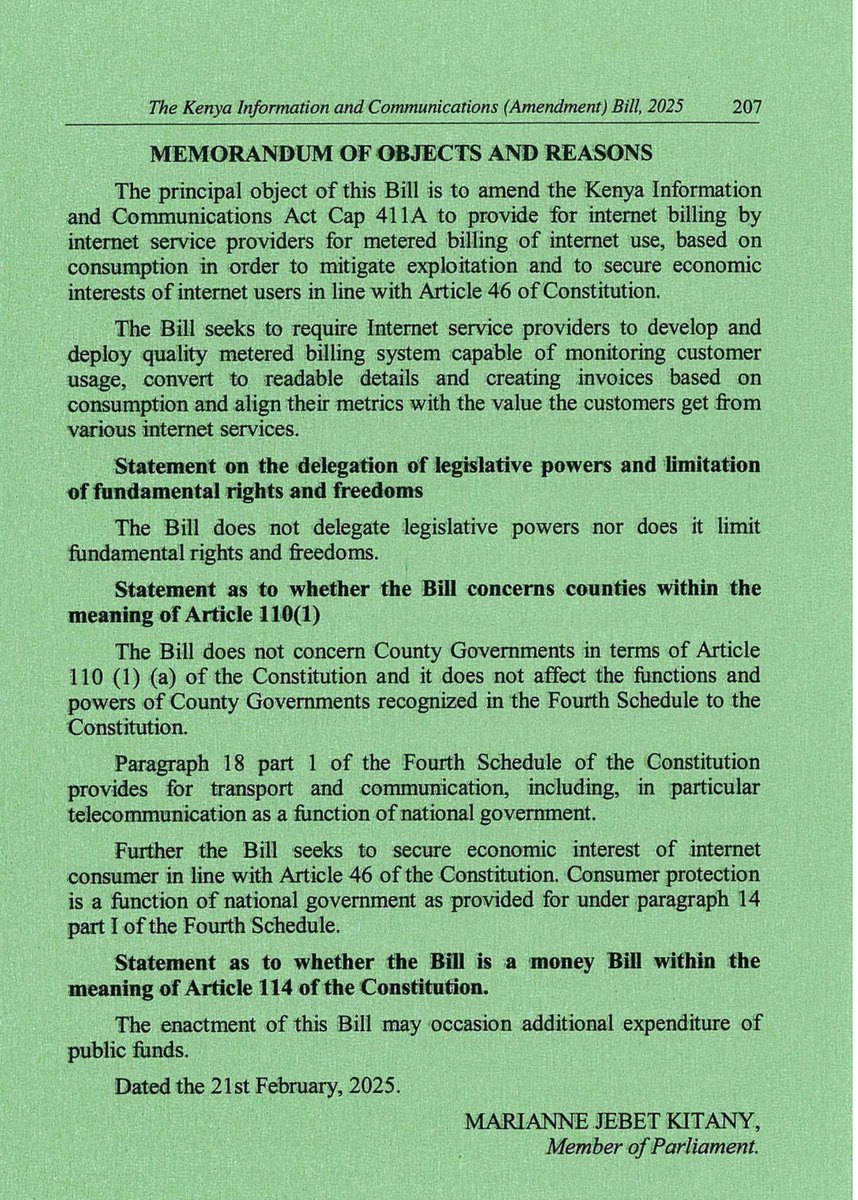
The Kenya Information and Communications (Amendment) Bill (National Assembly Bill No. 9 of 2025) is read a first time.
The Bill seeks to amend the Kenya Information Communications Act Cap 411A to provide for internet billing internet service providers for metered billing of internet use, based consumption in order to mitigate exploitation and to secure economic interests of internet users in line with Article 46 of Constitution.
#BungeLiveNA.
Our Litigation Counsel, @SumayyahMokku, will be on #FixingTheNation on @ntvkenya and @NationFmKE tomorrow from 7:00 a.m. to discuss the High Court's decision declaring the current Cabinet unconstitutional for failing to comply with the Constitution's gender representation requirements.
Tune in.
Friends of Devolution:
Yesterday, our team paid a courtesy visit to the offices of the @KenyaGovernors, where we met the team led by Kizito Wangalwa, Director of Committees and Programmes. Our discussions focused on shared priorities and opportunities for future collaboration in advancing devolution and constitutional governance.
At Katiba Institute, we promote and defend Kenya's system of devolution by advancing constitutional governance, accountability, transparency, public participation, and effective service delivery at both the national and county levels.
Through strategic litigation, policy advocacy, research, civic engagement, and capacity building, we work to safeguard devolved functions and resources while addressing governance challenges that undermine devolution.
We look forward to working closely with the Council of Governors to strengthen devolution and ensure it continues to deliver equitable development, accountable governance, and improved public services for all Kenyans.
High Court rules that President Ruto's Cabinet violates the Constitution by failing to meet two-thirds gender rule, gives him 120 days to reconstitute it.