Russische Soldaten berichten von einem System der Erpressung an der Front. Wer nicht in besonders gefährliche Sturmangriffe geschickt werden will, zahlt Geld an seine Kommandeure. In Teilen der Armee ist daraus eine Schattenwirtschaft geworden. https://t.co/xWoORTfOxV
"'All military work goes through Telegram — all communication,' Anton, whose name has been changed because he fears government reprisal, told @POLITICO in voice messages sent via the app. 'That would be like shooting the entire Russian army in the head.'"
Investigation by @KatjaBody: https://t.co/znYOeVB6S7
Meine Kollegin @KatjaBody zeigt in diesem Text, wie Russland seine Bürger gängelt, zensiert und sie Schritt für Schritt ins digitale Mittelalter zurückbefördert. ⤵️
Mit der Blockade ausländischer Plattformen und neuen Gesetzen zur Kontrolle des Netzes treibt der Kreml das Land immer tiefer in die digitale Isolation. Manche Russen greifen bereits wieder zu Funkgeräten, Pagern und Papierkarten. https://t.co/T2S7B7RSKY
Silicon Valley is pulling the plug. The Kremlin is locking the doors. Inside the race to cut #Russia off from the global internet — and what comes after.
An investigation by @katjabody: https://t.co/Tg73nShkrh
My latest story for @politico, @welt & @OnetWiadomosci looks at how Russia is drifting toward a digital iron curtain — and what it means when it starts logging off. @investigativ_de
What happens when a nuclear power goes offline? In Moscow last week, mobile internet was repeatedly cut off. Sales of walkie-talkies, pagers & paper maps surged. Regions have been affected by internet shutdowns and mobile network restrictions on a regular basis since May 2025.
Civilians are turning to VPNs—and the government is racing to block them. “It’s turned into a guerrilla war,” says Mikhail Klimarev of the Internet Protection Society. “They hunt down the VPNs they can see, they block them—& the ‘partisans’ run, build new bunkers, and come back.”
The European Commission is embarking on a joint exercise with member states to evaluate Germany’s application of Schengen border rules and safeguards, with the review expected to begin in March, according to two sources familiar with the process.
https://t.co/su8Wnqqr7D
Endlich legen wir los! Folge 1 von Power & Policy ist da - unser neuer wirtschaftspolitischer Podcast von @JoanaAvion und mir🎙️
👉 Thema für die Premiere: Wie Rüstungs-CEOs auf der #MSC2026 Millionen-Deals einfädeln.
👉 Im Policy-Talk ist Sven Kruck, Co-CEO von Quantum Systems.
👉 Und Insides im Format "Off the Record" von @lundayfunday dazu, welche Rolle Pistorius bei großen Deals spielt.
Immer donnerstags. Hier entlang: https://t.co/LrVMikaMcD Freuen uns über Abo, Likes, Kommentare und 💐 @GordonRepinski@rixa_fursen
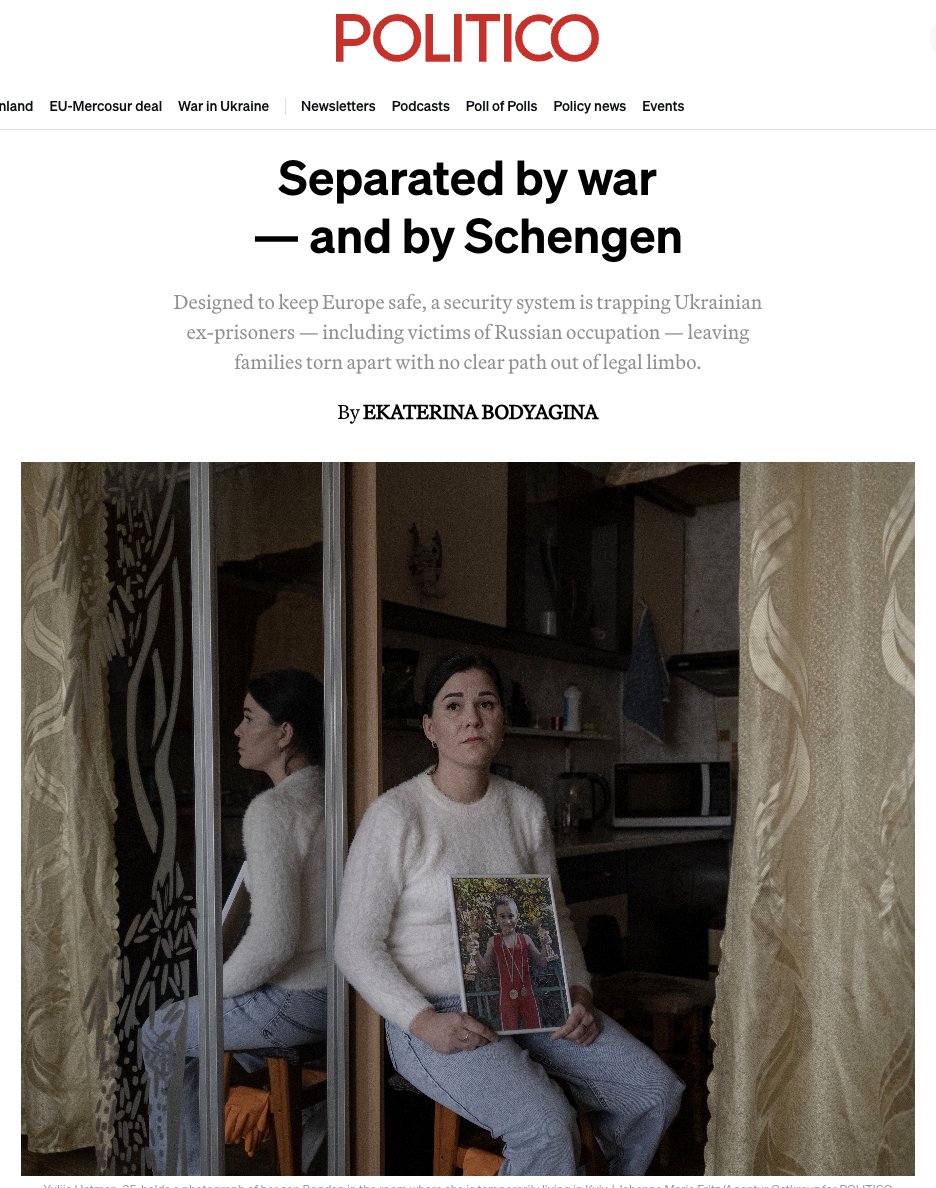
🔴 The #EU speaks of solidarity with Ukrainians — but an investigation by my colleague @KatjaBody shows how Europe’s own security systems are tearing Ukrainian families apart.
Out of fear of Russian espionage, former prisoners who survived Russian occupation are being flagged in #Schengen databases. Over three months, Ekaterina reviewed entry refusals and the fates of multiple former prisoners who cannot join their loved ones in the EU because they were held in occupied territories or forcibly transferred to #Russia.
For many families, it is no longer the war that keeps them apart, but Schengen.
Today, we start to publish the investigation across the @axelspringer Global Reporters Network, starting with @politico and @POLITICOEurope (https://t.co/IIBDRmi80a). You'll also find the article in the new @WELTAMSONNTAG.
Special thanks to @sissenberg (POLITICO) and @AlexanderDinger (WELT) for editing this piece and supporting Katja throughout this investigation.
Russland gelingt es weiterhin, seine massiven personellen Verluste in der #Ukraine zu kompensieren und neue Einheiten aufzubauen. Möglich macht das eine landesweite Headhunting-Industrie, die monatlich rund 30.000 neue Soldaten anwirbt.
Rekruten erhalten für die Vertragsunterzeichnung durchschnittlich rund 20.000 Euro, wie eine Analyse von @jakluge zeigt. Summen, die das Leben einer russischen Familie verändern können. Und es locken zusätzliche Anreize: Schuldenerlass, Kinderbetreuung, Studienplätze. „Diese Maßnahmen richten sich an eine ganz bestimmte Gruppe: sozial benachteiligte Menschen“, sagt Politikwissenschaftlerin Ekaterina Schulmann.
Im Rahmen einer Recherche für @welt & @politico haben wir Rekrutierungskanäle in Russland ausgewertet und mit mehreren Rekruten sowie Vermittlern gesprochen. Wer Putins Russland in diesem Krieg verstehen will, muss sich diese Rekrutierungsmaschinerie genauer anschauen.
Die ganze Recherche (mit @KatjaBody) hier: https://t.co/CewDYGFtyA
“For many Russian men, this is the last opportunity to build a life that feels meaningful”
Despite heavy losses in #Ukraine, Russia continues to raise new forces and replace its dead. Enabling this is a nationwide, quasi-commercial headhunting industry that recruits roughly 30,000 new soldiers per month.
For this @politico & @welt investigation, we reviewed recruitment channels across Russia and interviewed multiple recruits and recruiters. Here are three key findings:
1. For Russian men, war now advertises itself like any other job. Offers for front-line contracts circulate on Telegram alongside group chats, promising life-changing money and incentives. Criminal records, illness and even HIV are no longer automatic disqualifiers. “These measures target a specific demographic: socially vulnerable men,” says political scientist Ekaterina Schulmann.
An analysis by economist @jakluge, based on data from 37 regions, shows that average signing bonuses have climbed to more than 20,000$. “This kind of money can completely transform a Russian family’s life,” said Kluge.
Incentives go beyond cash, with pledges of debt relief, free childcare for soldiers’ families and guaranteed university places for their children.
2. Russia has built a coordinated recruitment system run through more than 80 regional governments.
Pressured by the Kremlin to deliver manpower, the regions have become de-facto hiring hubs. What began as a wartime fix has hardened into a quasi-commercial headhunting industry. Any Russian citizen can now work as a wartime recruiter who earn commissions of up to $3,800 for delivering bodies to the front.
“The program works surprisingly well, but it has become far more expensive for the Kremlin,” says Kluge. Russian regions are already tapping reserve funds to maintain recruitment levels.
3. German security officials say Putin is well-positioned to hit his declared target of a 1.5-million-troop army next year.
The recruiting machine brings in roughly 30,000 volunteers every month. That number is sufficient to offset Russia’s heavy casualty rate and sustain long-term operations. “Russia is continuing to build up its army and is mobilizing on a scale that suggests a larger military confrontation with additional European states,” says @RKiesewetter, a security expert from Chancellor Friedrich Merz’s party.
You can read our full investigation here 👇🏼@KatjaBody
https://t.co/OKRggDWCKb
An online bazaar of freelance headhunters finds new recruits to fight Ukraine, emboldening #Putin at the negotiating table and scaring European leaders about what his growing army might do next. Investigation by @IbraNaber & @KatjaBody https://t.co/gUmjgndpK0
I’m beyond grateful for almost three years of storytelling as a regular contributor at the NYT — and excited for what comes next.
https://t.co/I2pWqci3yC
Out today in the @nytimes : a story I had the joy of co-reporting with the brilliant @jimtankersley and Laetitia Vançon, digging into how Germany’s newest arrivals are not just navigating migration, but also the lingering divide between East and West.
With this piece, I’m also closing a chapter: it’s one of my last stories for @nytimes for now, as on October 1 I joined the investigative unit of Premium-Gruppe (@politico , @BusinessInsider & @welt ).